


Honey Bee Crisis Not Helped by Evolutionists
Given the critical importance of bees,
how were flowers able to survive
without them in an evolutionary past?
Honey Bee Losses at Crisis Stage
Leading to Questions of How, When and Where they Evolved
by Jerry Bergman, PhD
The headline was stark: “U.S. beekeepers had a disastrous winter. Between June 2024 and January, a full 62% of commercial honey bee colonies in the United States died, according to an extensive survey. It was the largest die-off on record, coming on the heels of a 55% die-off the previous winter. USDA research points to viruses spread by pesticide-resistant mites, indicating a worrying trend.”[1] According to the article, “nearly all the dead colonies tested positive for bee viruses spread by parasitic mites. Alarmingly, every single one of the mites the researchers screened was resistant to amitraz, the only viable mite-specific pesticide—or miticide—of its kind left in humans’ arsenal.”[2]
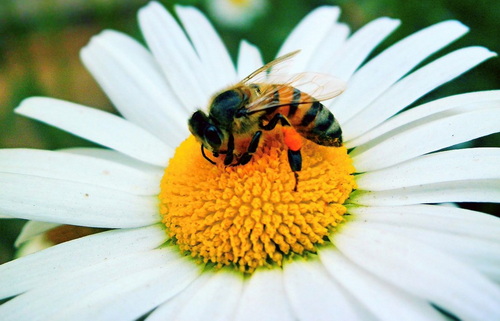
A bee in the process of pollinating flowers. From Wikimedia commons.
Why did this die-off event cause so much concern? One reason is that more than a third of global food crops require insect pollination and honey bees are the principal pollinators. Honey bee pollination enhances both the yield and quality of crops while sustaining biodiversity through plant reproduction, particularly in fruits, nuts, vegetables, oilseeds, and legumes.[3] Bees also contribute to a healthy ecosystem by providing food and shelter for other species. The grave implications of bee population decline are highlighted by Mandy Shaw in the following paragraph:
A world without bees is a terrifying thought: quiet fields, empty fruit trees, and a shrinking variety of foods on our tables…. Bees are in trouble, and so are we. We are facing a potential collapse of the natural systems that have sustained human civilization…. about one-third of the world’s food production depends on pollinators like bees, underlining how crucial their survival is for our food systems…. Bee pollen isn’t just a superfood; it’s a symbol of sustainability. Packed with essential vitamins, minerals, and antioxidants, bee pollen is nature’s multivitamin, providing a range of benefits from boosting immunity to improving skin health, cardiovascular health and providing a natural, sustained energy boost. It’s one of the most nutrient-dense superfoods on the planet, offering everything you need to support your health and wellbeing.[4]
Beyond their environmental role, honey bees also produce honey, a nutritious human food, and beeswax, which has both cultural and economic value. Given the critical importance of bees and their central role in plant pollination, how were flowers able to survive without them in the past?
The Evolution of Bees
The modern evolution theory says that
“bees evolved from ancient predatory wasps that lived 120 million years ago. Like bees, these wasps built and defended their nests, and gathered food for their offspring. But while most bees feed on flowers, their wasp ancestors were carnivorous. They stung and paralyzed other insects, bringing them back to feed developing offspring in the nest.”[5]
The problem with assuming that bees evolved from wasps is that there is no direct evidence for this hypothesis. Furthermore, it is hard to imagine how a carnivorous insect could have transformed into one that feeds on flower nectar.
Another major problem for bee evolution is that bees require pollen to survive, and many flowers require pollination to survive. Nectar is a sugary liquid produced in the plant’s nectaries designed to attract pollinator bees. Pollen is a powdery substance obtained from a flower’s male parts (anthers). Pollen contains protein, lipids, vitamins, and minerals and other nutrients essential for bee larval rearing.[6] It is also required for plant reproduction.
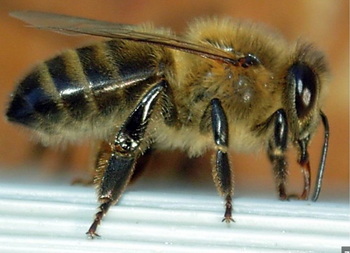
A typical bee. Note the fuzz covering its legs that allows them to pick up pollen and transfer it to other flowers. From Wikimedia commons.
When a bee collects nectar and pollen from a flower’s male part (anther), pollen sticks on its fuzzy body and specialized leg structures. As the bee visits other flowers of the same species, some of this pollen transfers to the flower’s female part (stigma) causing fertilization. This transfer of pollen enables the plant to produce seeds, which then grow into new plants. Bees are by far the most important pollinators of flowering plants.[7]
Evolutionists believe bees appeared on earth “ca. 120 million years ago, but the uncertainty of how and when bees spread across the planet has greatly obscured investigations of this key mutualism.”[8] However, there exists a big problem with this view because evolutionists believe flowers appeared many millions of years before bees. According to evolutionary timelines, the earliest known bees appeared 60 million years after flowering plants had already evolved.[9]
Insect Evolution Problematic in General
The two areas of significant uncertainty here are the origins and the evolution, not just of bees, but of all insects. Many hypotheses exist, but there are few facts. As Stanford University professor and paleoentomologist Sandra Schachat noted, “There’s been quite a bit of mystery around how insects first arose, because for many millions of years you had nothing, and then just all of a sudden an explosion of insects.”[10] Professor Schachat explains this problem, called the Arthropod Gap or the Hexapod(a) Gap here:
Insects are everywhere—in the air, on the ground, in the ground, and sometimes in your house and food. Yet there are none whatsoever in the known fossil record between 385 million and 325 million years ago. The earliest known insect fossil is a 385-million-year-old wingless creature that looks like a silverfish. But for the next 60 million years, there is not so much as a single dragonfly, grasshopper, or roach.
Schachat and her team combed through fossil information from a public paleontology database and realized there was something special about many of the insect fossils that came after this gap: they had wings. This was likely the trait that helped hexapod diversity take off; winged insects can zip away from predators and get at otherwise unreachable foods, such as leaves and other insects. According to Schachat, “The gap is simply the tail end of a larger interval in which insects are very rare on the landscape because wings had not yet originated.”[11]
This so-called Hexapod Gap has long vexed paleontologists, given that more than 20,000 bee species, across seven families, are found in nearly every terrestrial habitat today, with the sole exception of Antarctica.
Watch and share the Short Reel about this article! Click to view it now.
However, there is an even more basic mystery that Schachat and other entomologists face—how and when insect wings evolved. The earliest flying insects found after the Hexapod Gap were already very diverse: “The two very first winged insects that we have in the fossil record—they’re about as different from each other as you could imagine”[12] The origins of wings remain unknown in the fossil record, leaving an evolutionary ‘gap’ regarding how and when insects supposedly became the first animals to take to the skies.
Summary
We recognize that the bee-flower plant symbiosis is critical for the survival of both bees and flowering plants. This raises the question, “How did the bees and flowering plants survive until they both evolved to allow their symbiosis to evolve?” Evolutionists claim that, over time, bees and flowers developed a mutualistic symbiosis. The importance of bees as pollinators highlights not only the need to address their population decline, but also the deeper questions of how bees originated and how such a vital ecological function—one that humans depend on—could have evolved.
References
[1] Thompson, Joanna, “Scientists identify culprit behind biggest ever U.S. honey bee die-off,” Science, https://www.science.org/content/article/scientists-identify-culprit-behind-biggest-ever-u-s-honeybee-die, 30 June 2025.
[2] Thompson, 2025
[3] Khalifa, S., “Overview of bee pollination and its economic value for crop production,” https://pmc.ncbi.nlm.nih.gov/articles/PMC8396518/, 31 July 2021.
[4] Shaw, Mandy, “Supporting ethical companies is key to saving the bees,” Beekeeper Confidential, https://www.beekeeperconfidential.com, 20 February 2025.
[5] Museum of the Earth, ”Evolution & fossil record of bees,” Paleontological Research Institution, https://www.museumoftheearth.org/bees/evolution-fossil-record, August 2025.
[6] Nicolson, Susan, “Bee food: The chemistry and nutritional value of nectar, pollen, and mixtures of the two,” African Zoology 46(2):197-204, https://www.tandfonline.com/doi/abs/10.1080/15627020.2011.11407495, October 2011.
[7] Almeida, Eduardo, et al., “The evolutionary history of bees in time and space,” Current Biology 33(16):3409-3422, 21 August 2023.
[8] Almeida, et al., 2023.
[9] Almeida, et al., 2023.
[10] Than, Ker, “Insects took off when they evolved wings,” Stanford University (School of Sustainability), https://sustainability.stanford.edu/news/insects-took-when-they-evolved-wings, 23 January 2018.
[11] Joel, Lucas, “Missing bugs,” Scientific American 318(5):18, May 2018.
[12] Quoted by Joel, 2018.
 Dr. Jerry Bergman has taught biology, genetics, chemistry, biochemistry, anthropology, geology, and microbiology for over 40 years at several colleges and universities including Bowling Green State University, Medical College of Ohio where he was a research associate in experimental pathology, and The University of Toledo. He is a graduate of the Medical College of Ohio, Wayne State University in Detroit, the University of Toledo, and Bowling Green State University. He has over 1,900 publications in 14 languages and 40 books and monographs. His books and textbooks that include chapters that he authored are in over 1,800 college libraries in 27 countries. So far over 80,000 copies of the 60 books and monographs that he has authored or co-authored are in print. For more articles by Dr Bergman, see his Author Profile.