

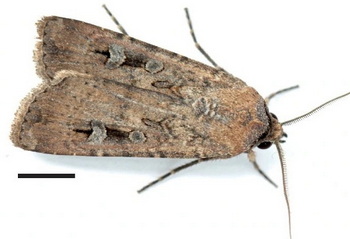

Little Moths Have Redundant Navigation Tools
Australian moths can migrate
1000 km with independent
methods if one is unavailable
Behold another wonder of nature that defies evolution.
 Bogong moths navigate with a light-dependent geomagnetic inclination compass (Nature, 18 Nov 2026). Small brown moths in Australia measuring less than 1.5 inches possess a skill belying their tiny size: the ability to navigate hundreds of miles in the dark of night. They use two independent methods to reach their destinations: stars and quantum mechanics. If the stars are not visible, they can follow the inclination of the earth’s magnetic field to stay on course using a quantum phenonenon called radical pairs.
What’s more, these methods of navigation are very similar to those of navigating songbirds. How will Darwinism handle an extreme case of similarities?
Details of the Research
Researchers from Lund University (Sweden) and Australia tackled the question of how Bogong moths navigate with such extreme precision. I had written about these little moths for Science & Culture back in April 2016, marveling at how the small insects found a small cave, their home, in the dark from hundreds of miles away. Now, part of the answer is revealed in the new study.
The scientists built special chambers for the moths where they could manipulate the light, the stars, and a magnetic field. The Abstract of the open-access paper describes their methods, and summarizes the findings:
Bogong moths (Agrotis infusa) migrate biannually up to 1,000 km between their breeding areas and geographically restricted aestivation sites in the Australian Alps. These moths navigate towards their distant goal using the stars as a compass but navigate correctly even when the stars are obscured by clouds, suggesting that their magnetic sense probably harnesses the Earth’s magnetic field as a compass. However, the nature of this compass, and of the magnetic sense underlying it, remains unknown.
Here we show that Bogong moths, tethered in a flight arena under a full-spectrum randomized starry night sky, navigate in their inherited migratory direction using the geomagnetic field alone. If the geomagnetic field is turned by 180°, or if inclination is inverted, moths fly in the opposite direction. If polarity is inverted, moths fail to turn. Furthermore, if violet–blue light (380 nm < λ < 500 nm) is removed from the illumination spectrum, or if tethered moths are exposed to weak broadband radiofrequency fields (150 kHz to 60 MHz), magnetic orientation is abolished. Our results indicate that Bogong moths use the geomagnetic field as an inclination compass for long-distance navigation at night and possess a light-dependent radical-pair-based magnetic sense.
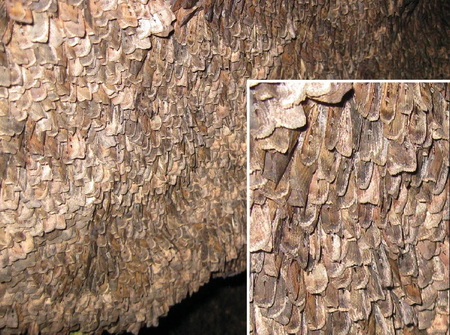
Bogong moths hang from the ceiling of their cave home looking like roof shingles “Around 17,000 moths per m2 aestivate on the walls of specific caves in the Australian Alps for up to 4 months before making the return migration.” (Nature, Fig 1c).
Variations on the magnetic field and light in the “flight arena” demonstrated that the moths have both methods of navigation, and can find the target in the absence of stars.
The authors note that monarch butterflies in the Americas possess similar navigational aids – but those insects are on the other side of the world. Both species of lepidopterans fly to distant destinations they have never seen before. Bogong moths are much smaller than monarch butterflies.
Explaining Unrelated Similarities
The authors note that migrating songbirds have these same mechanisms, and that the genetic basis for cryptochrome proteins that mediate the radical-pair method of orienting to the magnetic field are remarkably similar. How is this to be explained, considering that insects and birds are extremely far apart on the Darwinian tree of descent?
Our results indicate that Bogong moths rely on two global compasses for robust nocturnal navigation—a light-dependent radical-pair-based geomagnetic inclination compass and a stellar compass3. This is also the case in night-migratory songbirds, revealing an impressive example of convergent evolution in two widely separated taxa that diverged approximately 700 million years ago but share similar migratory behaviour.
If you are about to choke at that explanation, hold it in; the authors extend the absurdity further:
In the case of magnetic sensing, this convergence may indicate deeply conserved biophysical principles for sensing and using the Earth’s magnetic field for long-distance navigation. Moreover, other nocturnal insect migrants, even if not heading to a specific geographic destination like Bogong moths, may also take advantage of geomagnetic and stellar compass cues to maintain their seasonal migratory direction. Indeed, the fall armyworm moth, and possibly the oriental armyworm moth, have also recently been shown to possess a magnetic sense, so this sense is probably widespread in nocturnal moths.
Once you’ve swallowed one incredible miracle, the others go down easier.

Consider the absurdity of the explanation that “biophysical principles” caused these moths to evolve sophisticated navigational tools “for sensing and using the Earth’s magnetic field for long-distance navigation.” This is like saying:
-
 Principles of digestion caused us to evolve guts to eat food.
- Principles of light caused us to evolve eyes to sense electromagnetic waves.
- Principles of heredity caused us to develop sex to combine genes.
- Principles of land surfaces caused us to evolve feet to walk on them.
- Principles of air vibrations caused us to evolve ears to detect them.
- Principles of grammar caused languages to evolve to utilize them.
- Principles of beauty caused an earth to form to display it.
- Principles of fine-tuning caused a universe to form to exemplify them.

This might make sense to DODOs who have sold their souls to philosophical naturalism, but not to most of us. We can retort that principles of unbelief caused the emergence of philosophies to justify them.