


Whale Fossils Dog Evolution and Cannot Bear Storytelling
What seemed far-fetched
in Darwin’s day still seems
just as implausible today
Did Whales Evolve from a Dog-Like Creature, or a Bear?
New Discoveries Fail to Provide Support for This View
by Jerry Bergman, PhD
When attempting to determine the possible evolutionary history (or phylogeny) of a past life-form, researchers typically select a living animal whose design offers clues that help them postulate the evolutionary path of the organism in question. For instance, in developing a potential precursor model for human evolution, the obvious choice would be a large primate because, of all known animals, the great apes look the most like us. For this reason, the great apes (chimpanzees, gorillas, orangutans, and bonobos) are considered to be a useful animal model for postulating the phylogeny of modern humans.
Modern humans obviously could not have evolved from extant chimpanzees, gorillas, or orangutans. Instead, evolution postulates that humans and these great apes share a common ancestor that lived many eons ago. Since among the great apes, chimpanzees are most similar to humans, it has been postulated by evolutionists that some chimp-like animal is the common ancestor of humans and chimps. However, this common ancestor is purely theoretical, and no agreed-upon physical evidence has, so far, been found.
The Common Ancestor of Whales

Watch and share the Short Reel about this article! Click to view.
With whales, the problem of postulating a common ancestor is far more difficult. Whales are enormous fish-shaped marine animals very similar to other very large fish, such as the whalefish family Cetomimidae. A whalefish is a deep-sea creature that resembles a whale in its body shape. They have a large, gaping mouth, lack scales, and most resemble baleen whales. The problem is that whales are not fish but marine mammals that breathe air using lungs like every other land mammal. In contrast, whalefish are true bony fish that breathe using gills.
Consequently, evolving the ability to breathe air while still living in water presents a major challenge. An organism cannot survive on land without a functional means of breathing oxygen through lungs; therefore, whales must have retained gills until lungs had evolved. Why it would evolve lungs to replace its fully functional gills is a major problem for evolutionists.
The evolutionary solution to this major problem was to assume that whales evolved from some land-breathing terrestrial mammal and then evolved to live in the water as a large fish/mammal. Of course, no evidence exists for this hypothesis—only assumptions. However, if creation is rejected as a possible solution to this problem, then this proposal becomes the most plausible among many implausible theories—the best of all the bad options available (see Best-in-Field Fallacy).
Darwin likely realized these problems and consequently suggested that whales could have evolved from bears.[1] He wrote:
“I can see no difficulty in a race of bears being rendered, by natural selection, more and more aquatic in their structure and habits, with larger and larger mouths, till a creature was produced as monstrous as a whale.”[2]
Even though this idea of a bear evolving into a whale is completely non-viable, given the strong belief of Darwinists that evolution is true, it seems to be the best choice of all the existing possibilities.
Nonetheless, it was obvious to many academics in Darwin’s day that this bear-to-whale hypothesis was seriously problematic. Several professors have spoken out against this idea of Darwin. Trinity College, Dublin, biology professor William Henry Harvey wrote: “the speculation on the bear & the whale, of which I dare say you have heard enough, simply made me laugh.”[3] The opposition to this idea was so great that Darwin ended up regretting this proposal, and it was removed in later editions of On the Origin of Species. The details behind the reasons for its removal were
Darwin came to regard ‘bear’ as a ‘word of ill-omen‘. In the first edition of Origin, he told the story of a black bear seen swimming for hours with its mouth wide open, scooping insects from the water ‘like a whale’. He went on to imagine that natural selection might produce increasingly aquatic bears ‘with larger and larger mouths’ until a creature ‘as monstrous as a whale’ emerged.[4]
The Bear to Whale Theory Resurrected
Ironically, the bear-evolving-into-a-whale hypothesis, although widely viewed as foolish in Darwin’s day, has been replaced by another hypothesis equally irresponsible. Instead of a bear evolving into a whale, though, the tetrapod animal currently thought to be the precursor to whales, Pakicetus, looks more like a dog than a bear.
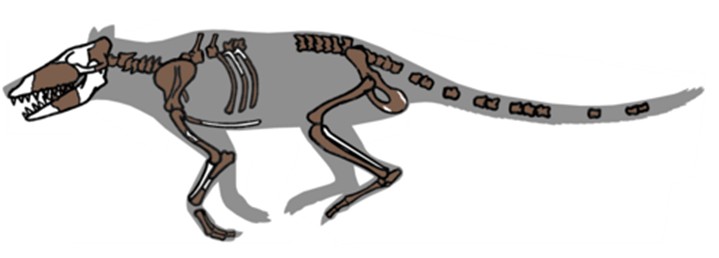
The dog-like Pakicetus was claimed to be the first step in whale evolution. The bone evidence is shown in dark brown. From Wikimedia Commons.

If a dog, why not a cat? Cartoon by Brett Miller.
Pakicetus had long, slender legs and a long, narrow tail, and was about the size of a modern wolf. They were not aquatic but may have waded in muddy water or even swum like dogs. Fossil evidence of Pakicetus has only been found in freshwater stream sediments in northwestern India and northern Pakistan. Furthermore, they were probably waders rather than swimmers.
The Whale Valley Report[5]
According to the Whale Valley Report, Egypt’s Whale Valley “holds more than 400 primitive whale skeletons that offer a snapshot of the evolution of these creatures from land-based to marine animals…. These skeletons and other marine fossils date to the late Eocene epoch (55.8 million to 33.9 million years ago), when … whales had just evolved into sea creatures.”[6]
The UNESCO report on the Whale Valley find assumed, without scientific evidence, that the bones there belonged to transitional forms on their way to becoming modern whales:
the Western Desert of Egypt, contains invaluable fossil remains of the earliest, and now extinct, suborder of whales, Archaeoceti. These fossils represent one of the major stories of evolution: the emergence of the whale as an ocean-going mammal from a previous life as a land-based animal. This is the most important site in the world for the demonstration of this stage of evolution. It portrays vividly the form and life of these whales during their transition… The fossils of Al-Hitan [i.e., Wadi al-Hitan (“Wadi of the Whale”)] show the youngest Archaeocetes, in the last stages of losing their hind limbs.” [7]
Unfortunately, the Live Science report noted above provides almost no details about the find, except that it is part of one of the largest collections of fossil whales in the world. The report written by Sascha Pare claims it contains over 400 primitive skeletons representing a variety of whale species from the Eocene era.[8] I was unable to find more details about which specific whale skeletons were found with four limbs. Nor was there detailed evidence of four limbs on whales that would enable it to walk.
Although images of the limbs were shown on the NOVA science program,[9] the bones appear to be so disordered that categorizing them has proved to be a monumental task. One photo on the internet depicts a creature that some claim to be a previously unidentified species of ancient whale dating back 43 million years. The photo caption highlights its significance as an unprotected specimen exposed to the elements.[10]
However, the animal discovered and reported by Pare in Live Science found in Whale Valley was not actually a whale, but rather a dolphin-like creature known as Archaeoceti, which measured about eight meters in length—significantly smaller than the average modern whale, which typically reaches around 27 meters length, making it roughly 3.4 times longer than Archaeoceti.
The many similarities of Archaeoceti to terrestrial mammals include their dentition consisting of incisors, canines, premolars, and molars, as well as the fact that as far as can be determined, they were warm-blooded, possessed hair, produced milk, and gave live birth. The many significant anatomical differences include the absence of key features such as echolocation and baleen, and the presence of other features not found in modern whales. Although many evolutionists claim Archaeoceti evolved into whales, this is an unproven assumption. Whale Valley is called “Whale Valley” not because it contains only whales, but because evidence of at least one whale skeleton has been found there, as shown in the photo below.
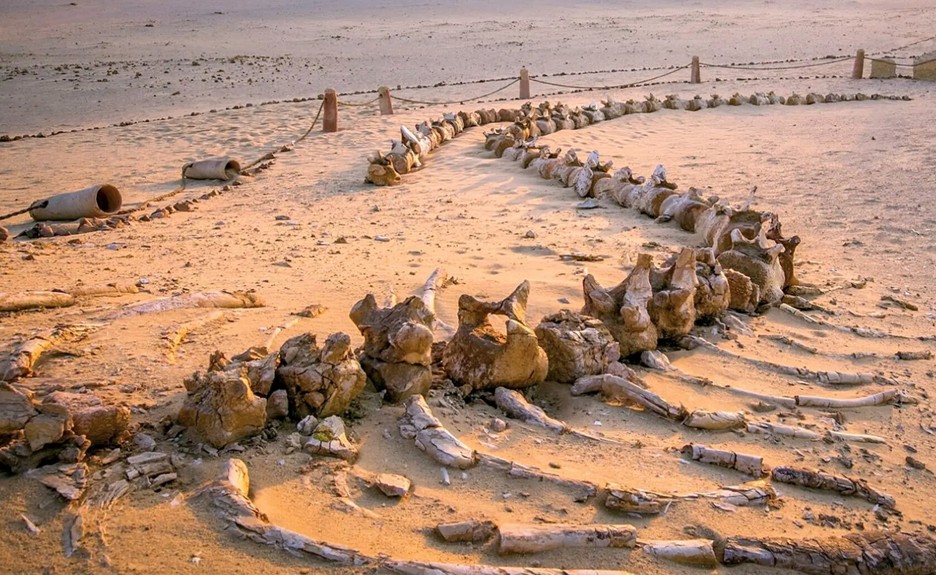
A modern whale located in Whale Valley, From Wikimedia commons.
Many of the bones in the valley, though, are not whale bones but those of animals that scientists simply assume evolved into whales. In reality, Archaeocetes represent a separate lineage that ultimately went extinct.
Summary
The fossilized animal that was found which had four limbs was not an animal evolving into a whale, but rather a four-limbed cetacean that became extinct. No direct evidence exists that proves it was on the way to evolving into a whale or even that connects it in any way to whale evolution. It is ironic that Darwin’s idea about a bear evolving into a whale, which was derided in Darwin’s day to the extent that Darwin removed the claim from his 1859 book, has been replaced by an equally preposterous idea: the hypothesis that a small, wolf-like land animal gradually evolved into a whale. But what seemed far-fetched in Darwin’s day still seems just as implausible today.[11]

The Current Theory of Whale Evolution. Illustration from Jonathan Wells “From Bears to Whales: A Difficult Transition. “2018. Evolution News and Science Today. July 17. Many of the illustrations are of living or extinct animals. https://evolutionnews.org/2018/07/from-bears-to-whales-a-difficult-transition/
References
[1] Darwin, Charles. The Origin of Species, John Murray, London, England, 1859, p. 184.
[2] Darwin, 1859, p. 184.
[3] Harvey, William Henry, Letter to Charles Darwin dated 4 August 1860. https://www.darwinproject.ac.uk/letter?docId=letters/DCP-LETT-2898.xml
[4] https://www.darwinproject.ac.uk/letters/darwins-works-letters/rewriting-origin-later-editions/whale-bear.
[5] Pare, Sascha, “Whale Valley: The whale graveyard in the Sahara desert that shows they
once had feet and toes,” Live Science, 4 July 2025.
[6] Pare, 2025.
[7] “Wadi Al-Hitan (Whale Valley),” https://whc.unesco.org/en/list/1186/, 14 July 2005.
[8] Pare, 2025.
[9] “When Whales Could Walk” (PBS video), https://www.pbs.org/wgbh/nova/video/when-whales-could-walk/, 31 January, 2024.
[10] Pare, 2025.
[11] Wells, Jonathan, “From Bears to Whales: A Difficult Transition,” Evolution News and Science Today, https://evolutionnews.org/2018/07/from-bears-to-whales-a-difficult-transition, 17 July 2018.

Silhouette looks uncannily like Eugenie Scott as Miss Information.
 Dr. Jerry Bergman has taught biology, genetics, chemistry, biochemistry, anthropology, geology, and microbiology for over 40 years at several colleges and universities including Bowling Green State University, Medical College of Ohio where he was a research associate in experimental pathology, and The University of Toledo. He is a graduate of the Medical College of Ohio, Wayne State University in Detroit, the University of Toledo, and Bowling Green State University. He has over 1,900 publications in 14 languages and 40 books and monographs. His books and textbooks that include chapters that he authored are in over 1,800 college libraries in 27 countries. So far over 80,000 copies of the 60 books and monographs that he has authored or co-authored are in print. For more articles by Dr Bergman, see his Author Profile.