

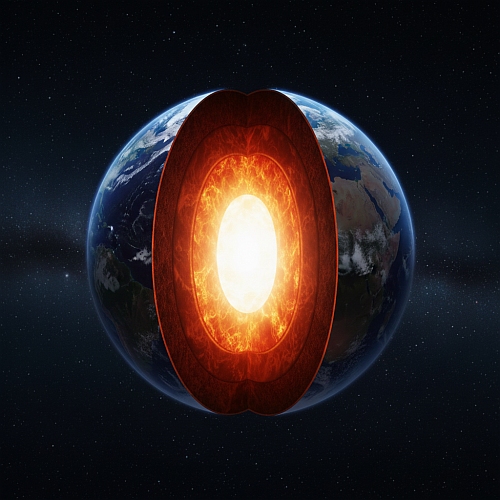

Models of Early Magnetic Field Violate Physics
Proposed dynamo models fail because they require
unrealistic parameters that contradict both physical
estimates and planetary constraints, undermining
their ability to explain Earth’s early magnetic field
3D Models of Earth’s Basal Magma Ocean (BMO) Fluid
Exposes Flaws in Evolutionary Geophysical Theories
by Dr. Sarah Buckland-Reynolds
For decades, evolutionary cosmology has proposed that Earth’s magnetic field arose from naturalistic processes deep within the planet’s interior, specifically, through convection-driven dynamos in molten layers. This magnetic field, essential for shielding life from solar radiation and preserving our atmosphere, has long been considered a product of Earth’s early thermal and rotational dynamics. But recent high-resolution modeling of the basal magma ocean (BMO) published in PNAS in November 2025 reveals a sobering truth: the assumptions behind these models are failing, showing that the Earth’s magnetic field is more complex than previously thought.
The BMO Dynamo Hypothesis: A Crumbling Pillar
Researchers Schaeffer et al introduced their paper by highlighting the theory that the BMO hypothesis suggests that a thin layer of molten silicate at the base of Earth’s mantle could have sustained the planet’s early magnetic field before the core became convective. Schaeffer et al. Began their paper by highlighting the BMO hypothesis, which suggests that a thin molten-silicate layer at the base of the mantle could have supported Earth’s early magnetic field prior to the onset of core convection. This idea gained traction because it offered a way to reconcile paleomagnetic evidence of an ancient field with models that suggest Earth’s core was initially too stable to generate one.
However, Schaeffer et al’s study challenged this view using advanced 3D numerical simulations to test whether a BMO could realistically generate a strong, Earth-like magnetic field. Their conclusion is striking. Quoting from their paper, the authors stated: “Achieving dynamo action in a BMO is certainly more challenging than previously surmised.”
Specifically, the study found that for a BMO to generate a strong dipolar field, its electrical conductivity would need to be “roughly a factor of five larger than current estimates.” Recognizing the implications of their results, the authors admitted that “another mechanism may thus be required to explain Earth’s ancient magnetic field.” This admission is profound. It means that the most widely accepted naturalistic explanation for the early geomagnetic field cannot meet its own physical requirements.
Moreover, the authors found that the BMO would need to behave in ways inconsistent with established physics. More importantly, they admitted that their models rely on assumptions that may not be valid under actual planetary conditions. In their own words, Schaeffer et al stated that:
“Our work highlights that BMO-type dynamos intrinsically require a larger product of electrical conductivity and velocity than core-type dynamos…The buoyancy forcing is set to drive rapidly rotating turbulent convection… although the boundary conditions on the buoyancy field are not fully realistic.”
Evolutionary Assumptions Under Pressure
Schaeffer et al’s admissions expose a broader limitation of scientific models. By definition, models are simplifications of reality. The problem arises when models and theories are treated as having the same scientific authority as observational science, without sufficient acknowledgement of the assumptions on which they are based. As this study highlighted, evolutionary models based on deep time often rely on idealized parameters, oversimplified physics, and optimistic extrapolations. The BMO models assumed nonmagnetic, nonrotating mixing length relationships and neglected the influence of a stably stratified core. These simplifications were necessary to make the models computationally feasible, but they also rendered them physically unrealistic. As one example of these shortfalls, the authors stated elsewhere in their article: The BMO models assumed nonmagnetic, nonrotating mixing-length relationships and neglected the effects of a stably stratified core. Although these simplifications were necessary to make the simulations computationally feasible, they also rendered the models physically unrealistic. Illustrating one of these shortcomings, the authors noted elsewhere in their article:
“Boundary-forced zonal flows do not penetrate a stably stratified core and therefore do not generate strong magnetic fields.”
The violation of the assumed simplified state is an immense blow to the idea that the core could have assisted the BMO in sustaining a dynamo. The authors also admit that their simulations used viscosities “at least 6 orders of magnitude higher than that of the magma ocean,” a concession that further distances the model from reality.
In addition to this, the simulations reveal that traditional models failed to account for other factors which would significantly impact the speed of convective dynamics. Most notably, they did not incorporate the impact of Earth’s rapid rotation on BMO convection. Because Earth is a rotating system, the Coriolis force restricts the vertical movement of fluid, significantly reducing convective efficiency. This results in convective velocities that are much slower than those predicted by nonrotating models. To evaluate fluid behavior, the authors simulated flow by calculating what is known as the “Reynolds number”, which predicts whether a fluid would move smoothly or chaotically. Their results showed that rotational constraints in the BMO system substantially reduce convective velocities, making it even more difficult to achieve the magnetic Reynolds number necessary for sustaining dynamo action. From their results, the authors concluded that:
“They are similarly rotationally constrained, so that velocities are significantly reduced compared to nonrotating estimates.”
This means that even if the BMO had the right composition and thickness, it likely could not move fast enough to generate a magnetic field.
A Case for Design
If naturalistic models fail to explain the origin and persistence of Earth’s magnetic field, what limits the adoption of an alternative design hypothesis? Earth’s magnetic field is not just strong, but is structured, stable, and finely tuned to protect life from solar radiation, cosmic rays, and atmospheric erosion. These characteristics reflect intentionality, foresight, and integration across planetary layers.
Unlike evolutionary models that struggle to simulate even basic field generation, a design perspective sees the magnetic field as part of a coherent system, embedded on Earth from the beginning. The field’s alignment, strength, and longevity are not incidental; rather are essential for life and suggest a purposeful origin.
The BMO study itself inadvertently affirms this by highlighting the improbability of spontaneous dynamo action:
“Large uncertainties still remain, calling for refined models of deep Earth thermal and mineralogical processes… Nonetheless, our work highlights that BMO-type dynamos… are more difficult to realize than previously thought.”
Schaeffer et al’s paper is a tacit acknowledgment that the current geophysical evolutionary paradigm is insufficient. The more we learn about Earth’s interior, the more it appears that naturalistic explanations are being retrofitted to match the observations, rather than arising from genuine predictive power.
Furthermore, ongoing studies continue to provide evidence that Earth’s magnetic field is not a simple byproduct of molten rock and rotation. It is a multi-layered, finely tuned phenomenon that depends on precise conditions across the core, mantle, and crust. The BMO study demonstrates that even minor deviations in conductivity, flow velocity, or boundary conditions can cause the entire system to fail.
The shortcomings of these models point toward the same conclusion: the universe bears the marks of design. The deeper we probe Earth’s interior, the more we encounter systems that defy chance-based explanations and demand fuller accounting.
The elegance of Earth’s magnetic architecture echoes the Scriptural affirmation in Hebrews 1:10 that:
“And Thou, Lord, in the beginning hast laid the foundation of the earth; and the heavens are the works of thine hands.”
In the face of failed predictions and mounting evidence of Earth’s complexity, the evidence points not to randomness, but to a Creator whose design surpasses our models and sustains our world.
 Dr. Sarah Buckland-Reynolds is a Christian, Jamaican, Environmental Science researcher, and journal associate editor. She holds the degree of Doctor of Philosophy in Geography from the University of the West Indies (UWI), Mona with high commendation, and a postgraduate specialization in Geomatics at the Universidad del Valle, Cali, Colombia. The quality of her research activity in Environmental Science has been recognized by various awards including the 2024 Editor’s Award from the American Meteorological Society for her reviewing service in the Weather, Climate and Society Journal, the 2023 L’Oreal/UNESCO Women in Science Caribbean Award, the 2023 ICETEX International Experts Exchange Award for study in Colombia. and with her PhD research in drought management also being shortlisted in the top 10 globally for the 2023 Allianz Climate Risk Award by Munich Re Insurance, Germany. Motivated by her faith in God and zeal to positively influence society, Dr. Buckland-Reynolds is also the founder and Principal Director of Chosen to G.L.O.W. Ministries, a Jamaican charitable organization which seeks to amplify the Christian voice in the public sphere and equip more youths to know how to defend their faith.
Comments
Earth’s magnetic field is one age-limiting factor as well as limiting life to earth and earth alone.
Excellent column as usual.
We in engineering have to do simulation and modeling our entire careers. Hearing about various evolutionists modeling across a spectrum of applications it came to mind that you can make your simulation model any outcome you want. But that does not mean it represents reality.
One example is discussed in the book Genetic Entropy where they exposed how evolutionists used unrealistic parameters. Like mentioned above the viscosity was admittedly modeled at a MILLION times higher!
You say this much kinder than I would 🙂 “evolutionary models based on deep time often rely on idealized parameters, oversimplified physics, and optimistic extrapolations”. Engineer here saying they use fraudulently unrealistic parameters. 🥴
evolutionary models based on deep time often rely on idealized parameters, oversimplified physics, and optimistic extrapolations