

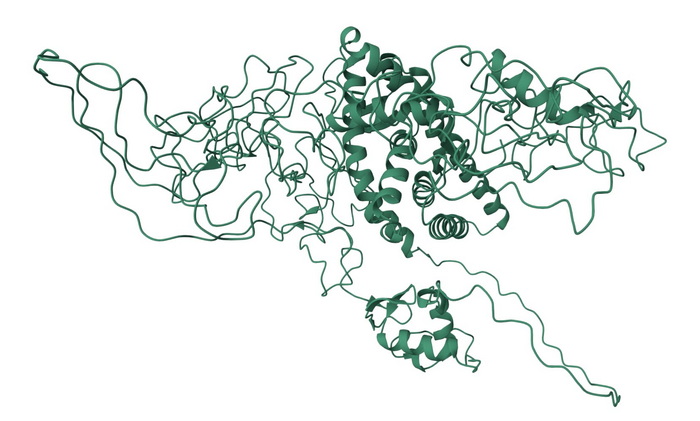

SCT: Even Loose Proteins Show Design
So-called “disordered proteins”
that don’t fold into compact
forms show design for function
This article first appeared in Science & Culture Today.
Active Matter: Newfound Order in “Disordered” Proteins
by David Coppedge
Science & Culture Today, 25 June 2026
Intrinsically disordered portions of proteins may not be functionless after all. They appear to be multi-functional, says a new study published in PNAS, titled, “A functional map of the human intrinsically disordered proteome.”
Proteins used to be visualized as tightly packed, stable structures. Indeed, AlphaFold in 2018 was one of the first winners of a major grand challenge in biochemistry and genetics: predicting the end state structure of a protein with high accuracy from the sequence of its amino acid residues. For 50 years, the “protein folding problem” appeared too difficult for computation. The Levinthal paradox estimated it would take longer than the age of the universe for random sequences to achieve a functional structure, yet cells fold many proteins in milliseconds.
Overlooked in this success was the mystery of intrinsically disordered proteins (IDPs): polypeptides that do not fold into a stable shape. Because researchers were looking for stable structures, it was more difficult to observe and study flexible polypeptides. Are they mistakes, mere flotsam and jetsam in the cell, getting in the way of the “real” proteins? Some proteins are partly folded with intrinsically disordered regions (IDRs) that, by first appearances, seem to be useless, like threads unraveling on a sweater. This was based on the naïve assumption that only a stable fold could do anything.
Exploring the Frontier
Some functions of IDRs have been coming to light in recent years. Now, the study by a team primarily from the University of Toronto has discovered “a hidden logic of information encoded in disorder”….
Click here to continue reading.
 David Coppedge, B.S. Education, B.S. Physics, founded Creation-Evolution Headlines in late 2000 as a way to share science news he was encountering at NASA. It has grown into a highly-trusted source of news and commentary critical of the pro-Darwin consensus, providing analysis of breaking news of interest to creationists and evolutionists, without the Darwin spin. He has authored over 7,000 entries at CEH since its inception.