



Scientists Attempt to Mimic the Cell’s Walking Motors
Apparently evolution is
smarter than twenty-five
world-class scientists
Researchers Attempt to Mimic the Cell’s Motor Engines
by Jerry Bergman, PhD
Introduction
Recently, a team of twenty-five researchers set out to imitate one aspect of the intracellular transportation system by designing an artificial molecular motor capable of moving along a microscopic track. Their impressive accomplishment represents a significant achievement in nanotechnology. Yet their work also highlights a striking contrast. It takes twenty-five highly trained scientists, armed with modern laboratories, advanced technology, and decades of accumulated scientific knowledge, to construct even a simplified imitation of one of the motors used in the cell’s transport systems. And many other vastly more sophisticated molecular motors are found in all living organisms that operate seamlessly within every living eukaryotic cell.
 Researchers mimic life’s own engines (Lund University, 7 July 2026). As part of the effort to imitate sophisticated molecular motors, an international team of twenty-five led by researchers from Lund University in Sweden and the University of New South Wales designed an artificial protein motor capable of taking directed steps along a DNA track. Achieving such a motor has been “a long-standing goal in synthetic biology.”[1]
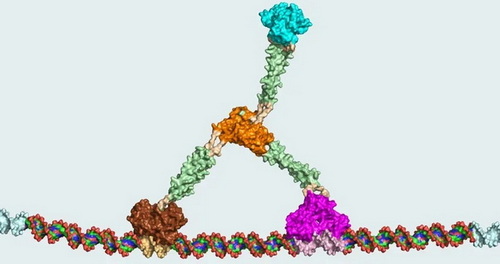
Artificial motor protein walking on DNA. Nicknamed Tumbleweed by the research team.
Evolutionary biology attributes the origin of these molecular machines to countless unguided mutations filtered by natural selection over immense spans of time.
This comparison raises an intriguing question. If some of the world’s brightest scientists can only begin to reproduce a tiny fraction of what living cells routinely accomplish, what does that imply about the extraordinary sophistication of these molecular engines—and about the challenge of explaining their origin through unguided evolutionary processes? How plausible is it that an unguided process produced these remarkable molecular machines in the first place?
Let’s examine what these researchers accomplished—and compare it with the remarkable intracellular transportation system that has operated inside living cells from the beginning. Every second, countless molecular motors transport vital cargo around the cell with astonishing precision, carrying proteins, nutrients, and other essential materials to exactly where they are needed.
When I taught genetics at the college level, this was always one of my students’ favorite topics. It vividly illustrates that a living cell is far more than a bag of chemicals; it is an intricately organized factory filled with sophisticated machinery operating at incredible efficiency. As scientists have learned more about these molecular motors, their remarkable complexity have become increasingly apparent.[2]
The Cell Cytoskeleton
These molecular motors and their microscopic highways are components of the cell’s cytoskeleton—an intricate network that gives the cell its shape, organizes its internal structure, and functions as a dynamic transportation system. The cytoskeleton continually assembles and disassembles its microtubule highways, allowing molecular cargo to be delivered with extraordinary precision and efficiency to exactly where it is needed to keep the cell functioning properly. It is an elegant transportation system that human engineers can only admire.
These microscopic “machines” literally walk along tiny tracks called microtubules.
Among the most remarkable of these molecular machines are the motor protons kinesin and dynein (see illustration of each), a member of a large family of molecular motors that are essential to virtually all eukaryotic cells. Powered by ATP—the cell’s energy currency—kinesin literally “walks” along tiny tracks constructed by microtubules in tiny, coordinated steps while carrying cargo that includes proteins, nutrients, membrane-bound organelles, and other vital cellular components to exactly where they are needed in the cell. When their delivery is complete, the microtubule tracks can be disassembled, and their components recycled to construct new tracks elsewhere in the cell.
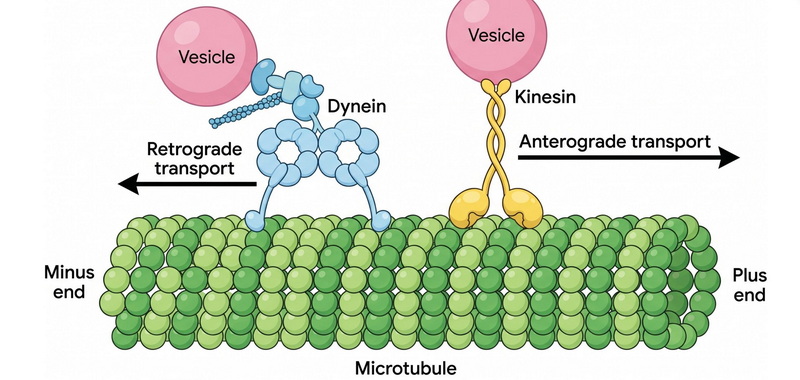
The cell’s walking motors, dynein and kinesin.
Kinesin and dynein are indispensable to numerous cellular processes, including intracellular transport, chromosome segregation during cell division, mitotic spindle assembly, and the continual maintenance and organization of the cell’s internal architecture. Together, these molecular motors and their dynamic microtubule tracks form one of the most sophisticated transportation systems known in biology. Without these molecular motors, life as we know it would not be possible. Professor Patrik Nilsson and his colleagues at Lund University describe the kinesin motor as follows:
The ability to transduce chemical energy to mechanical work is essential for life. Nature has evolved molecular motors that achieve this task with remarkable efficiency and precision, using engineering principles that are starkly different from our human-made engines. This high level of performance has been enabled by the chemical and structural complexity of proteins.[3]
That they were evolved is a belief that the articles I consulted on the achievements of Nilsson and his colleagues did even attempt to document. The major question is “how did the eukaryote cell function until they evolved? Lund University, in announcing the research, acknowledged the remarkable sophistication of these molecular motors:
The most advanced engines are not found in airplanes, cars, or other machines – they are found in nature. Inside our cells, tiny protein motors power everything from cell division to muscle movement with an efficiency and precision that has fascinated researchers for decades and inspired long-standing efforts to replicate them.[4]
The most advanced engines in existence are not man-made, but found in nature. These molecular motors were based on “engineering principles that are starkly different from our human-made engines.” They also openly recognize that the most advanced engines known to man are not products of human engineering but are the molecular machines operating inside living cells. Yet, they claim that this “starkly different” yet “most advanced engines” were designed and produced by evolution. Furthermore, the researchers emphasized the extraordinary capabilities of natural protein motors admitting:
Nature’s protein motors perform some of life’s most advanced mechanical tasks. … the motor protein myosin converts chemical energy into muscle force and plays an essential role in cell division… Proteins are far more complex than other molecular building blocks …. complexity that also makes them more challenging to understand how they work.[5]
They further noted that “Molecular motors are of central importance to a vast array of different cell processes, including cell crawling, cell division, chromosome segregation, and intracellular trafficking.”[6] Again it must be asked “how could the eukaryote cell live until they evolved these motors of central importance? The answer they could not. The researchers emphasized the fundamental importance of these molecular motors to the extent that
are fundamental to life because they transduce free energy into mechanical work, a capability rooted in the chemical and structural complexity of their constituent proteins. Although motors based on small molecules and DNA have been developed, the creation of an artificial protein motor has remained an elusive goal in synthetic biology.[7]
In other words, these molecular motors convert the energy stored in chemical bonds into precisely controlled mechanical movement—a process requiring extraordinary molecular coordination and the inability to live without there motors.
The Lund University researchers acknowledged that
“Nature’s protein motors carry out some of the most sophisticated mechanical tasks in the body with great precision and efficiency. Understanding and recreating how these biological motors achieve their remarkable performance has therefore been a major scientific challenge.”[8]
The researchers were careful to distinguish between what they accomplished and the capabilities of natural protein motors. They did not claim to have duplicated—or improved upon—the protein motors found in living cells. Instead, they repeatedly described their achievement as only an imperfect attempt to mimic the existing design. They also candidly admitted:
Despite recent progress, this goal has remained elusive. Major efforts in synthetic systems have yielded motors made from small molecules and DNA. However, none of these designed molecular machines have achieved the processivity, speed, and efficiency found in natural protein motors.[9]
Support for this conclusion has been well documented in several sources.[10] That admission is telling. The researchers successfully demonstrated that an artificial protein motor can be built and made to move. This represents an impressive engineering achievement and an important advance in synthetic biology. At the same time, it also underscores the enormous gap that still separates human engineering from the molecular motors operating routinely within all living cells.
Summary
Although the artificial motor designed by Nilsson et al. represents a significant engineering achievement, it still performs far below the efficiency and sophistication of the natural kinesin system found in all living cells. The researchers stated that one of their goals was to improve their understanding of how molecular motors evolved to achieve such remarkable performance. The study did not even attempt to propose an evolutionary pathway for the origin of kinesin. Instead, it demonstrated the extraordinary complexity of the system and the difficulty of reproducing even part of its function using modern technology.
While successful laboratory imitation can provide valuable insight into how molecular motors operate, it does not by itself eve begin to explain how such an integrated system originally arose in nature. Nor could they speculate how this evolution could occur let alone establish that it could have developed through unguided evolutionary processes.
References
[1] Sellergren, Jesika, “Researchers mimic life’s own engines,” Lund University, https://www.lunduniversity.lu.se/article/researchers-mimic-lifes-own-engines, 7 July 2026.
[2] Ali, Iftikhar, and Wei-Cai Yang, “The functions of kinesin and kinesin-related proteins in eukaryotes,” Cell Adhesion and Migration 14(1):139–152, doi: 10.1080/19336918.2020.1810939, 25 August 2020..
[3] Nilsson, Patrik, et al., “Clocked stepping of an artificial protein walker along a DNA track,” Nature Nanotechnology https://doi.org/10.1038/s41565-026-02211-3, 22 May 2026.
[4] Sellergren, Jesika, “Researchers mimic life’s own engines,” Lund University, https://www.lunduniversity.lu.se/article/researchers-mimic-lifes-own-engines, 7 July 2026.
[5] Sellergren, 2026.
[6] Milo, Ron, and Rob Phillips, “How fast do-molecular motors move on cytoskeletal filaments?,” Cell Biology by the Numbers, https://book.bionumbers.org/how-fast-do-molecular-motors-move-on-cytoskeletal-filaments/.
[7] Nilsson, et al., 2026.
[8] Sellergren, 2026.
[9] Nilsson, et al., 2026.
[10] Piranej, Selma, et al., “Programming DNA machines to move,” Nature Reviews Chemistry, 10:158–178, 19 January 2026.
 Dr. Jerry Bergman has taught biology, genetics, chemistry, biochemistry, anthropology, geology, and microbiology for over 40 years at several colleges and universities including Bowling Green State University, Medical College of Ohio where he was a research associate in experimental pathology, and The University of Toledo. He is a graduate of the Medical College of Ohio, Wayne State University in Detroit, the University of Toledo, and Bowling Green State University. He has over 1,900 publications in 14 languages and 40 books and monographs. His books and textbooks that include chapters that he authored are in over 1,800 college libraries in 27 countries. So far over 80,000 copies of the 60 books and monographs that he has authored or co-authored are in print. For more articles by Dr Bergman, see his Author Profile.
Comments
Evolutionists’ god of the gaps: “it evolved”