


National Geographic Comes Clean on Neanderthals
Elevating Neanderthals to humanity,
National Geographic author rebukes
Theodore Roosevelt for pushing a myth
National Geographic Condemns The Derogatory
Depiction of Neanderthals by Evolutionists
by Jerry Bergman, PhD

The cover of the October 2008 National Geographic showing that Neanderthals were simply ‘other humans’ and not a missing link as taught for over a century.
A 2026 National Geographic “Stones and Bones” article on October 9 has contrasted the once-common, openly racist teaching (or assertions) of evolutionists with the facts unearthed by researchers over the past century.[1] The article also tells a true story about an article about human evolution written in 1916 by Theodore Roosevelt that casts reproach on his otherwise stellar reputation. The real blame, however, should fall on the Darwinian scientists who influenced his thinking.
Neanderthal Man was once considered the premier evidence for human evolution. Today, it is widely acknowledged that Neanderthals were fully human like us. The revised view became evident on the cover of the October 2008 issue of National Geographic magazine, which labeled Neanderthals “The Other Humans.” (See National Geographic cover, right.)
In the Oct 2026 National Geographic article, Cornell University graduate and science writer Nicholas St. Fleur sharply criticizes a 1916 essay written by Theodore Roosevelt.
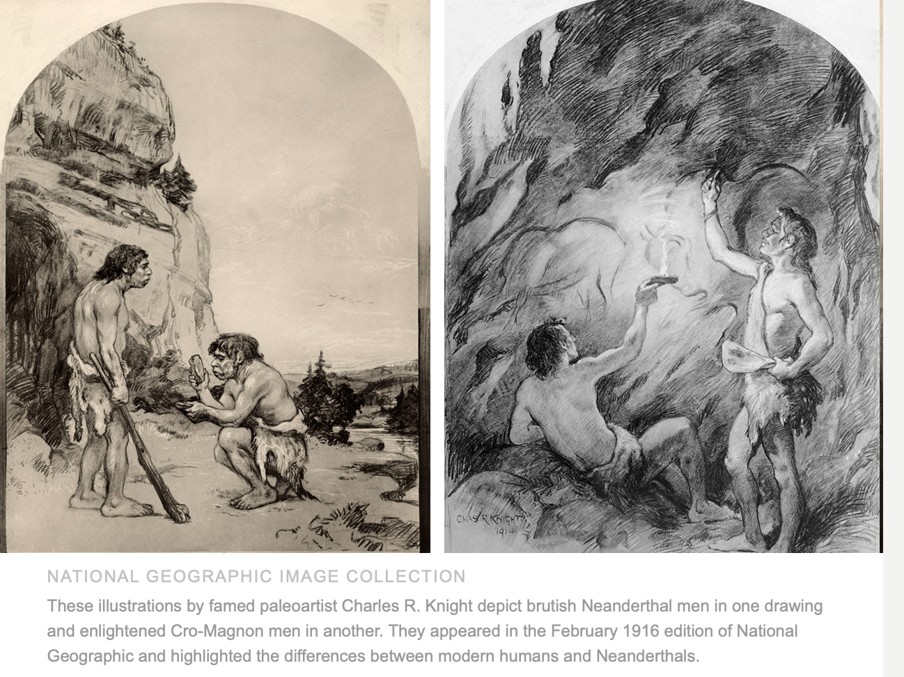
In that essay, Roosevelt surveyed the evidence for human evolution as it was understood in the early 20th century. He accompanying his text with illustrations by famed paleoartist Charles R. Knight (see illustration).
Both the article and its illustrations represent an enormous embarrassment for evolutionists today, effectively illustrating how a handful of fragmented bones were once used to construct an elaborate evolutionary narrative complete with multi-thousand-year timelines. The bias deceived one of America’s great presidents.
Roosevelt Brainwashed by Darwin
The entire evolutionary case Roosevelt presented has since been thoroughly dismantled by mainline science. As is obvious, Roosevelt, a keen naturalist and published ornithologist, deeply “admired Darwin (whose work he was reading at the precocious age of ten), and he wasn’t shy about telling the world” what he believed to be the firmly established fact of human evolution from some hypothetical ape ancestor.[2]
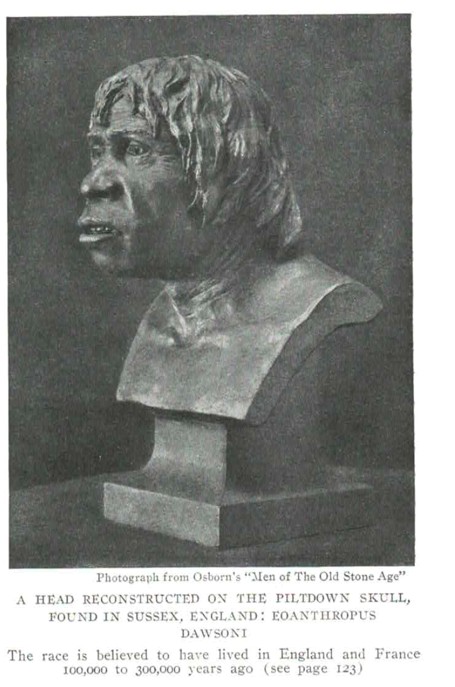
Piltdown Man, also highlighted in early evolutionary texts as a crucial transitional fossil proving human descent, was unmasked as an outright forgery only in the 1950s.
Furthermore, Roosevelt credited Darwin with “convincing practically all men of trained intelligence that the animal world, including man, has developed by evolution, not by an infinity of special creations,” adding that “The law of evolution is as fundamental to our understanding of life as the law of gravitation is to our understanding of the inanimate universe.”[3]
The law of evolution is as fundamental to our understanding of life as the law of gravitation is to our understanding of the inanimate universe. —Theodore Roosevelt
Roosevelt’s unshakeable faith in evolution motivated his 1916 National Geographic piece. The primary evidence he cited consisted of Neanderthals, Piltdown Man, Java Man and Heidelberg Man (Homo heidelbergensis). All three putative “missing links” have since collapsed as valid transitional evidence for human ancestry.
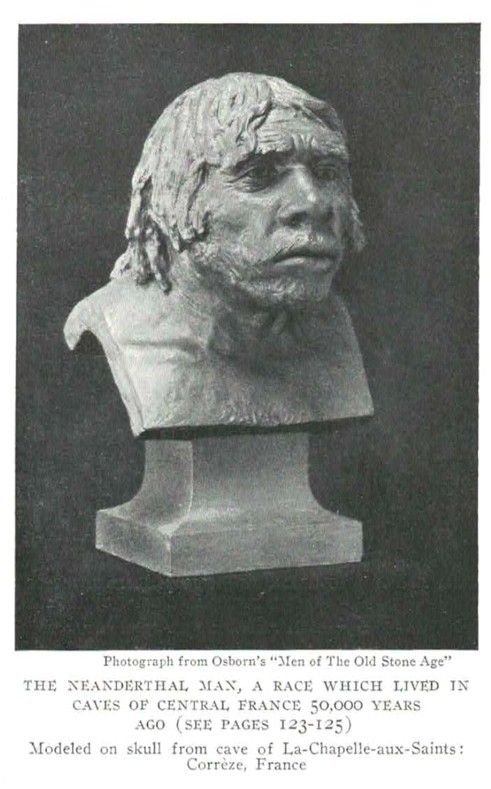
A Widely Circulated Picture of Neanderthal Man, featured in several major high school biology text books. It was originally published in Osburn’s book Men of the Old Stone Age in 1915. p. 242-243. It was based on the model done by J. H. McGregor.
Roosevelt’s Fake Neanderthals
St. Fleur aimed his sharpest criticism at Roosevelt’s portrayal of Neanderthals, noting that Neanderthals are now recognized as our extinct cousins rather than inferior evolutionary rivals who disappeared over 40,000 years ago as had previously been claimed. [4]
Roosevelt described the Neanderthal as more advanced than Piltdown Man, yet ranked him lower on the evolutionary ladder than any existing living human group (which Roosevelt termed “savages”):
“Neanderthal men were squat, burly, big-headed, thick-skulled savages, with brows projecting over cavernous eyes, knees permanently bent, and jaws almost chinless. Their brains were of good size, but the portions which represent the higher intellectual attainments were poorly developed.”
Roosevelt added that, for reasons unknown, Darwin largely overlooked Neanderthals, even though the specimen represented the very “missing link” that Darwin sought.
 Deceived by a Biased Artist
St. Fleur highlights how Charles R. Knight’s illustrations visually reinforced this bias, depicting a hunched Neanderthal clad in a makeshift fur loincloth, clutching a crude wooden club he used to club his woman. Directly opposite the Neanderthal stood an enlightened “Cro-Magnon Man” (i.e., anatomically modern human), shown upright painting a bison on a cave wall by the warm light of an oil lamp.[5]
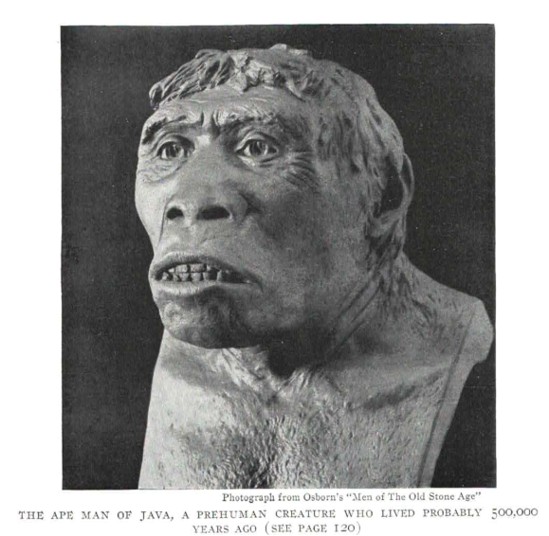
Java Man, also discussed by Roosevelt, was based only on a skull cap fragment and a human leg bone fragment. Likewise it has been rejected as problematic by many evolutionists today.
Roosevelt sought to “retrace the prehistory of man, the history of his development from an apelike creature struggling with his fellow-brutes,” while acknowledging that documented historical records extend back only about five thousand years (a timeframe matching Genesis).[6] He elaborated on this evolutionary progression, writing that mammals “developed along many different lines, including that of the primates, from which came the monkeys, the anthropoid apes, and finally the half-human predecessors of man himself…. Man was slowly developing from the half-human to the whole human.”[7]
Roosevelt conceded that “knowledge of the prehistory of man is almost, but not quite, confined to his development in Europe.”[8]
A Plague on Historic Justice
Commenting on the stark visual contrast drawn between Neanderthal and Cro-Magnon, St. Fleur noted:
Both Roosevelt and Knight were echoing the scientific sentiment at that time that Neanderthals were dumb and brutish, imagery that has plagued Homo neanderthalensis to various degrees since its discovery in 1856. But now, more than a century after America’s “Rough Rider” president maligned Neanderthals within our yellow borders, scientists are giving the archaic species some long-overdue justice.[9]
The reason is decades of archaeological discoveries have thoroughly overturned these early caricatures:
Decades of research have reshaped our image of Neanderthals, showing they were likely a sophisticated, intelligent branch of humanity, possibly even capable of art, culture, and empathy. Archaeological clues from scattered sites suggest that some may have buried their dead, practiced rudimentary dentistry, hunted birds at night, managed hearths, manufactured red ocher, constructed structures from cave stalagmites, and more.[10]
Dead Fossil Men Tell No Tales
St. Fleur also noted how difficult early fossil identification proved to be:
Neanderthals have been misunderstood since researchers first identified the fossils found in a quarry in the Neander Valley in Germany 170 years ago. Initially, the bones were believed to belong to a cave bear. Or maybe a deformed soldier who died in the Napoleonic Wars. Others thought they came from a wild race of men that wandered the woods.[11]
Then, in 1864, a geologist named William King evaluated the skeletal remains through an evolutionary framework, formally classifying them as Homo neanderthalensis—the first designated extinct human species. In his original paper, King emphasized the creature’s primitiveness:
“Considering that the Neanderthal skull is eminently simian, both in its general and particular characters, I feel myself constrained to believe that the thoughts and desires which once dwelt within it never soared beyond those of the brute.”
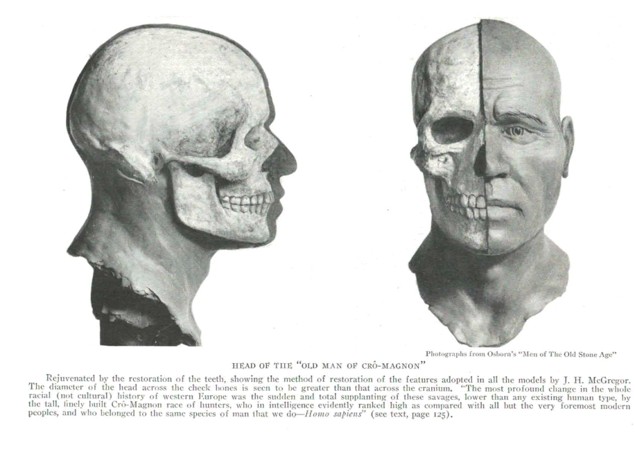
Cro-Magnon man is now considered a modern man; no longer a pre-man transitional link, but simply as an early anatomically modern human.
[1] St. Fleur, Nicholas, National Geographic, 9 Oct 2026. https://em.nationalgeographic.com/H/2/v63000001a11e09d0e8a9fb880039ca461a/d350fa80-ebff-48f9-89e0-e55ca36e5c7c/HTML, “Stones & Bones” is a National Geographic video and newsletter series that explores groundbreaking discoveries and mysteries in archaeology, paleontology, and ancient human origins.
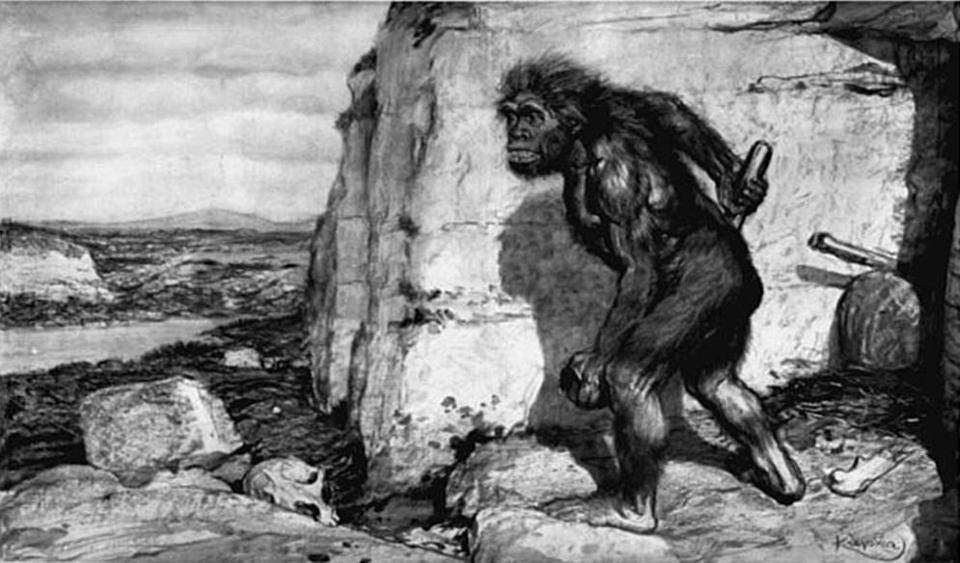
An early picture of a Neanderthal: beetle-browed, bow-legged, stooped over, and black.
[2] Branch, Glenn, “The Two Theodores,” https://ncse.ngo/two-theodores, 2014.
[3] Branch, Glenn, “The Two Theodores,” https://ncse.ngo/two-theodores, 2014.
[4] St. Fleur, Nicholas, “Justice for Neanderthals!,” National Geographic, https://archive.ph/tmzz7, 9 October 2026.
[5] St. Fleur, 2026.
[6] Roosevelt, Theodore, “How Old Is Man?,” National Geographic 29(2):111, February 1916.
[7] Roosevelt, 1916, p. 111.
[8] Roosevelt, 1916, p. 113.
[9] St. Fleur, 2026.
[10] St. Fleur, 2026.
[11] St. Fleur, 2026.
 Dr. Jerry Bergman has taught biology, genetics, chemistry, biochemistry, anthropology, geology, and microbiology for over 40 years at several colleges and universities including Bowling Green State University, Medical College of Ohio where he was a research associate in experimental pathology, and The University of Toledo. He is a graduate of the Medical College of Ohio, Wayne State University in Detroit, the University of Toledo, and Bowling Green State University. He has over 1,900 publications in 14 languages and 40 books and monographs. His books and textbooks that include chapters that he authored are in over 1,800 college libraries in 27 countries. So far over 80,000 copies of the 60 books and monographs that he has authored or co-authored are in print. For more articles by Dr Bergman, see his Author Profile.