


Darwin Still Snatches Souls Away from Logic
A young scientist reveals the
influences that led him down
the primrose path of evolution
There’s a great deal of worry in society today about radicalization: young people drawn into cultures that turn them into mind-numbed robots with narrow views and passionate activities. We would never claim that our dear evolutionary biologist interlocutors act like terrorists or lawbreakers; most of them are regular folks in many ways who would make nice neighbors, if you didn’t know what they believe. But their minds are closed to what really matters: knowing and relating to their Maker. God is the only source of non-evolving truth, morality, and relationships. Students drawn into evolutionary biology as a career find pleasure, instead, in worshiping the Stuff Happens Law, believing that everything emerged by itself without any purpose or plan. And just like radicalized activists, they become members of an echo chamber that forbids them thinking outside the box. Their peer group, like a cult, forbids them hearing or even thinking about intelligent design under threat of excommunication.

The Blind Watchmaker leads his flock on a field trip (emphasis on trip).
Inside this echo chamber, logic takes a beating. Because evolutionary biologists have been created in the image of God (like all human beings), they retain a capacity for logical thinking, but it has been corrupted. Consistent logic cannot exist within evolutionism. As John Wise wrote on 1 May 2025, they have twisted Darwin’s Hegelian ideas to embrace cognitive dissonance. The only glue that binds their contradictions together is plagiarized Christian assumptions: the conviction that truth exists and that it is morally good to seek the truth. If they lived by their own foundational principles, they would vocalize nonsense to attract mates like the chimp descendants they believe they are. Evolutionists cannot get truth, logic or morals out of a bottle of Darwine. Yet these inmates run the asylum, turning out an army of scientists controlling academia, generation after generation. If they stopped censoring scholars who believe God made the world, could they keep up this game rigged to guarantee their critics are disqualified from the outset?
Another Inductee’s Story
Current Biology this week interviewed Thibaut Brunet, an evolutionary biologist at the Pasteur Institute. Note the irony in that association: Louis Pasteur, the institute’s founder, was a theist. He once said, “The more I study nature, the more I stand amazed at the work of the Creator.” Not this guy. He studies nature to glorify Darwin. Appearing now as perhaps young middle age in his career, Brunet tells about the influences that turned him down this path:
Darwin rides his pet dino to teach the next lesson in Groupthink Class. The dino is a cool object lesson to show that stuff happens.
Like many kids of my generation, I was obsessed with dinosaurs and Jurassic Park, and that certainly played an important role in getting me interested in the history of life. There were no researchers among my family and acquaintances, and it was certainly important to have high-quality, somewhat well-documented pop culture around. Later, I discovered popular science books about evolutionary biology, notably those of Stephen Jay Gould, and this cemented my vocation.

Stephen Jay Gould was an apostle for evolutionary theory. Dinosaurs, though extinct, should be seen as marvelously designed animals from cell to bone to muscle. If you couldn’t imagine a single cell by chance, certainly much less credible is a giant sauropod! But to Brunet, they just emerged. He got the evolutionary story of their origins from Gould and Jurassic Park, and nobody ever challenged their just-so story. Parents had better be prepared to explain dinosaurs before their child receives the Darwin-colored glasses at school or from pop culture.
Asked about his favorite books, #1 was—you guessed it—
I would cite three books. The first one is not very original: On the Origin of Species by Charles Darwin. It is easy to misinterpret it as a long rambling about cabbage and pigeons, and perhaps Darwin didn’t do himself any favors by going on for so long about these, but it’s in fact the opposite of that: it is one long argument where every element is just in the place that it has to be to demonstrate its broader point, which is evolution by natural selection. Once one gets a sense of its global structure, it acquires the rigor of a mathematical proof and the beauty of a cathedral. I know of nothing else quite like it.
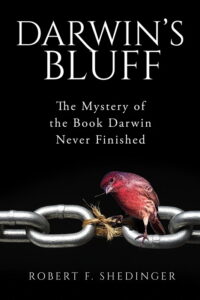
Good book proving from Darwin’s own letters that his theory lacked scientific rigor, relying on speculation.
Nobody ever handed him a copy of Darwin’s Bluff by Robert Shedinger. It’s not at all certain he would read it if it were handed to him now. And could his worship in the cathedral of Natural Selection survive our critique? (Note the long list of quotes by scientists and philosophers at the end.) No; Brunet’s die is cast. His reputation would be at stake if he entertained doubts about King Charley. A decade ago, when paleontologist Günter Bechly (tragically killed in a car accident earlier this year) dared to read intelligent design books, and reasoned that the arguments were good, he was expelled from the museum he helped to curate, even though he had earlier set up a display praising Darwin. Perhaps that is why Thibaut knows he dare not touch forbidden books like Darwin’s Black Box or Darwin on Trial.
The School of Darwin
Brunet likes detective stories, which is fine; forensics is an example of intelligent design in action. He likes making connections between pieces of evidence. But he was clueless about which book has the better Tree of Life. And he is too starstruck with Darwin to see the other one.
Darwin teaching his tree of life in Groupthink 101.
But my favorite connection of all remains the tree of life. I remain in awe of the fact that all life descends from a single common ancestor and that the differences between you, an oyster, and a mushroom are of the same nature as the differences between you and your second cousin — just extrapolated and scaled up over very many generations. The idea that all life is a single, continuous entity filled me with wonder the first time I heard it, it still fills me with the exact same wonder now, and it won’t stop filling me with wonder until I die.

His brain, the most complex object in the universe, looks back through the corridors of time and sees the Stuff Happens Law weaving its design from mushroom to oyster to human being. Why? No good reason. The Stuff Happens Law doesn’t need reasons. It just is. It already explains everything. Whatever evolves exists. And whatever exists evolved. This all makes perfect sense to DODO heads.

But the image of God within his created soul cannot stop the feeling of wonder at the beauty and complexity of life.
Wonder is good, and awe is powerful (see the new Illustra Media video). Brunet should be wondering, instead, how his soul emerged from matter in motion, from slime over time. Comfortable with his earned D-Merit Badge, he can now press the flesh with like-minded colleagues all afflicted with the Yoda Complex, unable to see their precarious position on their exalted plane which is standing on nothing.
An uncomfortable consequence of Darwinism requires believing that their own lives, habits and core values have no validity at all. It’s all about fitness! And what is fitness? Survival! And what is the good of surviving? Being fit!
O, the fit will be survivors and survivors will be fit,
And survivors will survive to prove the fitness of the fit.
O, this natural selection, it’s so simple isn’t it?
‘Tis ruthless marching on.
Fitness means only being a little more successful at passing on your genes than your neighbor (see “Fitness for Dummies“). Logic? What is that? What mutation got selected for such an eternal principle to emerge? Better hope that gene doesn’t mutate into radicalism when hit by the next cosmic ray.
Brunet is no victim of a fad, he assures us. He knows better. He knows that science changes like fashionable clothes. His God-given capacity for logic pops up out of the fogma occasionally, but not for long.
However, perhaps the deeper issue here is the very existence of fashions in science. It’s natural (and important) to try to be relevant, but it is easy to get a bit too preoccupied about doing things that seem cool. In today’s hyperconnected world, herding effects are stronger than ever and fads more global and more intense. I don’t have a great solution to this, except to take some distance from short-term buzzes (and from social media) and to read papers from diverse historical periods, including older ones. This helps filter out the short-term noise and get a sense of what questions were already interesting 20, 50, or 100 years ago. These questions are also the ones that are most likely to still be interesting 20, 50, or 100 years from now.
The Bible was answering questions 2000 years ago, and is likely to still be interesting as long as mankind exists on the earth. How about that one, Thibaut? Nope. Well, then, ask yourself: is Darwinism a fad? Is it popular because it seems cool? And since everything evolves, maybe evolution will evolve into creationism in 100 years. Could that happen? [Cue sound of implosion.]
Nobody will ask him those questions. That’s what is sad. Speaking of sad, here’s what Gad Saad said today: “It takes haughty professors decoupled from reality within the walls of their ivory tower to come up with some of the most imbecilic ideas imaginable.”
Parents, look at these influences on your kids, and take precautionary measures. Make sure your precautionary measures can survive graduate school in biology, where your precocious youngster will face forces of irrational darkness taught by likeable folks with PhDs.