


Of All the Nerves, the Great Vagus Connects Everything
Intelligent design accurately describes
every organ of the human body. But it also
describes something much smaller:
a single nerve, the vagus nerve
The Vagus Nerve Is Far More Complex Than Once Believed
And Evolutionists Are Clueless About How It Could Have Evolved
by Jerry Bergman, PhD
The vagus nerve is the tenth cranial nerve (CN X) and the longest and most widely distributed nerve of the autonomic nervous system. It serves as a major communication highway, connecting the brain to every major organ in the body The word “vagus” is Latin for “wandering,” An appropriate name for a nerve that travels extensively throughout the body.
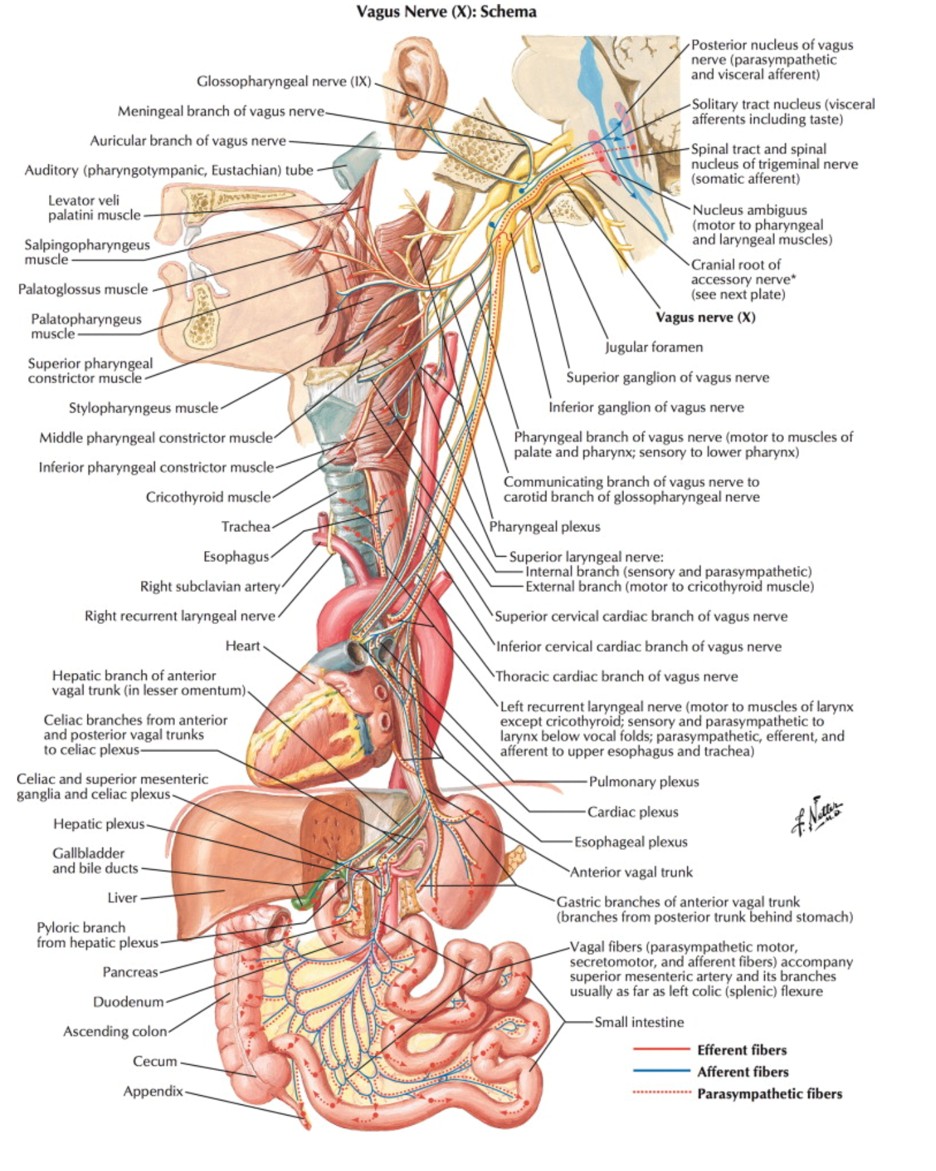
Vagus nerve with its connections to major organs of the body (Wikimedia Commons)
The vagus nerve originates in the medulla oblongata at the lower part of the brainstem and leaves the skull through the jugular foramen. It then travels down through the neck alongside the carotid artery and jugular vein. From there, it wanders through the chest and deep into the abdomen, connecting the brain with the throat, larynx, heart, lungs, stomach, liver, pancreas, and intestines.
This bidirectional information superhighway carries sensory signals from these organs to the brain, allowing it to monitor and evaluate various conditions throughout the body [read about interoception here]. Then, based on this information, the brain sends motor commands back through the vagus nerve to regulate the body’s response.
More Complex and Better Designed
A new empirical analysis, reviewed below, has documented that this system is even more complex and better designed than previously understood. The vagus nerve is the main component of the parasympathetic nervous system, which helps calm the body caused by stress by lowering the heart rate and blood pressure, and helping regulate breathing. It also stimulates gastrointestinal motility, triggers digestive secretions, and monitors activity in the stomach and digestive tract as well as enabling speaking and swallowing without choking on food. The vagus nerve is therefore a critical component of the nervous system, performing functions essential to maintaining life, much as the heart, brain, and digestive system.[1]
An article in Scientific American by Mary Randolph (11 August 2026) explains how new research has greatly improved our understanding of this organ, and how it plays a central role in regulating vital functions in vertebrates.[2] She writes,
vagus nerve is both an underappreciated and incredibly powerful instrument of the body. Researchers have long known that the vagus nerve serves as an information highway, ferrying signals between the brain stem and the rest of the body. It plays a role in everything from breathing and digestion to inflammation and immune responses. But exactly how it does this is somewhat of a mystery.[3]
Part of the reason for this complexity is that the vagus nerve’s intricate network consists of numerous nerves, blood vessels, and glands that extend to and from our organs. Tracing this inner cartography is an enormous challenge. The left and right branches of the vagus nerve contain approximately 200,000 individual nerve fibers, organized into bundles called fascicles. If the individual nerve fibers were laid out end-to-end, their combined length would be about 200 kilometers (124 miles).[4]
The Need to Map the Vagus Nerve
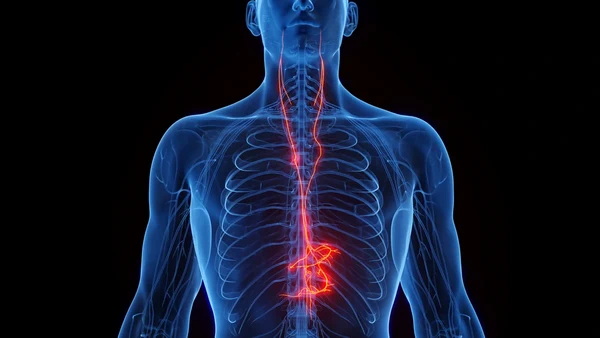
Location of the vagus nerve (red) inside the body. Sebastian Kaulitzki/Science Photo Library.
Mapping this system will help anatomists to better understand what the vagus nerve does and how it functions. The research examined the left and right branches of the vagus nerves from 30 human cadavers, producing a far more detailed map of the nerve and providing new insight into the functions of its individual fibers. By utilizing micro-dissection, micro-CT imaging, ultrasound imaging, and immunohistochemistry, the researchers produced a unique three-dimensional view of the intricate microscopic anatomy of the human vagus nerve.
The result was the world’s first comprehensive detailed map of the vagus nerve, reports Julianne Mosher Allen at the Feinstein Institutes for Medical Research. The project was led by Stavros Zanos, MD, PhD, with a team of neuroscientists at Feinstein. The result brings researchers “closer than ever to understanding the power of the vagus nerve.”[5]
A major goal of the research is to help medical-device engineers and surgeons design and implant more effective and precise bioelectronic devices for treating chronic conditions such as epilepsy, chronic pain, and even depression. On of the study’s important findings is that each vagus nerve is unique in the way its nerve fibers are organized.
The result is a publicly available dataset that maps thousands of individual nerve fibers throughout the body. To create the map, Zanos’s team used several complementary techniques. Ultrasound imaging captured the basic structure of the nerves; micro-computed tomography (micro-CT) imaging traced the specific paths of the fascicles; and microdissection allowed researchers to examine the nerves directly and better understand the functions of their many components. The team also used a machine-learning model to help analyze the 60 individual nerve branches. Research into this system is part of an explosion of knowledge about the vagus nerve and its functions. These detailed anatomical maps will enable surgeons to place medical devices with greater precision, while allowing medical-device engineers to design devices that are more effective and safer.[6] A press release from Feinstein Institutes on July 27th by Julianne Mosher Allen refers to the “great” vagus nerve:
“The dedication to deciphering the vagus nerve’s intricate language directly accelerates our mission in bioelectronic medicine,” said Kevin J. Tracey, MD, president and CEO of the Feinstein Institutes, Karches Family Distinguished Chair in Medical Research and author of the book The Great Nerve: The New Science of the Vagus Nerve and How to Harness Its Healing Reflexes. “This resource won’t just deepen global understanding; it will empower researchers worldwide to precisely re-engineer human biology, unlocking novel device-based therapies and transforming how we heal patients.”
Evolution of the Vagus Nerve
No direct evidence exists for the evolution of the vagus nerve. Evolutionary biologists assume that it evolved over 500 million years ago from primitive neural networks existing in ancient invertebrates and from homologous cranial structures in early jawless vertebrates. Evolutionists attempt to explain the origin of the vagus nerve by tracing it back to earlier body plans and neural structures.[7] However , invertebrates do not have a vagus nerve or anything close to it, and their neural architecture is fundamentally different from the vertebrate vagal pathway. Furthermore, the vagus nerve (Cranial Nerve X) is therefore a defining anatomical feature of vertebrates.[8]
The question is not whether evolutionary biologists can identify similarities between neural structures in different groups, but whether those similarities demonstrate a plausible step-by-step pathway by which the highly vertebrate vagus nerve could have evolved.
Summary
The vagus nerve is not simply a long cable running from the brain to various organs. It is an extraordinarily intricate, bidirectional communication network containing hundreds of thousands of nerve fibers, organized into specialized bundles and branches that interact with virtually every major system of the body. Its pathways are so complex that researchers are still working to understand precisely how its individual components function.
This raises an important question. If our knowledge of the vagus nerve has expanded so dramatically in just the past century, what does that tell us about the nature of the system itself? The answer is, it tells that science has revealed complexity that existed in the first man. The anatomy textbooks of a century ago described a vagus nerve that we understood only imperfectly. Today’s research is uncovering layers of organization that were hidden from earlier generations.
And that should give us pause.
The human body is not merely complicated; it is extraordinarily organized, integrated, and functionally coordinated. The vagus nerve provides a remarkable example of this. As researchers map its countless branches and fibers in ever greater detail, they are discovering not randomness, but an intricate communication system precisely integrated with the brain and virtually every major organ system.
Discoveries such as these are not surprising. They are another reminder that the more deeply we investigate the machinery of life, the more remarkable its organization becomes. The vagus nerve has existed from the original creation. What has changed is not the nerve, but our ability to see it using modern technology. And perhaps that is the most remarkable lesson of all is the human body has been telling us a story of extraordinary complexity all along. We are only now beginning to read it.
References
[1] Bergman, Jerry, “How the vagus nerve regulates digestion,” Creation Evolution Headlines, https://crev.info/2025/11/how-the-vagus-nerve-regulates-digestion/, 18 November 2025.
[2] Randolph, Mary, “Scientists are closer than ever to understanding the power of the vagus nerve. The vagus nerve is the autonomic nervous system’s highway, connecting every major organ,” Scientific American, 11 August 2026.
[3] Randolph, 2026.
[4] Julianne Mosher Allen, “Feinstein Institutes makes publicly available world’s first comprehensive human vagus nerve maps solidifying decades of leadership in bioelectronic medicine,” https://feinstein.northwell.edu/news/the-latest/feinstein-institutes-unveils-worlds-first-comprehensive-vagus-nerve-map, 27 July 2026.
[5] Randolph, 2026.
[6] Allen, 2026.
[7] Green, Stephen, et al., “Ancient evolutionary origin of vertebrate enteric neurons from trunk-derived neural crest,” Nature 544(7648):88-91, doi: 10.1038/nature21679, 6 April 2017; Epub, 20 March 2017.
[8] Green, et al., 2017.
 Dr. Jerry Bergman has taught biology, genetics, chemistry, biochemistry, anthropology, geology, and microbiology for over 40 years at several colleges and universities including Bowling Green State University, Medical College of Ohio where he was a research associate in experimental pathology, and The University of Toledo. He is a graduate of the Medical College of Ohio, Wayne State University in Detroit, the University of Toledo, and Bowling Green State University. He has over 1,900 publications in 14 languages and 40 books and monographs. His books and textbooks that include chapters that he authored are in over 1,800 college libraries in 27 countries. So far over 80,000 copies of the 60 books and monographs that he has authored or co-authored are in print. For more articles by Dr Bergman, see his Author Profile.