


Human Leg Acts Like a Pogo Stick
Fine tuning shown to produce
efficiency and precision
in bipedal movement

A diagram showing the major parts of the human leg. The bones are not shown. From Wikimedia Commons.
Progress in Understanding the Human Leg Design
by Jerry Bergman, PhD
I have not taught college-level ‘Anatomy and Physiology’ for almost a decade. If I were asked to teach it today, I would have to add a good amount of new material. One of the latest findings that would require me to teach it differently is our new knowledge of the functioning of the human leg design.

A diagram showing the human musculoskeletal system consisting of four interconnected rigid segments and nine muscle–tendon complexes used in the lower extremity. This diagram illustrates the complexity of the leg system. From Bobbert and Casius, May 2011.
When walking or running, a decade ago we taught that the leg is constructed out of bone which is stiff like an iron rod, not springy like the springs on a pogo stick. A pogo stick utilizes compression springs to power the forward motion of the stick rider. The pogo stick works as follows: “When the rider presses down on the footrests, the spring is compressed, storing potential energy. As the spring returns to its original length, this stored energy is released, propelling the rider upward.”[1] The result of this design is “Legs behave like compression springs during bouncing gaits such as running and hopping.”[2]
If I taught that the leg was more like a pogo stick than an iron bar a decade ago, there is a good chance that I would have been asked to have a “friendly” visit to chat with the dean about my knowledge of anatomy. However, new research has experimentally found that, in some ways, the human leg design does indeed resemble the pogo stick more than the static iron bar. Specifically,
When people hop at high speeds, key muscle fibers in the calf shorten [like a pogo stick] rather than lengthen as forces increase, which they call “negative stiffness.” This counterintuitive process helps the leg become stiffer, allowing for faster motion. The findings could improve training, rehabilitation, and even the design of prosthetic limbs or robotic exoskeletons.[3]
This quote is from new research by Kazuki Kuriyama et al. The team used a leg-sensing apparatus on which the subject jumped while wearing a combination of sensors to produce the test data. The research staff then analyzed the data to produce their conclusion on how the leg functions in real time.[4]
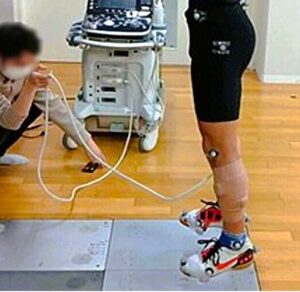
The experimental apparatus designed to evaluate the details of leg mechanics. From Kuriyama, Kazuki, et al., 2024.
The conclusion from the analysis was that leg-stiffness adjustment occurs during hopping due to a dynamic interaction between the muscle and tendon of the medial gastrocnemius.[5] The importance of this mechanism was explained by Kazuki Kuriyama et al. as follows:
The spring-like behavior of the human leg is a fundamental aspect of leg biomechanics involved in movements such as running and hopping. The “spring-mass model,” models the body as a mass and the leg as a supporting spring. Using this model, the adaptability of leg spring stiffness, commonly referred to as “leg stiffness,” has been evaluated.[6]
The author’s description of the purpose of the system makes the design obvious: “leg stiffness can be adjusted in response to diverse conditions, such as different ground surfaces, running speeds, and hop heights and frequencies. Therefore, the ability to regulate leg stiffness is crucial to ensure stable movement in various environments.”[7] The researchers admit that, in spite of the detailed research by numerous biomechanical specialists, “The mechanistic understanding of how humans adjust leg stiffness in bouncing exercises remains unclear.”[8]

Watch a Short Reel about this article on our YouTube Channel.
The Functional Complexity of the Human Leg
The human leg system is a very complex structure consisting of bone, cartilage, ligaments, nerves, arteries, veins, capillaries, tendons, hips, feet, and other parts, all assembled to function to achieve efficient, stable bipedal locomotion. The entire leg system is controlled by the brain, especially the frontal lobe and the cerebellum, which “fine-tunes” this movement. Consequently, determining the function of the spring compression system is not a simple matter. This is one reason why the mechanistic details of how “humans adjust leg stiffness in bouncing exercises remain unclear.”[9]

Corel pro photos
Conclusions
The greater knowledge of the details of the human leg system has resulted in an increased understanding of both the functional design and the complexity in the leg system which enables humans to traverse a wide variety of surface environments and conditions. As our knowledge of human anatomy and physiology grows, it becomes more obvious that evolutionary claims involving natural selection of genetic variations produced by mutations does not explain the human body design.
Ed. note: An article at The Conversation on May 15, “Why walking may be the key to a long and healthy life,” encourages us to use our wonderfully designed legs. It includes two video clips. The first, featuring Dr. I-Min Lee, advises that any amount of walking is good, and the more you can do, the better to a point, depending on your age and health. The second, featuring evolutionary propagandist David Attenborough, advises something creationists can agree on: enjoy nature. His personal account of how exposure to nature brings him joy and refreshment should prompt us to ask, “Then why did you teach for years that all of these beautiful living things just happened? Is your created soul speaking to you?”
References
[1] Pogo Stick mechanics: https://www.google.com/search?q=the+springs+on+a+pogo+stick.
[2] Boebert, M.F., and Richard Cassius, L.J., “Spring-like leg behavior, musculoskeletal mechanics and control in maximum and submaximal height human hopping,” Philosophical Transactions of the Royal Society London B Biological Science 366(1570):1516-1529, doi: 10.1098/rstb.2010.0348, PMID: 21502123, PMCID: PMC3130449, 27 May 2011.
[3] University of Tokyo, “The human leg adjusts stiffness during hopping, revealing a surprising muscle behavior,” MedicalXpress, https://medicalxpress.com/news/2025-03-human-leg-adjusts-stiffness-revealing.html, 27 March 2025.
[4] Kuriyama, Kazuki, et al., Leg stiffness adjustment during hopping by dynamic interaction between the muscle and tendon of the medial gastrocnemius. Journal of Applied Physiology. 138(4):899-908. April. https://journals.physiology.org/doi/full/10.1152/japplphysiol.00375.2024
[5] Kuriyama, et al., 2024
[6] Kuriyama et al., 2024.
[7] Kuriyama et al., 2024.
[8] Kuriyama, et al., 2024. P. 899-900.
[9] Kuriyama et al., 2024.
 Dr. Jerry Bergman has taught biology, genetics, chemistry, biochemistry, anthropology, geology, and microbiology for over 40 years at several colleges and universities including Bowling Green State University, Medical College of Ohio where he was a research associate in experimental pathology, and The University of Toledo. He is a graduate of the Medical College of Ohio, Wayne State University in Detroit, the University of Toledo, and Bowling Green State University. He has over 1,900 publications in 14 languages and 40 books and monographs. His books and textbooks that include chapters that he authored are in over 1,800 college libraries in 27 countries. So far over 80,000 copies of the 60 books and monographs that he has authored or co-authored are in print. For more articles by Dr Bergman, see his Author Profile.