



Sweet Potato Genome Decoded, Surprising Evolutionists
For those who expect evolution to lay out
a tidy breadcrumb trail from primitive ancestor
to modern plant, this genome is a rude awakening
by John D. Wise, PhD
Decoding sweet potato DNA: New research reveals surprising ancestry (Boyce Thompson Institute, Aug. 11, 2025).

Sweet potatoes are highly nutritious root vegetables offering a wide range of health benefits due to their rich content of vitamins, minerals, fiber, and antioxidants.
The humble sweet potato,[1] a favorite of holiday feasts and a subsistence and staple crop for many in the world,[2] has been hiding a secret. Scientists from The Boyce Thompson Institute (BTI) just mapped its genome in unprecedented detail – and what they found isn’t a clean family tree. It’s a mess. Or, in scientific terms, “a mosaic structure, with sequences from different ancestors interspersed along the same chromosomes.”
For those who expect evolution to lay out a tidy breadcrumb trail from primitive ancestor to modern plant, this genome is a rude awakening. It looks more like a deck of ancestral DNA cards shuffled together and dealt out randomly.
A Scientific First
The achievement itself is impressive. Led by BTI, the team has completed the first fully phased chromosome-level assembly of the hexaploid sweet potato genome. Sweet Potato DNA Decoded, reveals Ancestry ISAAA Biotech Updates, Aug. 13, 2025.
The complete phased genome assembly revealed the species’ complex evolutionary history.
“Phased” means that scientists could distinguish the six copies of each chromosome – no small feat when working with hexaploid[3] DNA. As ISAAA notes, sweet potato’s six chromosome sets come from more than one ancestor, making them especially hard to untangle.
A Genomic Mosaic, Not a Blueprint
The surprise is not just in the complexity, but in how that complexity is arranged. The cultivated sweet potato’s scientific name is Ipomoea batatas, and the variety sequenced is called Tanzania. It is a staple for sub-Saharan African populations. Under evolutionary assumptions the sweet potato must have been the result of a complex evolutionary history. Phys.org explains:
“Unlike what we see in wheat, where ancestral contributions can be found in distinct genome sections,” says Shan Wu, the study’s first author, “in sweet potato, the ancestral sequences are intertwined on the same chromosomes, creating a unique genomic architecture.”
The main contributors appear to be Ipomoea aequatoriensis (a wild species from Ecuador) and a tetraploid Ipomoea batatas-like species from Central America. But unlike wheat – where whole chromosomes can be traced to specific ancestors – the sweet potato’s ancestral fragments are shuffled together on the same strands.
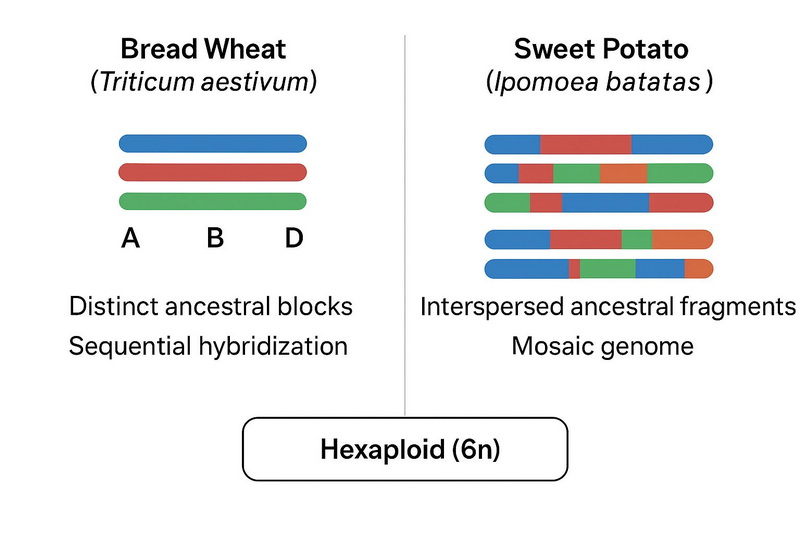
A diagram comparing bread wheat’s neat chromosome blocks with sweet potato’s multicolored mosaic shows just how messy it is. (ChatGpt)
Evolution’s Puzzle Pieces Don’t Fit
For neo-Darwinian gradualism, such a tangled genome poses a problem. As the Nature Plants abstract states, the sweet potato genome shows “mosaic genomic origins along haplotype-phased chromosomes” with contributions “intertwined along chromosomes,” rather than in neat ancestral blocks as in the wheat polyploid genome.
To be fair, evolutionary biologists are not ignorant of polyploidy, hybridization, or genomic rearrangements. These are well-documented processes in plants, and thus common explanatory tools in evolutionary biology. But acknowledging that such mechanisms exist is not the same thing as reconstructing a coherent history for the sweet potato.
The Nature Plants paper reports mosaic genomic origins along haplotype-phased chromosomes with ancestral contributions intertwined along chromosomes rather than neatly sorted into sub genomes, as we see in the wheat example above. In other words, the signals from presumed progenitor species are scrambled beyond recognition. Scientists can propose that a series of whole-genome duplications, hybridizations, and rearrangements occurred, but those events have left no clear trail. The story is written backwards: the conclusion (“it must have happened this way”) precedes and goes beyond the evidence.

Watch and share the Short Reel about this article! Click to view.
This raises a deeper issue. Neo-Darwinian gradualism is supposed to build complexity step by step, with cumulative changes, up the ladder of progress. Instead, what we find in the sweet potato genome is a mosaic puzzle retrofitted with ad hoc events to explain it. Here is the sweet potato genome. It exists, so it evolved. In contrast to evolutionary dogma, things in nature tend to get less complex over time, not more – absent intelligent intervention. Evolutionists have a term for the process by which polyploid genomes shed or silence genes over time: they call it diploidization. But despite the technical label, what it describes is straightforward – genomes losing genes, shuffling them, or silencing duplicates. That is a process of reduction, not innovation.
From a design perspective, the picture looks different. The genome’s resilience in tolerating multiple duplications without collapse suggests foresight: an architecture built with spare capacity and robustness. That robustness, now seen as evolutionary “messiness,” may in fact be evidence of life’s original richness.
Why Care?
Phased chromosome-level assembly provides insight into the genome architecture of hexaploid sweetpotato, NIH PubMed, 8 August 2025
To their credit, the BTI team isn’t just interested in evolutionary history. They see real-world applications:
This study improves our understanding of sweetpotato origin and genome architecture and provides valuable genomic resources to accelerate sweetpotato breeding.
Traits like disease resistance, drought tolerance, and nutritional enhancement could be developed faster now that breeders can target specific genes. The practical benefits are undeniable, and worth celebrating, especially when so many lives depend upon this crop.
But there’s more here than agricultural utility. The sweet potato genome reminds us that life’s information systems are far richer and more complex than our human stories about them. Materialist science too often works backward – starting with a theory, then patching it with increasingly elaborate scenarios when the evidence refuses to line up.
 George Washington Carver, who worked extensively with the sweet potato and drew inspiration from both the laboratory and the Bible, once put it this way:
God is going to reveal to us things He never revealed before if we put our hands in His.
Without God to draw aside the curtain I would be helpless.
Carver’s perspective is strikingly relevant. If genomic evidence defies evolutionary narratives, perhaps it is because we are looking to the wrong author.
Creationist Perspective: Complexity First
If we loosen the evolutionary blinders, another picture emerges. Instead of life building from simple to complex, what if it began with richness, variety, and depth? Polyploidy and hybridization, instead of being afterthoughts of an unguided process, could represent tools of resilience and diversification designed into plants from their creation.
Through this lens, the so-called “ancestral” diploid lineages may be stripped-down fragments of a once fuller genome. In other words, rather than the sweet potato being built up from simpler stock, it could be that the simpler wild species are degenerative offshoots of a more robustly endowed sweet potato kind. This is the process of “diploidization” referred to above – the fractionation and loss of genetic material over time, a well-documented occurrence. A creationist might simply call it decline after the Fall.

Sweet potatoes rank #8 among the world’s essential food sources. (Grok/AI)
Conclusion
In evolutionary thinking, genomes are supposed to be historical archives, their ancestry layered neatly like sedimentary rock. But the sweet potato’s genome is more like a scrambled jigsaw puzzle compounded from a variety of puzzle-sets that “somehow” forms a perfect picture. From a Creationist perspective, this picture is not surprising. Life, contrary to evolutionary dogma, did not begin as a set of minimal, fragile forms slowly climbing an evolutionary ladder, but rather as robust, information-rich kinds, endowed from the start with genomic depth and potential for variation. What looks like chaos under the lens of Darwinian reductionism can, in another frame, be seen as the fingerprint of foresight—structures poised to adapt, diversify, and flourish in a world that has since fallen into disorder.
George Washington Carver, who gave his life to studying plants for the benefit of his fellow man, and loved the Lord Jesus with all his heart, deserves the last word on this great achievement that I think he would find no surprise at all:
The 118 different and attractive products (to date) [that he had] made from [the sweet potato], are sufficient to convince the most skeptical that we are just beginning to discover the real value and marvelous possibilities of this splendid vegetable.
Footnotes
[1] The sweet “potato” is not a potato at all. The potato is a stem-vegetable (that happens to grow underground) in the nightshade family – like tomatoes, whereas the sweet potato is a root-vegetable in the morning-glory family.
[2] The “big three” staples are rice, wheat and corn (maize), together providing more than 50% of the world’s caloric intake. On this list of food-staple crops sweet potatoes is the 8th most important essential food source, and particularly for some populations in Africa, Asia and the Pacific Islands.
[3] The terminology can get heavy. “Hexaploid” means that the organism’s cells contain six full copies of the chromosomes. By contrast, human cells are diploid, containing two full sets of chromosomes (other than sex cells, which are a single set of chromosomes, or haploid (Gk. haplous – single, or simple)), one contributed by the father, the other by the mother. “Polyploid” means more than two complete sets of chromosomes in each cell.
 John Wise received his PhD in philosophy from the University of CA, Irvine in 2004. His dissertation was titled Sartre’s Phenomenological Ontology and the German Idealist Tradition. His area of specialization is 19th to early 20th century continental philosophy.
He tells the story of his 25-year odyssey from atheism to Christianity in the book, Through the Looking Glass: The Imploding of an Atheist Professor’s Worldview (available on Amazon). Since his return to Christ, his research interests include developing a Christian (YEC) philosophy of science and the integration of all human knowledge with God’s word.
He has taught philosophy for the University of CA, Irvine, East Stroudsburg University of PA, Grand Canyon University, American Intercontinental University, and Ashford University. He currently teaches online for the University of Arizona, Global Campus, and is a member of the Heterodox Academy. He and his wife Jenny are known online as The Christian Atheist with a podcast of that name, in addition to a YouTube channel: John and Jenny Wise.
Comments
You explain your case and differences with evolutionists very considerate and skillfully. As an engineer I would have difficulty replicating your skills while addressing such nonsense. Like their attributing so much to common ancestry instead of say functional requirements fulfilled by intelligent design.