


More Evidence that Homo naledi Is Not a Missing Link
Despite remaining questions,
evidence is compelling that
these bones were fully human
by Jerry Bergman, PhD

This book by Sanford and Rupe examines all the “hominins” and evolutionary myths about them.
In 2017, Chris Rupe, Ph.D., of Back2Genesis, published the book Contested Bones in which he argued that Homo naledi is not “a missing link” and does not “bridge the vast evolutionary gap between the ape-like australopiths and man… The missing link is still missing.”[1] This claim contradicts those evolutionists who argue that Homo naledi has both modern human and australopithecine features.
Some Background of the Find
The first Homo naledi fossils were discovered in 2013 in the Dinaledi Chamber of the Rising Star Cave system located in South Africa.[2] As of 2014, over 1,550 bone fragments from around 15 individuals were uncovered. There are fossils of nearly every bone in the human body from both genders and a wide range of ages, from children to mature adults. The claim that Homo naledi was a link between humans and Australopithecus was based on the following statement by expedition leader, Lee Berger:
This species is characterized by body mass and stature similar to small-bodied human populations but a small endocranial volume similar to australopiths. … H. naledi has humanlike manipulatory adaptations of the hand and wrist. It also exhibits a humanlike foot and lower limb. These humanlike aspects are contrasted in the postcrania with a more primitive or australopith-like trunk, shoulder, pelvis and proximal femur.[3]
The small brain problem is central to the question of whether H. naledi was fully human. Although, most of its traits were clearly human, it was described as an anatomical mosaic because a few of its traits were very apelike, in spite of the fact that these mosaic traits “overlap with modern human variation.”[4] For instance, the average brain size of Homo naledi is estimated to be between 465 and 610 cubic centimeters (cc). This is about 1/3 the size of the modern human brain, which averages around 1300-1400 cc. In comparison, the brains of chimpanzees are around 390-500 cc. Thus, the human brain is, on average, three times larger than the average chimp brain.
Paleontologists generally conclude that a “small brain proves it could not be a modern human”, but there are problems with this conclusion. For instance, some of the australopithecine traits are likely due largely to the small body size of the creature, which was a major focus of many Home naledi discussions. The Homo naledi people were, on average, 4 feet 9 inches (1.44 meters), and their weight on average was from 88 to 123 pounds (39.9-55.8 kg).[5] This is slightly greater than the average height and weight of the Bambuti African pygmy. They are an average of 4 feet 6 inches (1.37 meters) tall, and their women were about 0.5 foot (6 inches) shorter. Their average weight was approximately 88 pounds (40 kg).[6] These comparisons with the Bambuti African pigmy show the Home naledi height and weight was actually slightly greater than some living humans.
New evidence they were fully human
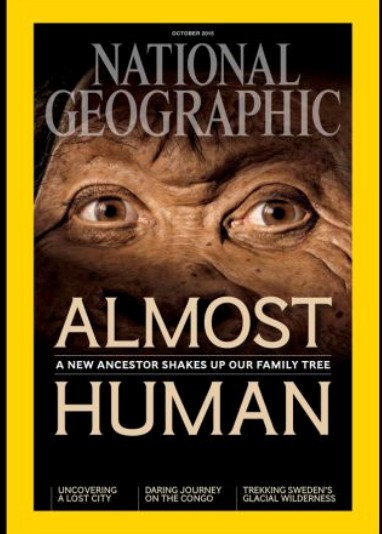
Cover of the October 2015 National Geographic.
From the beginning, the Homo naledi people were described as “almost human,”[7] implying that they were not truly human, but rather a link between humans and their supposed ape ancestors. However, new evidence increasingly supports the conclusion that they were not “almost human” but were fully human.
One of the new findings had to do with their burial practices as published in the July 23, 2025 New Scientist magazine in an article titled “Homo naledi‘s burial practices could change what it means to be human”. According to the article, the reason that H. naledi burial practices are important is that “our ability to recognize our eventual demise and the grief that comes with losing those close to us are core elements of what it means to be human…. We have long assumed that Homo sapiens was the only human species to have gained an awareness of the mortality of living things.”[8] The article concluded with this statement: “The provocative image of a grief-stricken H. naledi helping its young deal with loss forces as much of a rethinking about these ancient relatives as it does a reckoning of what it means to be human.”[9]
Another New Scientist article from the same July 23, 2025 magazine opined what appears to be fairly strong evidence for the deliberate burial of their young: “a team led by Lee Berger at the University of the Witwatersrand, South Africa, concluded that H. naledi … invented a complex ritual that involved burying its dead in a deep and difficult-to-access cave chamber.”[10] This behavior is widely recognized as evidence of human behavior, not non-human primate behavior. Berger and 36 of his colleagues then presented detailed evidence for their conclusion, including the deliberate placement of bodies in an intentionally dug pit which was rapidly covered with soil prior to the decomposition of soft tissue.[11]
Other Problems with the “Almost Human View”
No complete skull was ever recovered, only skull fragments from four individuals of different ages, genders, and sexes. These fragments were then assembled in an attempt to obtain a complete skull.[12] However, the major question whether a person with a brain between 465 and 610 cubic centimeters can function normally was answered by Harvard trained paleontologist Kurt Wise writing
that the conclusion that the H. naledi were human is almost inescapable. Even Dirks et al. conclude that the H. naledi deliberately placed their dead in this inaccessible location. This is in spite of how difficult this conclusion is for them to accept. Chris Stringer (2015) summarizes their dilemma well when he says ‘recognize that the intentional disposal of the dead bodies is a surprisingly complex behavior for a creature with a brain no bigger than that of a H. habilis or gorilla.’[13]
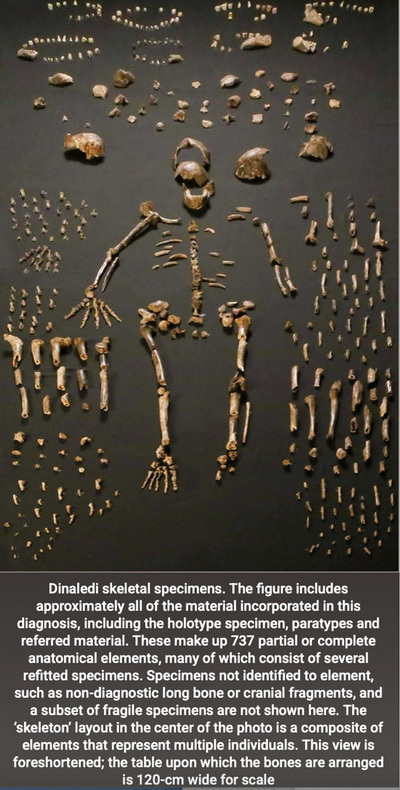
From Wikimedia Commons.
Despite its smaller size, the H. naledi brain, “particularly the frontal lobe, displayed a shape and structure remarkably similar to that of modern humans, indicating the potential for comparable cognitive complexity as modern humans. This challenges the previous belief that larger brains were a prerequisite for certain advanced behaviors in early hominins.”[14]
A new study, published in the Proceedings of the National Academy of Sciences also challenged the large brain requirement. The PNAS study shows that, though the H. naledi brain was small, similar to those of apes and our alleged more-distant human ancestors such as Australopithecus sediba, their brain shared structural features with human brains, such as grooves and folds.
Todd Wood’s Conclusion from Anatomical Comparisons
Todd Wood, in an extensive, detailed, and careful evaluation of the evidence, concluded that the “Results support inclusion of ‘early’ Homo in the human holobaramin, and the newly discovered Homo naledi can also be placed with confidence in the human holobaramin.”[15] He further concluded “H. naledi had extremely small brains but limbs resembling those of modern humans,” adding, “The newly-expanded human holobaramin implies a much greater diversity of human forms than previously recognized.”[16]
Summary
The case that Homo naledi is fully human—rather than a link between a common ancestor and modern humans—has increasingly become stronger. Evidence that they buried their dead has only reinforced this conclusion. Remaining questions about the fossil find include:
- Among the thousands of bone fragments, are some from animals?
- Can disease be ruled out?
- Can genetic abnormalities be excluded?
- Can inbreeding be eliminated as a factor?
- Can past or recent tampering with the bones be excluded?
One possibility is that humanity once displayed a broader range of normal traits than we see today. As it stands, the evidence that they were fully human is compelling, while the evidence for them being anything less than human is negligible—contrary to National Geographic’s description of them as “almost human.”

Watch and share the Short Reel about this article! Click to view.
References
[1] Rupe, Christopher, and John Sanford, Contested Bones, FMS Publications, Longmeadow, MA, p. 210, 2017.
[2] Berger, Lee, et al., “Homo naledi: A new species of the genus Homo from the Dinaledi Chamber, South Africa,” eLife, https://doi.org/10.7554/eLife.09560, 10 September 2015.
[3] Berger, et al., 2015.
[4] Rupe, p. 183, 2017.
[5] Smithsonian National Museum of Natural History, “What Does It Mean to be Human?: Home naledi,” https://humanorigins.si.edu/evidence/human-fossils/species/homo-naledi, 3 January 2024.
[6] Becker, N.S.A., et al., “Indirect Evidence for the Genetic Determination of Short Stature in African Pygmies,” American Journal of Physical Anthropology 145(3):390–401, July 2011.
[7] Cover of the National Geographic. “Almost Human,” October 2015.
[8] New Scientist.“Homo naledi‘s burial practices could change what it means to be human,” New Scientist, https://www.newscientist.com/article/mg26735532-600-homo-naledis-burial-practices-could-change-what-it-means-to-be-human, 23 July 2025.
[9] New Scientist, 23 July 2025.
[10] Barras, Colin, “What were ancient humans thinking when they began to bury their dead?,” New Scientist, https://www.newscientist.com/article/2487980-what-were-ancient-humans-thinking-when-they-began-to-bury-their-dead, 23 July 2025.
[11] Berger, L., and 36 co-authors, “Evidence for deliberate burial of the dead by Homo naledi, https://elifesciences.org/reviewed-preprints/89106v2, 28 March 2025.
[12] Rupe and Sanford, Contested Bones, pp. 180, 183, 2017.
[13] Wise, K.P., “Paleontological note on Homo naledi,” Journal of Creation Theology and Science Series B: Life Sciences 6:9-13, 9 May 2016.
[14] Tyrrell, Kelly, “Homo naledi had a tiny brain but it looked a lot like ours,” University of Wisconsin-Madison News, https://news.wisc.edu/homo-naledi-had-a-tiny-brain-but-it-looked-a-lot-like-ours/, 14 May 2018.
[15] Wood, Todd, “An evaluation of Homo naledi and “early” Homo from a young-age creationist perspective,” Journal of Creation Theology and Science Series B: Life Sciences 6(15):14-30, p.14, 9 May 2016.
[16] Wood. p. 14, 2016.
 Dr. Jerry Bergman has taught biology, genetics, chemistry, biochemistry, anthropology, geology, and microbiology for over 40 years at several colleges and universities including Bowling Green State University, Medical College of Ohio where he was a research associate in experimental pathology, and The University of Toledo. He is a graduate of the Medical College of Ohio, Wayne State University in Detroit, the University of Toledo, and Bowling Green State University. He has over 1,900 publications in 14 languages and 40 books and monographs. His books and textbooks that include chapters that he authored are in over 1,800 college libraries in 27 countries. So far over 80,000 copies of the 60 books and monographs that he has authored or co-authored are in print. For more articles by Dr Bergman, see his Author Profile.
Comments
Evolutionists have run out of missing links. How about this: humans were humans to begin with. Oh wait. That caveat tears down the house of cards for the evolutionists.