


Can Evolution Predict the Past?
What evolved fastest here
wasn’t the human skull—
it was the evolutionary story
EVOLUTION: PREDICTING THE PAST
Deep-Fake Science
by John D. Wise, PhD
A new 3-D skull study from University College London made headlines this week.
A picture may once have been worth a thousand words, but a deep-fake can say whatever you want it to. In this case, the 3-D skull images are genuine enough—but once evolutionary algorithms go to work, the model begins predicting a past it’s never seen. It’s a remarkable trick: turning a projection of the present into a record of the past.
EurekAlert, “Humans evolved fastest among the apes, 3D skull study shows,” 21 Oct 2025. It sounds definitive:
Lead author, Dr Aida Gomez-Robles (UCL Anthropology) said: “Of all the ape species, humans have evolved the fastest. This likely speaks to how crucial skull adaptations associated with having a big brain and small faces are for humans that they evolved at such a fast rate. These adaptations can be related to the cognitive advantages of having a big brain.”
University College London researchers scanned living species — gorillas, chimpanzees, orangutans, gibbons, and humans — and ran the shapes through statistical models to infer evolutionary “rates” of morphological change. Their conclusion: humans evolved fastest among the apes.
The trouble is, the evolutionary story wasn’t found in the pixels; it was layered on afterward.
The Frozen Present: How Evolution Turns Snapshots into Cinema
The researchers didn’t dig up fossils or measure changes through time. They scanned the skulls of living species—gorillas, chimpanzees, gibbons, orangutans, and Homo sapiens—and then calculated which shape differed most from a statistical “ancestral mean.” Humans came out the farthest from that midpoint, so the authors declared that our skulls “evolved” more rapidly.
That assumption—difference equals descent—does all the heavy lifting.
The Frozen Present — The Core Fallacy
What they really measured is morphological distance, not historical rate. It’s the same dance as deep-time radiometric methods—each turns present measurements into history by assuming the story that connects them. To turn a spatial comparison into a temporal narrative, you must first assume the very thing you hope to prove: that today’s species are snapshots in a single evolutionary movie.
But the apes alive today aren’t ancestral frames of a film; they are modern species with complex and unknown histories. Using them as waypoints in a straight evolutionary line is like reading a snapshot of cousins at a reunion as if it were a flipbook of one ancestor turning into another. In other words, they treat contemporaneous species as though they were successive stages of a single evolving lineage.
Philosophers call that a category mistake—confusing coexistence with succession. Lineages are temporal successions; individuals are… well, individuals—snapshots, not movies.
“Accelerated evolution increased craniofacial divergence between humans and great apes,” Aida Gomez-Robles, et al., 22 October 2025, Proceedings of the Royal Society B. This is the journal article itself. Its supplementary data make our point plain:
The level of craniofacial diversity of hominids is substantially higher than that of hylobatids [gibbons] for all craniofacial modules evaluated here.
That sentence reports variation, not rate, and certainly not direction.
The Inverse Problem: When Data Pretend to Tell Time
In philosophy of science this is called an inverse problem—inferring a process from its outcome.[1] It’s a familiar predicament: the effect is visible; the cause is conjecture. Countless causal pathways could lead to the same pattern we see today. Maybe skull shape changed through developmental plasticity; maybe gene-regulatory shifts altered bone growth without selective “pressure”; maybe environmental stress reshaped jaws within a few generations. The data themselves can’t decide among those possibilities—a textbook case of underdetermination.
The chosen[2] explanation—Darwinian tempo—is imported, not discovered. Once again:
The model predicts a past it’s never seen.
Circular Clocks: How Evolution Measures Itself
To compute “rate,” the study plugged those differences into a 20-million-year timeline derived from molecular clocks. But those clocks are themselves calibrated by evolutionary assumptions. The circle closes neatly: evolution is used to measure evolution. Each new iteration refines the algorithm’s ability to predict a past it never saw—a model rehearsing its own creation myth.
The outcome is as inevitable as it is uninformative.
Philosophy in a Lab Coat
When the press release announces that “Humans evolved fastest,” it sounds like a measurement, but it’s really a revival of nineteenth-century progress talk—speed as superiority. Morphometrics can quantify shapes; it can’t rank them on an evolutionary ladder.
Science could have reported the finding soberly: “Among living apes, human skulls show the largest geometric deviation.” But that headline doesn’t sell—or preach. So “difference” becomes “rate,” and “rate” becomes “evolutionary achievement.”
Why It Matters (and Why You Should Pay Attention)
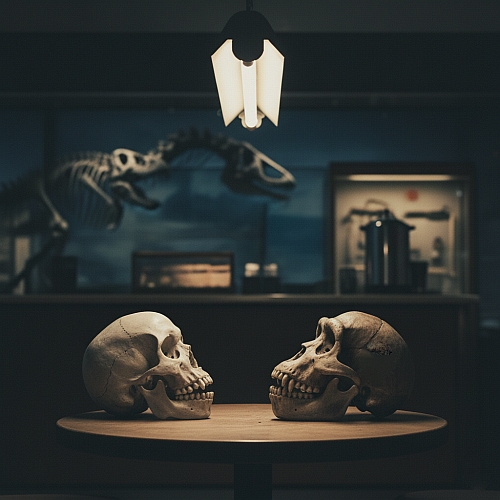
A night at the Museum of Natural History! Watch and share the Short Reel about this article! Click to view it now.
Creationists are sometimes accused of “smuggling” theology into data. Yet here we watch the evolutionary community import teleology under the guise of measurement.[3] The assumptions are hidden in plain sight: continuity of lineage, uniform temporal scaling, and the conviction that more change means more progress.
None of this is demonstrated by the scans themselves.
Strip away the scaffolding, and what remains is straightforward: human skulls look different. The leap from different to descended is philosophical, not empirical.
The rest is the model predicting a past it never saw.
Closing
If a picture is worth a thousand words, the conclusions drawn from these scans are worth a thousand assumptions. They reveal only geometry; the authors supply the genealogy. Once the evolutionary “filters” are applied—deep time, ancestral averages, molecular clocks—the image looks convincingly ancient. But peel away the deep-fake of theory, and what remains is the plain, unretouched truth: the data show difference, not descent.
What evolved fastest here wasn’t the human skull—it was the evolutionary story.
Footnotes
[1] It is also classic Hegelian philosophy, inferring what must have been from what is.
[2] Another classic Hegelian move, represent choice as necessity. Evolutionary science hides from itself that theory is a chosen lens through which data is filtered, not an objective instrument. This is what Hegel calls the “cunning of Reason” – the agents believe what Spirit needs them to believe in order to accomplish its ends.
[3] Once you see the strategy, you can unmask it in the evolutionary literature yourself. We can call it ‘teleology smuggling.’ Evolutionary theory must explain increasing complexity—telos—but it cannot admit teleology (‘the divine foot’) within methodological naturalism. So it hides teleology in plain sight by renaming it.
 John Wise received his PhD in philosophy from the University of CA, Irvine in 2004. His dissertation was titled Sartre’s Phenomenological Ontology and the German Idealist Tradition. His area of specialization is 19th to early 20th century continental philosophy.
He tells the story of his 25-year odyssey from atheism to Christianity in the book, Through the Looking Glass: The Imploding of an Atheist Professor’s Worldview (available on Amazon). Since his return to Christ, his research interests include developing a Christian (YEC) philosophy of science and the integration of all human knowledge with God’s word.
He has taught philosophy for the University of CA, Irvine, East Stroudsburg University of PA, Grand Canyon University, American Intercontinental University, and Ashford University. He currently teaches online for the University of Arizona, Global Campus, and is a member of the Heterodox Academy. He and his wife Jenny are known online as The Christian Atheist with a podcast of that name, in addition to a YouTube channel: John and Jenny Wise.
Comments
Evolution is as unstable as a house on sand that is also troubled within.