


ENST: Synchronized Swimming in Siphonophores
Learn about weird marine animals
called siphonophores and how
scientists want to mimic them
This article by the CEH Editor appeared at Evolution News on December 31, 2022.
Synchronized Swimming in Siphonophores
A Design Worth Imitating
by David Coppedge
Evolution News & Science Today, 31 Dec 2022
Learning more about strange and fascinating creatures could occupy a lifetime. I had heard about siphonophores (“siphon bearers”) but knew little about them. To report on a new paper about their swimming abilities I needed to brush up on their taxonomy, anatomy, physiology, and ecology, so I read articles and watched videos of them in action. As with everything in biology, the closer one looks, the clearer the design: and this one, again, has design worth imitating.
A Floater to Avoid
Watch and share the Short Reel about this article! Click to view it now.
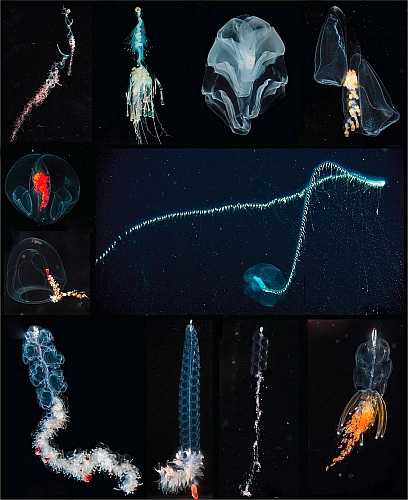
Siphonophores (phylum Cnidaria) are colonial marine organisms exhibiting division of labor: some of the “zooids” (individual members of the colony) provide propulsion; others hunt and digest prey. The best-known siphonophore is the Portuguese man-o’war, known to beachgoers as a jellyfish-like floater to avoid; it has nasty stinging cells strong enough to kill a human: (YouTube video).
But it’s not a jellyfish per se. The bell-shaped jellyfishes with which we are most familiar (phylum Cnidaria, subphylum Scyphozoa) are single individuals. The Portuguese man-o’war is classified in subphylum Hydrozoa, which includes the hydra. Like other siphonophores, it is a colony of individuals with specialized functions. Its distinctive gas-filled, sail-like bladder riding the waves like a Portuguese warship suggested the organism’s name.
Most other siphonophores — long, rope-like organisms with hairy-looking tentacles and gelatinous bulbs arranged in rows — sit and wait underwater until prey animals like fish and plankton drift into their stinging cells. But siphonophores can swim. In fact, they travel large distances every day. If the fishing is bad, they will move to a better spot….
Click here to continue reading.
See also, “The Meek Control the Earth,” 6 Sept 2014.