


Three-Legged Lizards and the Limits of Evolutionary Storytelling
When the evidence
refuses to behave, the
Darwinian narrative
expands to fit
by John D. Wise, PhD
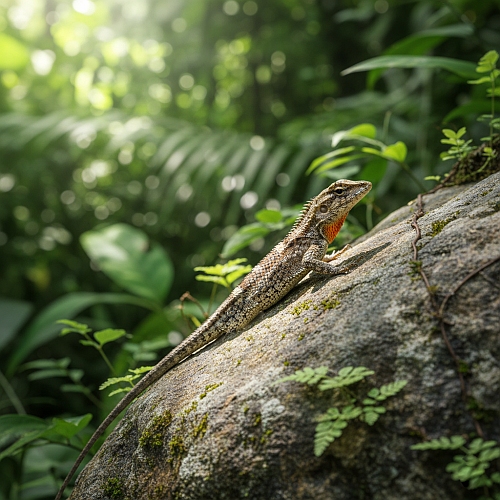
Photographs from the field show a stunning sight: lizards missing an entire limb—sometimes a leg, sometimes a foot—yet thriving against all odds. Far from starved or sluggish, these “three-legged survivors” are healthy, well-fed, and even reproducing.
 3-legged lizards can thrive against all odds, challenging assumptions about how evolution works in the wild, (The Conversation, 13 October 2025). Researchers James T. Stroud and Jonathan B. Losos “have documented 122 cases of limb loss across 58 species worldwide.” From tiny geckos to massive iguanas and tree-dwelling chameleons, these creatures are flourishing despite injuries that, by all evolutionary logic, should have spelled their doom.
This discovery is startling because lizard limbs represent one of biology’s most studied examples of evolutionary adaptation. For decades, scientists have demonstrated that even tiny differences in leg length between individual lizards can mean the difference between life and death – affecting their ability to escape predators, catch prey and find mates. Since subtle variations matter so much, biologists have long assumed that losing an entire limb should be catastrophic.
Yet here are the exceptions—thriving, breeding, and sometimes even outperforming their fully limbed counterparts. Evolutionary biologists have treated limb length in lizards as one of nature’s most delicate adaptive balances.
Shouldn’t natural selection have weeded out these “less fit” individuals?
That question should at least invite reflection. Yet rather than revisiting the premise, the authors double down.
Nature’s Built-In Resilience
According to the prevailing evolutionary narrative, every feature of a creature’s anatomy is the cumulative result of random variation, filtered by selection over countless generations. Small differences are supposed to matter enormously. But if that were true, how can a lizard missing a fourth of its limbs still climb, run, and reproduce? A counter-instance to the doctrine of natural selection? Not on your life!
But perhaps selection is more episodic than constant. Maybe sometimes limb length matters tremendously, while during other times – such as when food is abundant and predators are scarce – limb length matters less and three-legged lizards can flourish.
These lizard survivors showcase the incredible solutions that millions of years of evolution have built into their biology. Rather than being passive victims of their injuries, these lizards may survive by actively choosing safer habitats or hunting strategies, using smart behavior to avoid situations where their disability would be a disadvantage.
Really? Having set aside human exceptionalism, are we now to celebrate lizard exceptionalism? Doesn’t such language already hint at forces beyond a purely naturalistic framework? Why not simply take the step that the evidence itself invites?
The irony is hard to miss: the more the data suggest design, the more the language of “evolution” must borrow the vocabulary of intention and intelligence. The data point to foresight—creatures built with reserves of flexibility, able to survive in a broken world. These animals are not “lucky accidents.” They exhibit a depth of design that anticipates injury. One brown anole missing half a hind limb, for instance, adjusted its gait by undulating its body in a serpentine rhythm—an instinctive, pre-equipped biomechanical workaround. The scientists called it “creative biomechanical solutions.”
We might just as well call it ingenious design.
When “Evolution” Explains Everything—and Nothing
The researchers admit that such findings “force us to reconsider some basic assumptions about how evolution might work.” Their solution? To suggest that natural selection may be episodic rather than constant. In other words, when predictions fail, the model simply reshapes itself.
As Stroud and Losos write at the conclusion of their report:
By documenting the unexpected—the seemingly impossible survivors—we’re reminded that nature still holds surprises that can fundamentally change how we think about life itself.
Watch and share the Short Reel about this article! Click to view it now.
It’s a fine sentiment—but, as CEH editor David Coppedge has shown for decades, when a scientific discovery defies evolutionary expectation, the reflex is to fold it, by hook or by crook, back into “evolution.” The theory expands to cover both success and failure, strength and fragility, the predictable and the miraculous.
This is not science in the classical sense of measured inference from evidence. It’s metaphysics disguised as method—a legacy of Enlightenment confidence in self-sufficient nature. “Evolution” becomes an all-purpose incantation: whatever happens, it must have evolved.
Such elasticity in explanation is not new. It descends from Enlightenment habits of thought that treat nature as self-sufficient and purposeless—a worldview that inevitably mistakes adaptability for accident.
The Works of the Lord Are Great
The three-legged lizards, however, point in another direction entirely. They reveal a creation endowed with resilience, foresight, and an astonishing capacity for healing. These are not accidents of a blind process; they are marks of providential care. Even in a fallen world, the fingerprint of design endures—written into muscle, sinew, and instinct.
In 2024, as I examined the evidence firsthand, the framework of Darwinian evolution came crashing down around my ears. That evidence continues to mount. The mask is slipping, and we glimpse again in this simple story the truth that Darwin’s heirs are loath to admit: this is a designed world, and the Designer is not silent. This evidence of resilience in a fallen world reminds us that design is not fragile. The more we study life’s surprises, the more clearly we see the wisdom of the Designer. He speaks in words that all may understand.
The evidence continues its speech—loudly, clearly, and to any who have ears to hear.
“The works of the Lord are great, studied by all who have pleasure in them.” —Psalm 111:2
 John Wise received his PhD in philosophy from the University of CA, Irvine in 2004. His dissertation was titled Sartre’s Phenomenological Ontology and the German Idealist Tradition. His area of specialization is 19th to early 20th century continental philosophy.
He tells the story of his 25-year odyssey from atheism to Christianity in the book, Through the Looking Glass: The Imploding of an Atheist Professor’s Worldview (available on Amazon). Since his return to Christ, his research interests include developing a Christian (YEC) philosophy of science and the integration of all human knowledge with God’s word.
He has taught philosophy for the University of CA, Irvine, East Stroudsburg University of PA, Grand Canyon University, American Intercontinental University, and Ashford University. He currently teaches online for the University of Arizona, Global Campus, and is a member of the Heterodox Academy. He and his wife Jenny are known online as The Christian Atheist with a podcast of that name, in addition to a YouTube channel: John and Jenny Wise.
Comments
There are limits to evolutionary story telling indeed.