


First-Person Account of Hurricane Melissa
Dr Buckland-Reynolds endured
the savage effects of Hurricane
Melissa. Here is her report.
Hurricanes Highlight Human Limits
and the Prowess of Natural Systems:
The Case of Hurricane Melissa
by Dr. Sarah Buckland-Reynolds
How Aquifers, Scavengers, and Pollinators
Are Shaping Post-Hurricane Recovery in Jamaica
Hurricane Melissa, which devastated Jamaica and neighboring Caribbean nations in October 2025, was a Category 5 system that displaced tens of thousands of people and caused billions in damage. Less than a month in its aftermath, 45 human bodies have been recovered (with more under investigation), at least five major hospitals remain crippled, over 4.8 million tonnes of debris remain scattered across the island (primarily in the West), and access to clean water and electricity remain severely disrupted in several communities.
Amidst the widespread devastation and the long road to recovery, growing attention is being placed on a stark contrast: the remarkable resilience of natural systems: rivers reclaiming their ancient courses, aquifers rebounding, versus the alarming/surprising fragility of the human-built infrastructure that tried to constrain them. Biological agents such as turkey vulture scavengers (called ‘John Crows’ in local vernacular) and pollinators are also being increasingly recognized not only for their ecological roles, but for their potential to accelerate recovery in ways that machines cannot.
These events expose a sobering truth: Despite decades of technological progress, we remain fundamentally dependent on biological resilience to survive and rebuild. Yet, if our engineered systems falter under stress while natural systems adapt, absorb, and restore, how plausible is it that such biological sophistication arose from blind, unguided processes? In a world where human design struggles to replicate even basic functions of nature, the enduring strength of these systems invites a deeper question: would it not be more reasonable that they reflect intentional design rather than random gradual evolutionary changes from mutation and natural selection?
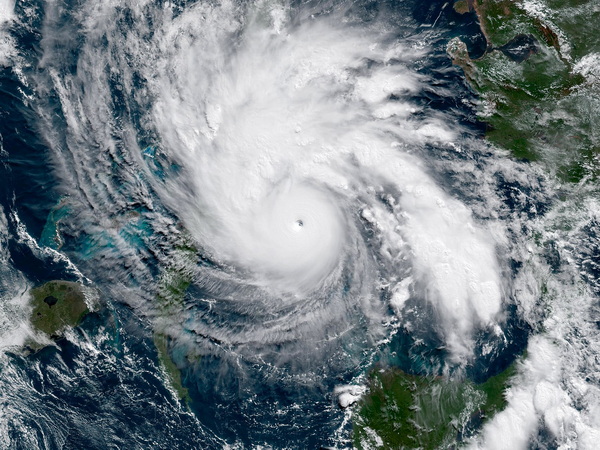
Category 5 Hurricane Melissa at peak intensity before landfall, Oct 28, 2025. (NOAA GOES-19 satellite image.)
Where Aquifers Endure and Rivers Remember:
The Limits of Human Engineering
Following Hurricane Melissa, after much of the floodwaters receded across the island, some sections not only remained flooded, but have continued to experience rising levels of water. In one example, a settlement called Content, located in the parish of Manchester in Central Jamaica, has seen floodwaters rise by over 100 meters (330 feet) since the storm. This settlement, home to hundreds of residents, had multistory buildings completely inundated. This was not due to infrastructure failure but to natural recharge from sustained rainfall. The aquifer absorbed vast volumes of water, redistributed it underground, and began a slow, self-regulated recession process. According to Jamaica’s national water resources regulatory body, the Water Resources Authority (WRA), “the water has risen in excess of seven feet… roughly a foot per day over the last seven days”. The aquifers recharge paralleled similar situations in other regions where previously diverted rivers have reclaimed their old courses.
This behavior illustrates the resilience and buffering capacity of natural hydrological systems. While hurricane Melissa was not the first event leading to rising flood waters in these areas, this was the first time in decades that this occurred. Previous events saw natural reduction of flood waters through its autonomous regulation. Aquifers are designed to absorb, store, and gradually release water, and they function in this way, operating without pumps, sensors, or software. The ‘memory’ stored in these systems outperforms the resilience of paved asphalt and concrete, despite the ingenuity of human engineers’ attempts to control these systems. These human-engineered systems in the area were overwhelmed. Despite monitoring and data collection, there is little that can be done to reduce the water levels, until its autonomous regulation reverses the flooding.
Beyond the comparative resilience of the natural environment, these drastic changes expose a deeper truth: catastrophic processes can reshape entire landscapes in mere days. Massive erosive structures, changed river courses, and associated geophysical processes, once assumed to require millions of years of gradual change, have appeared almost overnight. This shows the problem of catastrophic systems present for scientists seeking to accurately account for environmental changes when they were not there to observe what actually happened. Centuries from now, geologists studying Jamaica’s post-hurricane topography, absent any record of the storms themselves, might easily conclude that these dramatic landforms were carved slowly, uniformly, over eons, rather than in a single cataclysm.
Scavengers to Hunt: Journalists Highlight Nature’s Cleanup Crew
In the aftermath of Hurricane Melissa, John Crows (Jamaica’s native turkey vultures) have been spotlighted for their potential role in removing carrion and preventing disease spread. A recent commentary in the Jamaica Gleaner provocatively titled “John Crows to the Rescue” noted that these scavengers, often maligned in folklore, are in fact essential to post-disaster sanitation. [See Ilustra Media’s video about the ecological role of vultures.]
Watch and share the Short Reel about this article! Click to view it now.
During the hurricane’s aftermath, with 22 communities still inaccessible and many carcasses remaining unrecovered, the idea of deploying John Crows to assist in cleanup was floated. While emotionally difficult, this underscores a deeper truth: these birds are biologically equipped to neutralize pathogens that would otherwise pose serious public health risks. Their stomach acid is so corrosive it can kill anthrax, botulism, and cholera bacteria – something no engineered waste management system can replicate without complex infrastructure.
While scavengers such as John Crows would not be meat-eaters until after the Fall, their function cannot be explained by evolution. How and why would scavengers evolve with precisely the right physiological tools to sanitize ecosystems after death and disasters? Amidst death, scavengers are positioned as agents of ecological restoration.
The Birds and the Bees: Pollination Under Pressure
Complementary to the discussion on scavengers, the desiccation of many trees in Western Jamaica has created a crisis for bees which have reportedly migrated toward Eastern Jamaica in search for habitats. With estimates of tens of thousands of bee colonies affected in Jamaica, some local and international groups are focusing on restoring bee populations to aid in Jamaica’s recovery process.
Bees, unlike robotic pollinators still in experimental stages, navigate complex floral landscapes, communicate through dance, and adapt to shifting bloom patterns. An October 2025 publication in the journal Computers and Electronics in Agriculture shows that even advanced robotic pollinators still require manual operation. In contrast, bees possess decentralized intelligence, and their colony-level coordination is unmatched by any AI system. Bees therefore exemplify how biological systems are built to flex, adapt, and recover.
Design Amidst Disaster
While Jamaicans continue to pick up the pieces after hurricane Melissa, the lesson remains that humans remain dependent on our Creator to sustain and protect us. Nature presents marvels that remind us of the limits of our infrastructure, show ingenuity, and provide inspiration in the rebuilding process. Scavengers and pollinators further provide robust systems that surpass the efficiency of manmade machines in ecosystem recovery. With such immense efforts to create manmade machines, how could these creatures be evolutionary accidents?
As the Jamaican government has acknowledged our dependence on our Creator, they have proclaimed November 15 and 16 as national days of prayer. As we seek to honour God and rebuild, do remember our nation in prayers, and if you feel so led, please donate supplies through an existing charity to Jamaica, or through the Government of Jamaica’s official portal: supportjamaica.gov.jm (Support Jamaica – Official Disaster Relief & Recovery Portal).
 Dr. Sarah Buckland-Reynolds is a Christian, Jamaican, Environmental Science researcher, and journal associate editor. She holds the degree of Doctor of Philosophy in Geography from the University of the West Indies (UWI), Mona with high commendation, and a postgraduate specialization in Geomatics at the Universidad del Valle, Cali, Colombia. The quality of her research activity in Environmental Science has been recognized by various awards including the 2024 Editor’s Award from the American Meteorological Society for her reviewing service in the Weather, Climate and Society Journal, the 2023 L’Oreal/UNESCO Women in Science Caribbean Award, the 2023 ICETEX International Experts Exchange Award for study in Colombia. and with her PhD research in drought management also being shortlisted in the top 10 globally for the 2023 Allianz Climate Risk Award by Munich Re Insurance, Germany. Motivated by her faith in God and zeal to positively influence society, Dr. Buckland-Reynolds is also the founder and Principal Director of Chosen to G.L.O.W. Ministries, a Jamaican charitable organization which seeks to amplify the Christian voice in the public sphere and equip more youths to know how to defend their faith.