


Another Australopithecus, Another Debunking
Was this ape a missing link? The
evidence shows diversity among
extinct apes, not a lineage toward man.
A Half-Century Old Claim of Human Evolution Trashed
by Jerry Bergman, PhD
One claim that is regularly stated in paleontological literature is ‘New fossil discovery is changing the human family tree’… again.[1]
The evolution of clams, sponges, or spiders may generate some interest, but the main concern that generates headline-level interest is the impact it has on the beliefs about the evolution of man. In this instance, the discovery of Australopithecus deyiremeda fossils may upend a half-century old icon of evolution. A Google search about the fossils has generated several scores of new articles.[2]
What is Australopithecus deyiremeda?
Australopithecus deyiremeda fossils were discovered in Ethiopia’s Woranso-Mille area. They were first identified in 2015 from fragments that were found in 2011 by Yohannes Haile-Selassie’s team. Haile-Selassie is at the Institute of Human Origins and School of Human Evolution and Social Change, Arizona State University, Tempe, AZ.
Determined to be a new hominin species that coexisted with A. afarensis (Lucy’s species), the find has challenged previous beliefs that only the Lucy primate kind lived at this time in history.[3]
This find documents the conclusion that much diversity existed in the Australopithecus family. It also supports the growing evidence that the claimed evolutionary progression from chimp to modern man does not exist (see illustration).
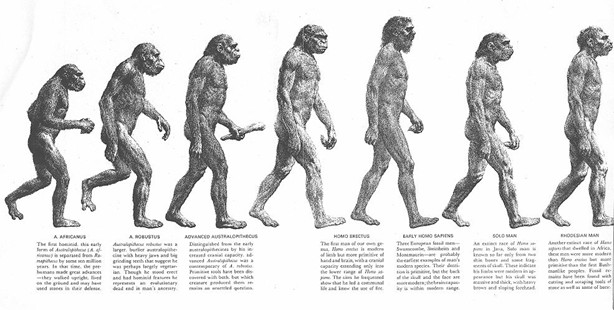
The now refuted evolutionary progression allegedly showing evolution from ape to human. From Wikimedia Commons.
Rather, what exists is another type of extinct Australopithecus primate. The evidence leads to the conclusion that the ape—A. deyiremeda—was not evolving toward modern hominin but rather it was, “dentally and postcranially more primitive than A. afarensis [Lucy], particularly in aspects of canine and premolar morphology, and in its retention of pedal grasping traits.”[4]
The Fossil Evidence for Australopithecus deyiremeda
A total of 25 fossils, mostly jaw and teeth fragments, were found. They possessed unique features shared with the Lucy family kind (Australopithecus afarensis), including a robust jaw, thick tooth enamel, small canines, and a grasping foot, which allowed them to climb trees.[5] These traits document that the animal was living in woodland, not in open area habitats, as was Lucy.
Why Is This Find Important?
To many people, this and other similar finds are critically important because they support belief in human evolution. It is especially important to evolutionists because they have dedicated their work and lives to the belief that we evolved and were not created, as the Bible teaches. Thus, the details and implications about any alleged “hominin” find and must be revealed to the public very judiciously so as not to upset the narrative about human evolution.
Notice how the quotations reproduced below were very carefully worded by the evolutionists to reduce hints of doubt about human evolution. I emphasize examples by adding italics and, in a few cases, by adding boldface. Instead of openly admitting, “We were wrong,” evolutionists blunt the bad news in terminology. In court, lawyers do this by saying a witness “misspoke” instead of calling him a liar.
“While Australopithecus afarensis has long been considered an ancestor of all later human species, including our own, new research suggests that might not be the case. One of the most recognizable names in human evolution might not be as related to us as we thought.”[6]
“When it was discovered in 1974, the Australopithecus afarensis fossil that came to be called ‘Lucy’ was heralded as one of the first humans. For more than 50 years, this skeleton has graced the halls of museums around the world as a landmark in our journey to becoming Homo sapiens.
More recent discoveries have slightly altered this picture. These suggested that while Lucy was not one of the earliest humans, her species was still thought to be an ancestor to our own lineage.”[7]
“However, newly studied remains from another species of ancient hominin, known as Australopithecus deyiremeda, have called even this into question. It now seems more likely that this species instead descended from an earlier member of the family, Australopithecus anamensis. If that’s the case, then A. afarensis might not be the ancestor of all later human species. Dr. Fred Spoor, one of our Research Leaders in human evolution, says that this idea “will cause quite a stir” among scientists.[8]
“For decades, we’ve been inundated with textbooks and documentaries that say that Lucy and her relatives are our ancestors,” Fred explains. “Even when A. anamensis was named, it was seen as the ideal ancestor for A. afarensis, so [it] was slotted into the evolutionary tree behind it.”[9]
“The new research suggests that A. anamensis wasn’t just the ancestor of Lucy, but that many other human species could descend from it as well – including our own. … This unexpected result suggests that, contrary to decades of scientific thought, Lucy’s species might not have been the ancestor of all later and our own genus, Homo.[10]
Summary
A. deyiremeda is another example illustrating diversity in the Australopithecus family. In this way they are no different than dogs, cats and many other creatures that display variation within their kinds. Although it’s claimed to be part of the human family tree—and thus named a hominin—no solid evidence exists to support this claim. What was actually found was an Australopithecus species, which evolutionists have judged as more primitive (dentally and postcranially) than A. afarensis [Lucy].

Instead of an evolutionary progression as shown above, what is found in the fossil record is several distinct families of primates. From Wikimedia Commons.
References
[1] Ashworth, James. “New Australopithecus fossils found in Ethiopia are changing the human family tree,” https://www.nhm.ac.uk/discover/news/2025/november/early-hominin-australopithecus-afarensis-may-not-be-our-human-ancestor.html, 26 November 2025.
[2] Haile-Selassie, Yohannes, et al., “New finds shed light on diet and locomotion in Australopithecus deyiremeda,” Nature 648:640-648, https://www.nature.com/articles/s41586-025-09714-4, December 2025.
[3] Spoor, Fred, et al., “Middle Pliocene hominin diversity: Australopithecus deyiremeda and Kenyanthropus platyops. Philos Transactions of the Royal Society of London B Biological Science 371(1698): 20150231, 2016.
[4] Haile-Selassie, 2025, p. 640; italics added.
[5] Haile-Selassie, 2025, p. 642.
[6] Ashworth, 2025.
[7] Ashworth, 2025.
[8] Ashworth, 2025.
[9] Ashworth, 2025
[10] Ashworth, 2025.
 Dr. Jerry Bergman has taught biology, genetics, chemistry, biochemistry, anthropology, geology, and microbiology for over 40 years at several colleges and universities including Bowling Green State University, Medical College of Ohio where he was a research associate in experimental pathology, and The University of Toledo. He is a graduate of the Medical College of Ohio, Wayne State University in Detroit, the University of Toledo, and Bowling Green State University. He has over 1,900 publications in 14 languages and 40 books and monographs. His books and textbooks that include chapters that he authored are in over 1,800 college libraries in 27 countries. So far over 80,000 copies of the 60 books and monographs that he has authored or co-authored are in print. For more articles by Dr Bergman, see his Author Profile.
Comments
I’ve seen the (in)famous picture of man evolving portrayed in media and pop-culture. It’s a shame it hasn’t been observed. In order to spread lies and falsehoods, you must repeat it over and over again.
I remember as a teen in the mid 1970’s our church youth group being told by an MD that also attended about Lucy. He explained how his specialty on the subject of skeletal structure allowed him to see the false claims being promoted about the find. I appreciated having him around!