


The Brain Cannot Evolve Piece by Piece
The brain operates as an integrated,
irreducibly complex, multifunctional unit
The Brain: A System That Cannot Evolve Piece by Piece
Additional Evidence for Irreducible Complexity
by Jerry Bergman, PhD
Introduction
Irreducible complexity (IC) is the observation that living systems require a minimum set of coordinated parts in order to function. When AI was asked whether this principle is valid, it replied: “Yes, all life requires a certain minimum number of parts to function, with the cell being the fundamental unit of life. Below this level of complexity, life cannot exist.”
The fact and reality of irreducible complexity has also been verified experimentally by scientists at the J. Craig Venter Institute. Their scientists assembled a self-replicating synthetic bacterial cell with a stripped-down genome containing a whopping 531,000 base pairs organized into 473 genes.[1] This represented the minimal genetic complement required to sustain a “simple” living cell capable of growth and reproduction in a nutrient-rich laboratory environment.
Specifically, they removed the original genome from an already functioning cell—leaving all components other than the genome itself in place—and replaced it with a synthetic genome, which was built in the lab (with some modification) from Mycoplasma mycoides.
Now Greatly More Irreducible and Functionally Complex
Another example can be added to the many known examples of IC: the human brain. The problem was “For decades, scientists have mapped attention, memory, language, and reasoning to separate brain networks — yet one big mystery remained: why does the mind feel like a single, unified system?”[2]
Another difficulty for evolutionary explanations is the existence of human language. Only humans possess true language, creating a vast cognitive gap between humans and all other forms of life, including the primates most closely related to us.[3] For more than a century, the prevailing evolutionary assumption was that the brain is essentially a collection of specialized systems. Functions such as attention, perception, memory, reasoning, and language, were believed to be specifically controlled by designated brain areas. As a result, these systems were typically studied in isolation.
A report from the University of Notre Dame presents compelling evidence that the long held belief that “specific function is located in one specific area of the brain” is wrong.
 The network architecture of general intelligence in the human connectome (Wilcox et al., Nature Communications, 26 Jan 2026). The report concluded that “intelligence doesn’t live in one ‘smart’ region of the brain at all. Instead, it emerges from how efficiently and flexibly the brain’s many networks communicate and coordinate with each other.”[4]
A summary of this paper was published by ScienceDaily (3 March 2026) under the title, “Intelligence emerges when the whole brain works as one.” It was based on a press release from the University of Notre Dame (28 Jan 2026).
Why Darwinians Need a Theory of Language Evolution
The importance to Darwinians of explaining language was described by W. Tecumseh Fitch in his 2010 book, The Evolution of Language:
Language, more than anything else, is what makes us human. … no communication system of equivalent power exists elsewhere in the animal kingdom. Any normal human child will learn a language based on rather sparse data in the surrounding world, while even the brightest chimpanzee, exposed to the same environment, will not. … Since Darwin’s theory of evolution, questions about the origin of language have generated a rapidly-growing scientific literature, stretched across a number of disciplines, … Fitch cuts through this vast literature, bringing together its most important insights to explore one of the biggest unsolved puzzles of human history.[5]
Furthermore, the relationship between language and general intelligence is considered one of the most important and “fundamental and enduring questions in modern science.” For decades, scientists believed that language was produced primarily by a single region of the brain, the Broca’s area, located in the posterior inferior frontal gyrus of the brain’s left hemisphere. The new research by Wilcox et al., however, has produced experimental evidence that language does not arise from one isolated area. Rather, it emerges from the coordinated activity of networks distributed throughout the entire brain.
Implications of the Notre Dame Study
This discovery has the potential to transform our understanding of how the brain functions. Consequently, to claim that the brain and its many functions evolved as a unit, as the Notre Dame research implies, results in the probability that the “biggest unsolved puzzles of human history” is now many times greater than once believed.
If language and intelligence arise from the integrated operation of many interconnected systems—as research reported by the University of Notre Dame supports—then explaining how such a highly coordinated complex system could evolve step by step becomes an even greater challenge to evolution. The problem may, therefore, extend far beyond the origin of language itself, touching on some of the largest unsolved questions about the origin and nature of human cognition.
The Scientific Evidence for This Conclusion
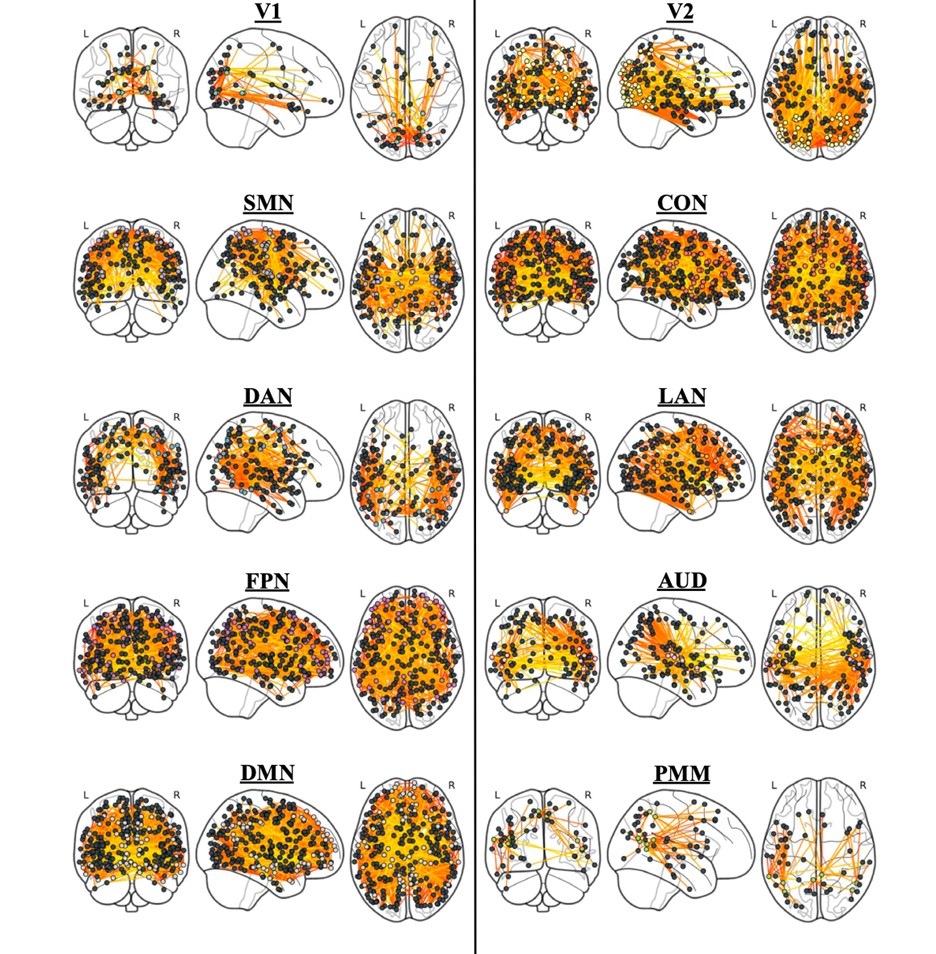
Data from the Human Connectome Project map of the neural pathways in the healthy adult human brain. This map identifies both structural and functional connections using functional Magnetic Resonance Imaging (fMRI). This technique includes both resting-state (rfMRI) and task-based (tfMRI) to map the human brain’s functional and structural connectivity to study how different brain regions interact.
Functional Magnetic Resonance Imaging works by detecting changes in blood flow and blood oxygen level which map brain activity. When neurons become active, they consume more oxygen, prompting increased blood flow to that region of the brain. The scanner detects these changes by detecting strong magnetic force fields, allowing researchers to identify patterns of brain activity.
Using this method, scientists can map distinct brain subdivisions and the neural systems involved in functions such as language. The project analyzes data from approximately 1,200 subjects to chart the brain’s “wiring” (white matter tracts) and patterns of activity (functional networks). This map helps researchers better understand brain organization, behavior, and genetics.[6] The results from these fMRI scans are shown in the accompanying picture.
Summary
The evolution of language in humans is widely regarded as one of the most difficult problems for evolutionary theory.[7] In the past, neuroscientists often described the brain as a collection of specialized, but largely separate systems. For this reason, neuroscientists have for decades normally studied these brain systems individually. Brain functions, such as language, were commonly explained as the result of separate or mosaic evolution, in which different cognitive abilities evolved somewhat independently and evolved to become associated with specific neural networks. A good example of a researcher in this field is Boston University neuroscientist Andrey Vyshedskiy, Ph.D. [8]
The result of the University of Notre Dame project is a clearer understanding of how “efficiently and flexibly the brain’s many networks communicate and coordinate with each other.”[9] The fMRI analysis produces clear evidence that language processing and production do not reside in a single region of the brain. Instead, it involves widely distributed networks across the brain. This finding is a game changer and has major implications, not only for theories about the evolution of language but also for our understanding of brain function as a whole. If language and intelligence arise from the integrated and coordinated activity of many interconnected brain systems, this presents a much greater challenge for evolutionary explanations because it suggests that the brain operates as an integrated, irreducible functional unit. In order for an organism to survive, the brain would need to remain functional throughout the entire evolutionary process.
References
[1] Glass, John, “First Minimal Synthetic Bacterial Cell,” https://www. jcvi.org/research/first-minimal-synthetic-bacterial-cell, 2016.
[2] University of Notre Dame, “Intelligence emerges when the whole brain works as one,” ScienceDaily, www.sciencedaily.com/releases/2026/03/260303050632.htm, 3 March 2026.
[3] Bergman, Jerry, “Is Language an Exclusive Ability of Man?,” Creation Research Society Quarterly 17(4): 214-216, p. 226, March 1981.
[4] University of Notre Dame, 2026.
[5] Finch, W. Tecumseh, The Evolution of Language, Cambridge University Press, Cambridge, UK; quote from back cover.
[6] Wilcox, Ramsey R., et al., “The network architecture of general intelligence in the human connectome,” Nature Communications 17(1). DOI: 10.1038/s41467-026-68698-5, 26 January 2026.
[7] Bergman, Jerry, “The Human Mind and Language.” Creation Research Society Quarterly 31:91, September 1994.
[8] Vyshedskiy, Andrew, The Evolution of Language: How the Brain Evolved Syntactic Language from Early Mammals to Homo sapiens, Cambridge University Press, Cambridge, UK.
[9] University of Notre Dame, 2026.
 Dr. Jerry Bergman has taught biology, genetics, chemistry, biochemistry, anthropology, geology, and microbiology for over 40 years at several colleges and universities including Bowling Green State University, Medical College of Ohio where he was a research associate in experimental pathology, and The University of Toledo. He is a graduate of the Medical College of Ohio, Wayne State University in Detroit, the University of Toledo, and Bowling Green State University. He has over 1,900 publications in 14 languages and 40 books and monographs. His books and textbooks that include chapters that he authored are in over 1,800 college libraries in 27 countries. So far over 80,000 copies of the 60 books and monographs that he has authored or co-authored are in print. For more articles by Dr Bergman, see his Author Profile.
Comments
Always appreciate your articles, Dr. Bergman. One question on this one. In the second paragraph, you use the word “created” to describe what Craig Venter did in his lab, saying “Their scientists created a self-replicating synthetic bacterial cell..” I think that’s a little generous.
I may be in error, but as I understand it, they simply removed the original genome from an already functioning cell–leaving all components other than the genome itself in place–and replaced it with a synthetic genome, which was built in the lab, but not original work, having essentially been copied (with some modification) from Mycoplasma mycoides.
Thank you for the comment. Dr Bergman agrees, so we changed the word “created” into “assembled” and added another explanatory sentence: “Specifically, they removed the original genome from an already functioning cell–leaving all components other than the genome itself in place–and replaced it with a synthetic genome, which was built in the lab (with some modification) from Mycoplasma mycoides.”