


Sea Turtle Stampede: Local Event or Global Flood?
Rapid burial was clearly essential to preserve
more than 1,000 delicate paddle prints – strong
evidence that fast sedimentation occurred here
by Ronald Fritz, PhD
Trace fossils (also called ichnofossils) are preserved signs of animal activity — footprints, tracks, burrows, feeding marks, and similar traces left behind by organisms. In many ways, they are like wet footprints in the sand: fragile, temporary, and quickly erased. Because of this, they should be extremely rare.
But they’re not.
In fact, trace fossils are among the most common and widespread fossil types in the geologic record. They are frequently found on bedding planes (the surfaces between sedimentary rock layers), but they also occur within individual layers.
A fascinating new example was recently discovered in Italy.1 The find is described in the article:
 “Hikers stumble upon evidence of a sea turtle stampede from 80 million years ago.” (Eric Ralls, Earth.com,, 5 May 2026).2 A spectacular ichnofossil discovery was made in the Monte Conero anticline near Ancona, in Italy’s Marche region: over a thousand of sea turtle paddle prints on a limestone slab exposed to the air. The article struggles to fit them into a long-age narrative.
As the article explains:
Free climbers … noticed something odd on a broad slab of limestone… many deep, paddle-like footprint tracks packed together on one surface.
Researchers believe:
The footprints probably represent a stampede of panicking sea turtles that were mobilized en masse by an earthquake. These tracks were subsequently covered by a fluxoturbidite triggered by the same earthquake.
A fluxoturbidite is essentially a fast-moving underwater mudflow or sediment avalanche.
Scientists conclude the tracks formed on a deep open-ocean “pelagic seafloor,” hundreds of meters underwater and far from land. The turtles were calmly “half-swimming” (punting along the seafloor with their flippers) when an earthquake startled them into a frantic stampede. Moments later, a dense mudflow rapidly buried and preserved their tracks.
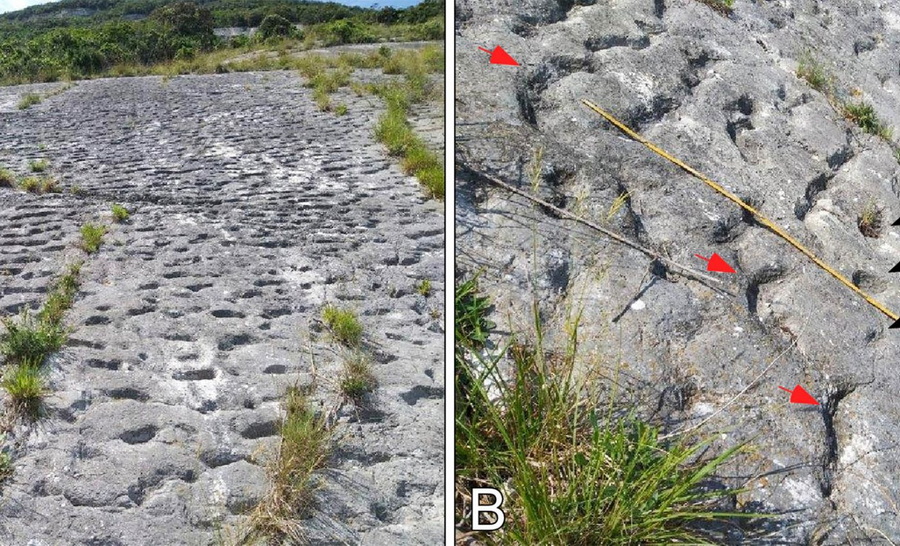
Turtle prints on a limestone slab in Italy, from the Earth.com article.
Anyone Believe This Story?
The mainstream interpretation dates this event to roughly 80–83 million years ago using microfossils and magnetic signatures. In that view, the tracks were first rapidly buried by the earthquake-triggered mudflow (turbidite), which preserved them. Additional sediment then accumulated slowly above them over millions of years, turning the layer into solid rock. Tectonic uplift and erosion eventually exposed the slab at Monte Conero, a prominent limestone promontory on Italy’s Adriatic coast.
But what if this same evidence is viewed through a different lens — one not tied to slow processes over millions of years, interrupted only by rare, perfectly timed events?
What if, instead, these events were all part of one massive, planet-scale catastrophe?
The mainstream view already requires a sudden violent event to explain both the turtles’ frantic stampede and the rapid burial that preserved the tracks. Yet it insists that such events must be rare, isolated, and unrelated — brief interruptions in an otherwise calm, stable deep-sea environment lasting tens of millions of years.
Incredible Implications
This creates a major challenge for the standard deep-time model.
Trace fossils like these occur all over the world and throughout the geologic column. If every delicate trackway, footprint surface, or mass stampede requires an unusual rapid-burial event, then the deep-time model must invoke enormous numbers of special catastrophes scattered across the globe and spread over immense spans of time.
A global Flood model, by contrast, naturally predicts exactly this pattern: widespread, repeated episodes of high-energy sedimentation as waters rose and receded, capturing short-lived markings on a massive scale.

Sea turtles swim; they do not normally paddle on the seafloor, not in numbers like this. (Credit: Illustra Media)
The Monte Conero sea turtle tracks vividly illustrate the challenge. Rapid burial was clearly essential to preserve more than 1,000 delicate paddle prints, and the thin turbidite layer provides strong evidence that fast sedimentation occurred. Even though the researchers propose that an earthquake both startled the turtles and triggered the mudflow, it remains remarkable that thousands of fragile impressions on soft seafloor mud survived long enough to be preserved.
The scientific literature itself acknowledges how unusual the discovery is. The paper describing the tracks calls them “unique for this period and rare for the deep seabed paleoenvironment”1, while a related 2023 study on similar marine reptile tracks found in the same area concluded:
“The extreme rarity of ichnofossils of tetrapods on the deep-sea bottom in the whole world is herein confirmed.”3
And importantly, the Monte Conero discovery is far from an isolated case. Similar patterns of panic behavior, mass movement, and rapid burial appear repeatedly throughout the geologic column in both trace fossils and massive bonebeds.
Trace Fossil Trackways Suggesting Panic or Mass Movement
- Lark Quarry, Australia (Cretaceous): More than 3,000 dinosaur footprints appear to record a mass stampede. The tracks shift suddenly from calm movement to frantic running and then were rapidly buried by sediment. Mainstream scientists commonly interpret the site as animals fleeing a predator — though one might also ask whether the animals were fleeing the very catastrophe that buried their tracks.4
- Dinosaur Freeway / Dakota Group, Colorado–New Mexico (Early Cretaceous): Hundreds of parallel dinosaur trackways suggest large groups moving together, with evidence of hurried movement followed by rapid sediment burial.5
- Paluxy River Trackways, Texas (Early Cretaceous): Sauropod (plant eaters) and theropod (meat eaters) trackways preserve animals running along shorelines before sudden burial by flood sediments.6
- El Molino Formation, Bolivia (Cretaceous): One of the world’s largest track sites, containing roughly 18,000 theropod tracks preserved through rapid burial.5
- Prehistoric Trackways National Monument, New Mexico (Early Permian): Thousands of amphibian, reptile, and insect trackways preserved on multiple layers through repeated rapid burial events.7
- West Gold Hill Dinosaur Trackway, Colorado (Late Jurassic): The world’s longest continuous sauropod trackway — extending more than 100 yards — including a dramatic directional turn preserved by rapid sedimentation.8
Dinosaur Bonebeds and Mass-Death Deposits: Evidence of Widespread Catastrophe
- Hilda Mega-Bonebed & Pipestone Creek (“River of Death”), Alberta, Canada (Late Cretaceous): Thousands of centrosaurine and Pachyrhinosaurus dinosaurs buried together in what mainstream researchers interpret as catastrophic flooding.9
- Hanson Ranch Bonebed, Wyoming (Late Cretaceous): An estimated 10,000–25,000 Edmontosaurus bones preserved in a massive deposit interpreted as a herd rapidly buried during a flood event.10
- Dinosaur National Monument “Wall of Bones,” Utah/Colorado (Late Jurassic): More than 1,500 disarticulated dinosaur skeletons jammed together and rapidly buried in flood sediments.11
- Dinosaur Death Pits, Shandong, China (Middle Jurassic): At least 18 small theropod dinosaurs were trapped and rapidly buried inside the giant footprints of much larger sauropods (long-necked dinosaurs). The enormous, deep sauropod footprints acted like death traps — where the smaller, lighter theropods fell into the soft, muddy pits and couldn’t climb out being quickly buried by sediment.12
- Dalton Wells Bonebed, Utah (Early Cretaceous): A debris-flow bonebed containing multiple dinosaur species rapidly buried in a catastrophic sediment flow.13
The mass stampede behavior and rapid preservation at Monte Conero are not unusual anomalies — they are part of a consistent global pattern. When combined with dozens of similar trackways and massive bonebeds found throughout the geologic column, the evidence fits far more naturally with a single, planet-scale watery catastrophe than with countless isolated “rare events” — each one requiring its own perfectly timed coincidence of panic, track formation, and immediate burial — scattered across deep time.
From a Flood perspective, the Monte Conero sea turtle stampede is simply one more local snapshot of the enormous high-energy processes that operated during Noah’s Flood.
In the end, rocks do not come with built-in biographies. They preserve what actually happened: sudden widespread panic, frantic stampedes, rapid burial of delicate traces, and massive death deposits found throughout the geologic column. These features — including the deep-sea turtle stampede — are exactly what one would expect from one great global watery catastrophe. They are far more difficult to explain as the result of countless isolated, local disasters scattered across deep time.
Which lens are you looking at the evidence through?
References
1. Sandroni, P., Church, N. S., Coccioni, R., Frontalini, F., Mainiero, M., & Montanari, A. (2026). Reptile footprints on a pelagic seafloor as a vestige of a synsedimentary seismic event in the lower Campanian Scaglia Rossa basin of the Umbria-Marche Apennines (Italy). Cretaceous Research, 179, Article 106268. https://doi.org/10.1016/j.cretres.2025.106268
2. Ralls, E. (2026, May 5). Hikers stumble upon evidence of a sea turtle stampede from 80 million years ago. Earth.com. https://www.earth.com/news/fossil-tracks-sea-turtle-stampede-evidence-monte-conero-italy-80-million-years-ago/
3. Natali, L., & Leonardi, G. (2023). Coneroichnus marinus ichnogenus et ichnospecies nov., a fossil trackway of marine reptile in the Maiolica Formation (Upper Jurassic–Lower Cretaceous) from Monte Conero, Marche, Italy. Revista Brasileira de Paleontologia, 26(3), 156–171. https://doi.org/10.4072/rbp.2023.3.02
4. Thulborn, R. A., & Wade, M. (1984). Dinosaur trackways in the Winton Formation (mid-Cretaceous) of Queensland. Memoirs of the Queensland Museum, 21, 413–517. Romilio, A., Salisbury, S. W., & Kear, B. P. (2013). Reevaluation of the Lark Quarry dinosaur tracksite (late Albian–Cenomanian Winton Formation, central-western Queensland, Australia). Journal of Vertebrate Paleontology, 33(1), 102–120.
5. Lockley, M. G., et al. (various papers, especially 1980s–2010s). Key reference: Lockley, M. G., & Hunt, A. P. (1995). Dinosaur tracks and other fossil footprints of the western United States. Columbia University Press.
6. Bureau of Economic Geology, University of Texas at Austin. (n.d.). Paluxy River Trackways. Retrieved from https://www.beg.utexas.edu (or specific ichnology reports on the Glen Rose Formation).
7. MacDonald, J. (various reports). Prehistoric Trackways National Monument, Bureau of Land Management (BLM), New Mexico.
8. S. Forest Service. (2024). West Gold Hill Dinosaur Trackway discovery announcement.
9. Eberth, D. A., & Getty, M. A. (2005). Ceratopsian bonebeds: occurrence, origins, and significance. In P. J. Currie & E. B. Koppelhus (Eds.), Dinosaur Provincial Park: A spectacular ancient ecosystem revealed (pp. 501–536). Indiana University Press. Bamforth, E. L., et al. (recent papers on Hilda and Pipestone Creek bonebeds).
10. Chadwick, A. V., et al. (various reports, especially Hanson Ranch bonebed studies, ~2020–2023).
11. Carpenter, K. (1988). Taphonomy of the Carnegie Quarry, Dinosaur National Monument. Annals of Carnegie Museum. National Park Service. (ongoing). Dinosaur National Monument Quarry Exhibit Hall documentation.
12. Xing, X., et al. (2010). Dinosaur death pits from the Jurassic of China. Palaios, 25(2), 112–125.
13. Britt, B. B., et al. (various papers). Dalton Wells Bonebed, Utah (Cedar Mountain Formation)

Ronald D. Fritz, PhD, is a retired research statistician whose career spanned 27 years. Before entering the field of statistics, he worked as an engineer and engineering manager in the defense industry. He earned his doctorate in Industrial Engineering, with a minor in Mathematical Statistics, from Clemson University, where he was honored as a Dean’s Scholar. Dr. Fritz served as a consulting statistician across a broad range of industries, culminating in a 12-year role as a global statistical resource at PepsiCo. During his time at PepsiCo, he led significant research on gluten contamination in oats and its relationship to celiac disease, publishing several articles on the subject.
In retirement, Dr. Fritz developed a deep interest in creation science, sparked by a visit to the Creation Museum in Petersburg, Kentucky. As he delved into the topic, he shared his findings with his pastor, which led to an invitation to speak at their church. This initial presentation opened the door to further speaking engagements at churches throughout the region. Dr. Fritz has been married for 35 years to his wife, Mitzie. They live in the mountain community of Bee Log, North Carolina, within sight of the church where they were married and now worship. In his free time, Dr. Fritz tends a small chestnut orchard on their property, working to revive what was once a cherished local delicacy. The couple has two adult children.
Comments
Great list of sites from around the globe relating to the Worldwide Flood. The Worldwide Flood is confirmed by other parts of Scripture (Matthew and Peter) as well as extrabiblical sources (Josephus is the main one that I think of) from the Middle East and the rest of the planet.
An article I found on the web in the past few days. The “80 million year old” age is extremely questionable. How would the fossil survive wind, erosion, geological, sun or water damage? “Pretty much all of the middle of America used to be underwater”. I will have to agree with him there. Actually, the whole earth was covered by the Worldwide Flood (10 generations after Creation (43-50 centuries ago)).