


Stone Tools Are Hard, Evolutionary Dates Are Soft
This story illustrates how tenuous
and assumption-dependent many
evolutionary dates can be
How to Explain Advanced Stone Tools Made by Early Humans: Add 20,000 Years
Revisionist Science At It Again
by Jerry Bergman, PhD
Scientists in China discovered that ancient humans were making surprisingly advanced stone tools during a harsh ice age 146,000 years ago. The tools, created by Homo juluensis, show careful planning and complex thinking rather than simple stone-chipping. Researchers dated the site using tiny calcite crystals inside animal bones, revealing the tools are much older than expected. The discovery challenges the idea that human creativity only thrives in easy, prosperous times
—ScienceDaily
Evolutionary theory often appeals to vast spans of time to explain the development of sophisticated human behavior. However, a recent discovery suggests that our putative primitive ancestors were more behaviorally advanced than previously assumed by evolutionists. One recent report concluded that “ancient humans were making surprisingly advanced stone tools during a harsh ice age” some 146,000 years ago.[1] The problem is that this is a full 20,000 years earlier than previously assumed. The solution? Revise the estimated age of the emergence of advanced stone tools by 15% — from approximately 126,000 years ago to about 146,000 years ago.
The Details of the Study
The study reviewed in this paper was conducted by Yuchao Zhao, assistant curator of East Asian archaeology at the Field Museum in Chicago. Zhao was the lead author of a paper examining stone tools discovered at Lingjing in northern China. Published in The Journal of Human Evolution, the report claims that the earliest sophisticated, systematic centripetal flaking system was discovered in eastern Eurasia. One major problem concerns the dating of the tools. Earlier estimates suggested that the Lingjing tools were no older than about 126,000 years. However, crystal analysis conducted by Zhao and his team was able to push the proposed age of the tools back by roughly 20,000 years, to approximately 146,000 years ago.
The revised date is also problematic because it places these early stone toolmakers in a far more hostile environment than archaeologists previous research had indicated.[2] Many archaeologists assumed that ancient humans in East Asia had not developed stone-tool technologies as sophisticated as those found in Europe or Africa—a view challenged by the Lingjing artifacts. From a creationist perspective, this finding is consistent with the view that all humans descended from our first parents. Therefore, we would expect sophisticated stone-tool technologies used by those living in East Asia to resemble those used by persons living in Europe or Africa.
The Lingjing Tool Technology Sophistication
Some of the stone cores were shaped on both sides. One side served as the striking surface, and the other was prepared to produce sharp flakes. The toolmakers shaped the cores in multiple stages while maintaining the angles necessary to create numerous cutting edges.[3] This process demonstrates careful planning and reasoning that go far beyond simple stone-chipping.[4]
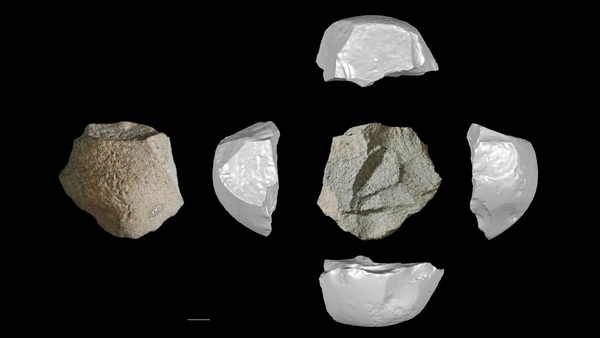
One of the 146,000-year-old stone cores used to make butcher’s tools, found in Lingjing, China. Credit: Yuchao Zhao
The Revised Dating Details and Problems
The revised dating was based on a medium-sized ungulate fossil rib containing calcite deposits. Eight calcite samples were collected for uranium-thorium (230Th) dating.[5] However, several problems can affect this dating technique.
One concern is detrital contamination from non-radiogenic impurities such as mud or aeolian dust, which can produce artificially old dates. These errors maybe substantial, in some cases as high as 100,000 years. The method also assumes the sample has remained a “closed system,” meaning that no uranium or thorium has been added or removed since the sample formed. Processes such as groundwater leaching or recrystallization can violate this assumption by altering isotopic ratios, thereby invalidating the results.
Highly porous or contaminated samples are especially difficult to date accurately, which appears to be the case with the mid-L11 rib. In addition, low initial uranium concentrations can limit the accumulation of daughter isotopes, making it more difficult to establish precise chronologies. Ideally, corrections for initial 230Th are made using isochron methods or stratigraphic constraints, but these approaches often require complex multi-sample analyses to produce reliable results.[6] Other potential concerns were noted in the study’s conclusion:
The late Middle Pleistocene (ca. 300–120 ka BP) heralded the transition from the Lower Paleolithic to Middle Paleolithic (MP) in western Eurasia and Africa (Early to Middle Stone Age) and substantial milestones in human evolution, including the gradual transition from Homo erectus to later forms [of humans]. However, recent fossil, genetic, and archaeological findings reveal a more complex evolutionary and behavioral landscape. This study further challenges this narrative by examining lithic technology at Lingjing (ca. 146–90 ka BP), northern China, a critical site for understanding human evolution in eastern Asia.[7]
One concern is the claim that northern China represents a “critical site for understanding human evolution in eastern Asia.” This wording implies that human evolutionary development proceeded differently in different regions of the world. The view that human evolution occurred at different rates in different parts of the world is often associated with what is called the theory of Multiregional Evolution.
Critics have noted that some earlier forms of multiregional thinking were connected to polygenic and racialized interpretations of human origins, which treated human groups as evolving along separate and unequal paths. In contrast, the modern scientific consensus holds that all humans share a common origin and belong to a single human family. This view is often referred to as monogenesis or common ancestry.
Monogenesis proposes that all human populations descended from a single ancestral population, in contrast to polygenism, which argued that the different races originated separately. Historically, this position was used by some proponents to support racist claims that certain races—especially the White race—were more highly evolved than other races, such as the Black race. However, modern genetics strongly supports the monogenesis view.
One important line of evidence for monogenesis is that genetic variation within human populations is often greater than the variation between populations. In other words, while physical differences among ethnic groups certainly exist, humans are genetically very similar overall. This finding strongly supports the unity of the human race.
Summary
Only a few of the potential problems involved in pushing sophisticated tool-making behavior in early humans back an additional 20,000 years were reviewed here. These concerns illustrate how tenuous and assumption-dependent many evolutionary dating conclusions can be.
—Ed. note: 20,000 years is over twice all recorded history, during which humans went from mud huts to the skyscrapers, from foot travel to space travel, and from log rafts to aircraft carriers. Accepting the evolutionary dates for these stone tools requires believing that their human designers, with bodies and brains equal to ours, never invented better implements for all that time.
References
[1] Field Museum, “Ice age humans in China crafted surprisingly advanced stone tools 146,000 years ago,” ScienceDaily, www.sciencedaily.com/releases/2026/05/260508003113.htm, 9 May 2026.
[2] Scott, Anastasi, “146,000-year-old butchering tools reveal creativity may have helped ancient humans adapt to the Ice Age,” Discover Magazine, https://www.discovermagazine.com/146-000-year-old-butchering-tools-reveal-creativity-may-have-helped-ancient-humans-survive-the-ice-age-49071, 2026.
[3] Scott, 2026.
[4] Field Museum, 2026.
[5] Kamrani, Kambiz, “The crystals in the bone changed everything at Lingjing,” https://www.anthropology.net/p/the-crystals-in-the-bone-changed, 2026.
[6] Garnett, E., et al., “230Th/234U dating of Holocene tufas: Possibilities and problems,” Quaternary Science Reviews 23(7-8):947-958.
[7] Zhao, Yu-chao, et al., “Earliest centripetal flaking system in eastern Eurasia reveals human behavioral complexity in late Middle Pleistocene China,” Journal of Human Evolution, in press, corrected proof, article 103841, published online 7 May 2026.
 Dr. Jerry Bergman has taught biology, genetics, chemistry, biochemistry, anthropology, geology, and microbiology for over 40 years at several colleges and universities including Bowling Green State University, Medical College of Ohio where he was a research associate in experimental pathology, and The University of Toledo. He is a graduate of the Medical College of Ohio, Wayne State University in Detroit, the University of Toledo, and Bowling Green State University. He has over 1,900 publications in 14 languages and 40 books and monographs. His books and textbooks that include chapters that he authored are in over 1,800 college libraries in 27 countries. So far over 80,000 copies of the 60 books and monographs that he has authored or co-authored are in print. For more articles by Dr Bergman, see his Author Profile.
Comments
In the biblical timeframe, these tools must have been made after the Dispersal from Babel.