

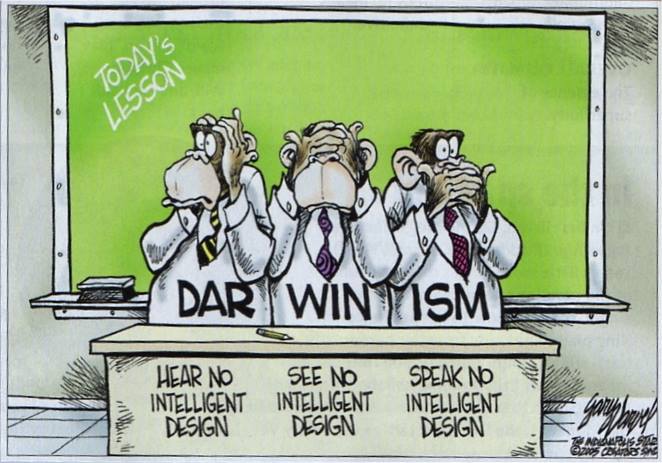

SCT: Darwinists Fear Validating Outsiders
There must be no hint of agree-
ment with any ideas emanating
from the intelligent design heretics
This article was first published in Science & Culture Today
Darwinists Afflicted by Fear of Validating Outsiders
by David Coppedge
Science & Culture Today, 14 May 2026
It used to be considered an ethical obligation of good scholarship to do a thorough literature search before writing a book or scientific paper, and to reference sources with opposing or supportive ideas. When it comes to topics related to origins, however, ignorance is bliss.
Among phobias and anxieties, you may have heard of FOMO, the Fear of Missing Out, or FOFO, the Fear of Finding Out. A new acronym I just coined is FOVO: the Fear of Validating Outsiders. When one’s opposition concerns origins, FOVO is considered almost a qualification for many scientists these days. There must be no hint of agreement with any ideas emanating from the intelligent design heretics! This is highly unfortunate, because it cuts off bountiful streams of information that could raise the scholarship in their scientific writings and journal book reviews. Ignore-ance of these sources increases ignorance: that is, deficient knowledge of the scope of the subject matter being discussed.
“A Masterpiece of Design”?
FOVO causes academics to repeat debunked notions. A case in point is Lucy Hyde’s article at The Conversation titled, “The human body isn’t a masterpiece of design — it’s a patchwork of evolutionary compromise.”
The human body is often described as a marvel of “perfect design”: elegant, efficient and finely tuned for its purpose. Yet, when we look closer, a rather different picture emerges.
Far from being a flawless machine, the body reads more like a patchwork of compromises shaped by millions of years of evolutionary tinkering. Evolution does not design structures from scratch. Rather, it modifies what already exists.
As a result, many aspects of human anatomy are just “good enough” solutions — functional, but far from perfect. Some of the most familiar medical problems and ailments arise directly from these inherited constraints.
This lecturer on anatomy at the University of Bristol knows that there are claims of good design out there. She could have done a simple literature search on the subject to find the best arguments for it. Or she could have stopped by the Faculty Club lunchroom. She ignored the work of Dr. Stuart Burgess — an award-winning biomimetics engineer at the very same university! — whose recent book Ultimate Engineering trounces every one of Hyde’s alleged examples of poor design as well as the evolutionary logic behind it….
Click here to continue reading.
 David Coppedge is a freelance science reporter in Southern California. He has been a board member of Illustra Media since its founding and serves as their science consultant. He worked at NASA’s Jet Propulsion Laboratory (JPL) for 14 years, on the Cassini mission to Saturn, until he was ousted in 2011 for sharing material on intelligent design, a discriminatory action that led to a nationally publicized court trial in 2012. Discovery Institute supported his case, but a lone judge ruled against him without explanation. A nature photographer, outdoorsman, and musician, David holds B.S. degrees in science education and in physics and gives presentations on ID and other scientific subjects.