


Spud Cell Is Not a New Artificial Life Form
The attempt illustrates a major
argument against chemical
evolution of a living cell
An Attempt to Create A Living Cell in the Laboratory Fails
by Jerry Bergman, PhD
A long-term goal in the attempt to prove abiogenesis, (the evolution of life from nonlife), is the creation of a living cell in the laboratory. The reasoning is that, if all that is required is the right chemicals which are assembled correctly, then scientists can create life in the lab without God.
 Any Progress?
So far, all laboratory attempts to create a living eukaryotic cell that reproduces on its own in the required nutrient broth, as occurs in all living cells, has failed. As Space Science & Astrobiology Division, NASA Ames Research Center researcher Lynn Rothchild, et al. wrote,
“The de novo construction of a living organism is a compelling vision. Despite the astonishing technologies developed to modify living cells, building a functioning cell “from scratch” has yet to be accomplished.”[1]
Wangyu Xu is from the School of Chemical Engineering and Technology at Tianjin University. In Biosafety and Health (2024), he commented,
“creating a completely artificial eukaryotic cell from scratch remains a monumental challenge.”[2]
He gave a reason for the challenge:
“The complexity of a eukaryote—which requires a membrane-bound nucleus and highly intricate, multiple chromosomes—makes ‘bottom-up’ synthesis incredibly difficult.”[3]
One reason why it is a challenge is because the eukaryotic cell is one of the most astonishingly intricate and highly organized structures known to science. The eukaryotic cell functions like a highly automated, microscopic metropolis that coordinates thousands of simultaneous biochemical reactions with absolute precision.
Unlike simpler prokaryotic cells, eukaryotic cells isolate their specialized processes within membrane-bound compartments called organelles. Austin Booth and Ford Doolittle began an article in 2015 with these words:
“Eukaryogenesis is widely viewed as an improbable evolutionary transition uniquely affecting the evolution of life on this planet.”
They proceeded to challenge that assumption in their article.[4] But at one point they confessed,
“The eukaryotic cell originated by the most complex set of evolutionary changes since life began: eukaryogenesis”[5]
A Play on Words: What Would an Artificial Cell Prove?
If humans succeed in constructing a living cell, this would not prove that a living cell could be made in a natural environment without intelligence. In fact, it proves the opposite: constructing a functional cell requires enormous intelligence.
Because humans can produce theater plays of the quality of Shakespeare does not mean that natural events can achieve the same feat. If all of the English letters existed in a print shop, they must be correctly assembled into words, the words assembled into grammatically correct sentences, the sentences arranged into paragraphs, the paragraphs into chapters, and the chapters into a book. The words and punctuation must be assembled by intelligence in the right order to produce a play such as “Romeo and Juliet.” And the cell is far more complex than a theater play.
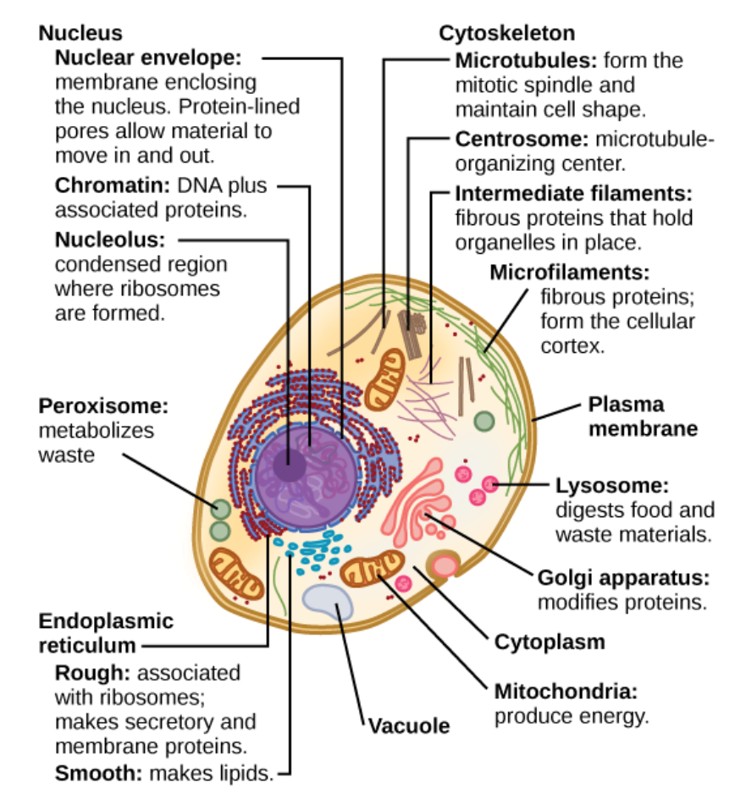
Parts of a eukaryotic cell, from Wikimedia Commons.
The Latest Attempt: SpudCell
The latest effort, which at first appeared to have successfully produced a living cell, occurred in a lab at the University of Minnesota. The tiny blob eats, grows, competes, divides, and replicates—nearly everything a living cell does. Called the SpudCell, its makers say it is the first synthetic cell to complete a full cellular life cycle.
The announcement of the synthetic cell earlier this month was met with a mix of shock and awe, with many asking whether it could be deemed alive. But after just five generations, SpudCell often fails—and some experts argue that perhaps it isn’t so close to life after all.[6]
The SpudCell Design
SpudCell is, in fact, “only a cell-like system” that was stitched together from a large set of nonliving parts. Only in a few ways does it resemble a living cell.
For example, it has a lipid membrane surrounding a small genome, as do living cells. It contains 36 purified enzymes, and a 90,000 base pair genome spread across nine separate DNA molecules.[7] It was built entirely bottom-up from individually purified, non-living components.
Although the enormously complex cell-like SpudCell system can perform a complete cell cycle, it fails to function as a normal cell. For example, SpudCell runs for only a few generations until the machinery degrades. Evidently, one reason it failed was that it lacked a cell self-repair system. The researchers admitted that, although “It can perform basic cellular functions, it falls very far short of life. It needs a lot of outside help to keep going, and even then, it can’t maintain its life cycle for more than a few generations.”[8]
No Ribosome, No Dice
Another reason the cell failed was that it lacked a crucial structure existing inside all eukaryotic cells called the ribosome. The SpudCell carried instructions for feeding, growing, copying, and cell division, but not for building ribosomes from scratch. The SpudCell lacked the required genes to produce a functional ribosome.
To assemble a ribosome from scratch is enormously complex. The researchers explained the ribosome building process by the following illustration: the DNA serves as the cookbook, the RNA as the recipe card, and the ribosome itself as the “chef” that assembles the finished product.[9]
Instead, the researchers borrowed ribosomes from Escherichia coli along with lipids and nutrients carried into the cell by liposome carriers. Building ribosomes from scratch required synthesizing dozens of proteins and RNA molecules, then causing them to assemble in the correct order and location on the ribosome.[10] These borrowed ribosomes keep SpudCells’ protein production going only for a very short time. After only five rounds of cell division, they deteriorate to the point that the cells are “limping along a little bit… We’re not able to get them to undergo successive rounds of division and behave as they did in the beginning.”[11]
Other Reasons for the Failure
Faulty inheritance could also be another problem that caused the cell’s failure. SpudCells’ genome was split across several separate DNA pieces rather than a single molecule, as in a living cell. Some of the synthetic cells may not have inherited a complete set of genes, which could explain the fact that, after five rounds, only about 30 percent of the cells inherited a full copy of the original genome.
Furthermore, an analysis determined that not every SpudCell component received every part required for each round of cell division. The reason is living cell divides through what is described as complex “exquisitely choreographed process” which the researchers have not been able to replicate. In contrast, SpudCell divides by a simpler mechanism, causing the proteins to crowd in its membrane until the stress forces it to separate into two cells.
Furthermore, the cell contents are packed together in an unorganized way.[12] Reproducing the required cellular order of structures is very important, but it was very difficult to achieve in the SpudCell. The SpudCell lacks this required high level of organization. The result is that when it divides, the cell parts will often not be distributed in the cell as required for it to function.
Summary
The fact is, as stated by the scientists involved in building SpudCell, “We’re pretty far away from something that’s fully self-replicating… But being able to build cells from the ground up could help researchers truly understand” the complexity of a cell.[13] The complexity was, indeed, illustrated in this project. The main takeaway of the SpudCell experiment is how enormously complex cells are. Although researchers are making progress in understanding cell complexity, the SpudCell experiment takes them farther away from fully understanding how a eukaryotic cell functions.
Evolutionists will likely adopt the opposite interpretation, claiming that the cell is purely a machine that evolution was able to construct piece by piece, given enormous blocks of time and enough mutations. The cell will not function, however, until all of the thousands of parts are created and assembled properly, and located in the correct location of the cell. As the SpudCell experiment showed, a cell will not function until many more parts, even beyond the several thousand used in the SpudCell experiment, are designed, constructed, and made an integral, functional part of the cell.

References
[1] Rothchild, Lynn et al. . Building Synthetic Cells From the Technology Infrastructure to Cellular Entities. 13(4) March 26, 2026. https://pubs.acs.org/asbcd6/article-abstract/13/4/974/141710/Building-Synthetic-Cells-amp-xe5f8-From-the?redirectedFrom=fulltext
[2] Xu, Wangyue, et al., “Towards the first synthetic eukaryotic cell,” Biosafety and Health 6(6):376–382, doi: 10.1016/j.bsheal.2024.11.001, 15 November 2024.
[3] Leslie, Mitch, “Synthetic yeast project unveils cells with 50% artificial DNA,” Science 382(6671), 8 November 2023.
[4] Booth, Austin and Ford Doolittle. 2015. Eukaryogenesis, how special really? Proceedings of the National Academy of Science U S A. 2015 Apr 16;112(33):10278–10285. doi: 10.1073/pnas.1421376112.
[5] Booth, Austin and Ford Doolittle. 2015. Note this article mentions evolution 104 times!
[6] Youmshajekian, Lori, “Did scientists just create synthetic life? The SpudCell resembles a living cell, but a key structure inside the cell fell short of the real thing, “Scientific American, 14 July 2026.
[7] Gaut, Nathaniel, et al., “A chemically defined synthetic cell capable of growth and replication,” https://biotic.org/research/spudcell/, 2 July 2026.
[8] Youmshajekian, 2026.
[9] Youmshajekian, 2026.
[10] Youmshajekian, 2026.
[11] Youmshajekian, 2026.
[12] Youmshajekian, 2026.
[13] Youmshajekian, 2026.
 Dr. Jerry Bergman has taught biology, genetics, chemistry, biochemistry, anthropology, geology, and microbiology for over 40 years at several colleges and universities including Bowling Green State University, Medical College of Ohio where he was a research associate in experimental pathology, and The University of Toledo. He is a graduate of the Medical College of Ohio, Wayne State University in Detroit, the University of Toledo, and Bowling Green State University. He has over 1,900 publications in 14 languages and 40 books and monographs. His books and textbooks that include chapters that he authored are in over 1,800 college libraries in 27 countries. So far over 80,000 copies of the 60 books and monographs that he has authored or co-authored are in print. For more articles by Dr Bergman, see his Author Profile.