


Why You Need a (Created) Thymus
An organ formerly thought of as a
vestigial structure may help predict longevity
and even improve cancer outcomes
A Forgotten Organ Performs Big Role:
Introducing the Thymus
by Dr. Sarah Buckland-Reynolds
Located in the upper chest, just behind the breastbone and in front of the heart lies a small organ in the central compartment of the thoracic cavity that most of us have never heard of: the thymus.
Up until the 1960’s, evolutionary biology often framed it as a vestigial structure, shrinking into adipose tissue through “thymic involution” and supposedly leaving the immune system to fend for itself.
Even after its immunological role was discovered, for decades, the thymus has been treated as having only scant importance, with its importance being most prominent during childhood because its structure shrinks upon approaching adulthood.
Recent research has overturned this assumption. On June 1, 2026, a ScienceDaily commentary built this intriguing conversation based on a study published earlier this year titled:
 Thymic health and immunotherapy outcomes in patients with cancer (Simon Bernatz et al), Nature (18 March 2026). In the authors’ commentary published in Mass General Brigham press release, Dr. Hugo Aerts describes the newly found significance of the thymus from their research:
“The thymus has been overlooked for decades and may be a missing piece in explaining why people age differently, and why cancer treatments fail in some patients” (Mass General Brigham, 2026).
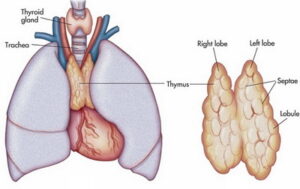
The thymus showing the two lobes. From Wikimedia Commons.
Several pressing questions arise from this rediscovery of the thymus. Chief among them is the extent to which evolutionary assumptions may have clouded scientific vision, delaying recognition of the organ’s enduring importance. By prematurely labeling the thymus as vestigial, evolutionary physiologists risked overlooking its vital role in adult immunity and longevity.
These findings also challenge the plausibility of evolutionary narratives that rely on piecemeal, gradual development. If the thymus truly emerged through such incremental processes, could human health have survived the long gaps in immune defense that partial functionality would entail? In light of its newly recognized, multifaceted functions, the assumption of gradual evolution seems increasingly untenable. Instead, the evidence points to a system that is integrated, and indispensable that defies reduction to slow, chance-driven processes.

History and Evolutionary Interpretations of the Thymus
The thymus was first described by Galen (~160 AD), who considered it merely an anatomical excrescence or cushion between the sternum and blood vessels. Its tendency to shrink with age reinforced the idea that it was functionless.
Upon the adoption of evolutionary theory post-Darwin, the thymus was listed among the organs classified as ‘vestigial,’ until the 1960s. During the 1960’s to present, there have been some discoveries showing the thymus’ role in programming central immunological self‑tolerance (teaching T cells to distinguish self from non‑self). This discovery revolutionized immunology, showing that thymic defects contribute to autoimmunity. Elaborating on these shifts, another article titled:
History of the Thymus: From a Vestigial Organ to the Programming of Immunological Self-Tolerance (Geenen and Savino), Springer Nature, In: Thymus Transcriptome and Cell Biology (12 April 2019), showed that this organ is active even before birth. In their words:
“Already during foetal life, this presentation promotes negative selection of T lymphocytes harbouring a receptor with high affinity for MHC/self-peptide complexes. Mainly after birth, this presentation also drives the generation of regulatory T cells specific for these complexes. Numerous studies, as well as the identification of Aire and Fezf2 genes, have shown that a thymus defect plays a crucial role in the development of autoimmunity. The discovery of the central tolerogenic action of the thymus revolutionized the whole field of immunology, and such knowledge will pave the way for innovative tolerogenic therapies against autoimmunity, the so heavy tribute paid by mankind for the extreme diversity and efficiency of adaptive immunity.”
With this Backdrop, What Do Evolutionists Now Teach?
Even with the discovery of the thymus’ significant role in immunity, evolutionary theory now suggests that the thymus originated as part of the vertebrate immune system, gradually specializing in T cell maturation. In this framework, its eventual shrinkage in adulthood is seen as an evolutionary trade‑off: energy conserved at the cost of reduced immune diversity.
Yet the 2026 findings from Bernatz et al further challenge this narrative. In specifically examining the thymus’ role in cancer treatment, the Nature study emphasizes that:
“Loss of thymic health increases mortality and disease incidence, including cancer and cardiovascular diseases” (Bernatz et al., 2026).
According to the study, adults who had their thymus removed experienced:
“adverse health consequences across multiple diseases and outcomes, where penetrance can be decades after thymectomy” (Bernatz et al., 2026).
If this is the case, then how would human health have been sustained if the thymus and its functions only arose gradually, as is postulated by evolution?
The Cost of Piecemeal Evolution
If thymic functions had arisen gradually, through random mutations and slow selection, the immune system would have endured long stretches of vulnerability. Imagine an incomplete thymus producing only partial T cell repertoires: pathogens would exploit the gaps, cancers would flourish unchecked, and cardiovascular inflammation would spiral.
To place this in perspective quantitatively, Bernatz and colleagues estimated that adults with low thymic health had a Kaplan–Meier mortality estimate of 25.5% at 12 years, compared to 13.4% for those with high thymic health (Bernatz et al., 2026).
Such stark differences highlight how finely tuned the system must be. A half‑formed thymus would not suffice. The interdependence and multiple system connections of the organ, including T cell training, immune diversity, cancer defense, cardiovascular regulation must also all be present together, or the system collapses.
More Information on Thymus Engineering
When examining the processes behind the thymus’ function, an even more spectacular pattern is seen. As previously mentioned, the thymus- trains T cells to distinguish self from non‑self, preventing autoimmunity while equipping the body to fight infections.
 It also simultaneously influences cancer immunotherapy outcomes, cardiovascular resilience, and even frailty scores. As the study notes, “Individuals with low thymic health… have a shorter lifespan and an increased risk of cancer and cardiovascular diseases” (Bernatz et al., 2026).
In these ways, the thymus acts as a master regulator with a level of complexity that cannot be easily justified as having arisen by gradual tinkering. This is seen as each subsystem depends on the others: T cell diversity requires thymic selection, which requires structural integrity, which in turn depends on metabolic and inflammatory balance. If one piece is removed, the whole collapses.
From an engineering perspective, it is more reasonable to believe that this is evidence of wisdom in design. The thymus was engineered to serve multiple roles across the lifespan, not just in childhood.
Scientific Surprise Yet Continued Evolutionary Appeals
The observed role of an organ once designated as ‘vestigial’ was admitted to be pivotal for the future of health sciences. In the words of the authors:
“Considering the prevailing perception of the limited role of the thymus in adults, our findings may change our understanding of human health” (Bernatz et al., 2026).
Despite unambiguous evidence of design, evolutionary language persists. The thymus is described by the authors as undergoing “involution,” as if its decay were a programmed evolutionary inevitability.
Yet the data show that what moderates the thymus is not an obscure process of evolution, rather is moderated by lifestyle factors. Smoking, obesity, and inflammation all accelerate this decline, while healthier choices preserve thymic function.
The Thymus Joins a Growing List of Multipurpose Organs
 The thymus joins a growing list of organs once dismissed as simplistic or vestigial but now recognized as multipurpose marvels. Among these include:
- The appendix, which was once thought useless, is now known to harbour beneficial gut bacteria.
- The tonsils, long removed without hesitation, are now seen as immune sentinels.
- The coccyx, once designated as the ‘tail bone,’ anchor muscles, tendons, and ligaments that support pelvic organs and contribute to posture, balance, and movement.
Adding these discoveries of the thymus’ functionalities adds further evidence that evolutionary assumptions often do not hold, rather, points to evidence of purposeful design.
The Thymus Speaks of God’s Providence
The study by Bernatz et al provides yet another useful case study of the wisdom of God in biology. This is unsurprising as in Psalm 139, Scripture reminds us that even the unseen, inward and hidden parts are known and cared for by God – with each of us being “fearfully and wonderfully made” (Psalm 139:14). This includes the silent and hidden thymus, that subtly trains the immune system, guards against cancer, and sustains resilience.
The complexity and multiple functions of the thymus further challenge the notion of piecemeal development, alongside several other similar discoveries with other organs. Evolution cannot explain why an organ dismissed as vestigial turns out to be central to longevity. However, an orientation of design makes more logical sense.
May the rediscovery of the thymus encourage further research, not only into its medical applications but into the broader question of design. So, while we may never actually see this small organ at work, the thymus declares that we are designed for resilience, and our stewardship of health is part of that design.
See also two previous articles by Jerry Bergman about the thymus:
- Thymus Cells Train in Boot Camp (12 July 2022)
- The Thymus: Vestigial Not! (24 Aug 2020)
 Dr. Sarah Buckland-Reynolds is a Christian, Jamaican, Environmental Science researcher, and journal associate editor. She holds the degree of Doctor of Philosophy in Geography from the University of the West Indies (UWI), Mona with high commendation, and a postgraduate specialization in Geomatics at the Universidad del Valle, Cali, Colombia. The quality of her research activity in Environmental Science has been recognized by various awards including the 2024 Editor’s Award from the American Meteorological Society for her reviewing service in the Weather, Climate and Society Journal, the 2023 L’Oreal/UNESCO Women in Science Caribbean Award, the 2023 ICETEX International Experts Exchange Award for study in Colombia. and with her PhD research in drought management also being shortlisted in the top 10 globally for the 2023 Allianz Climate Risk Award by Munich Re Insurance, Germany. Motivated by her faith in God and zeal to positively influence society, Dr. Buckland-Reynolds is also the founder and Principal Director of Chosen to G.L.O.W. Ministries, a Jamaican charitable organization which seeks to amplify the Christian voice in the public sphere and equip more youths to know how to defend their faith.