


Will Evolutionists Ever Admit That Life Never Existed on Mars?
After a long string of failures to find
life on Mars many scientists continue,
in hope against hope, to search for it.
One Failure After Another Dashes Hopes for Finding Life On Mars
by Jerry Bergman, PhD
The obsession over finding life on Mars (or other planets or moons), which NPR’s Science Reporter David Baron calls the “Alien Craze”, is based on several motives.[1] One important motive is to support the abiogenesis belief that, given the right conditions, life can arise from nonliving matter, thereby supporting evolution.[2]
A meteorite believed to have originated from Mars plunged into Earth some unknown time in the past. It had possible signs of life according to a breathless announcement from NASA in 1996. Berkeley PhD Donald Goldsmith opined, “This rock from Mars will change the way we think about life in the universe.”[3] It would change the way we think about life because it would lend support to the view that life can arise naturally and, given enough time, evolve.

False life form in Martian rock ALH 84001, reported 1996.
On August 7, 1996, a team of NASA scientists captivated the world by announcing they had discovered microscopic, worm-like structures resembling fossilized nanobacteria, along with organic molecules, inside the Martian meteorite ALH84001.[4]
See CEH reports from 1 Sept 2009 and 24 Feb 2022.
However, the worm-like structures were later determined to be inorganic mineral formations and artifacts resulting from laboratory preparation rather than fossilized alien life. See the illustration, right.
One of the major pieces of evidence against evolution is the difficulty of accounting for a material origin of life, both theoretically and in laboratory experiments. It is a problem of such magnitude that evolutionists often attempt to argue that the origin of life lies outside the scope of evolutionary theory.[5]
The common explanation is that evolution explains only how living organisms changed after they already existed.[6] The study of how life first arose from nonliving matter is a separate field called abiogenesis.[7] Evolutionists often claim only the diversification of living organisms through genetic change, which requires preexisting living things—even primitive organisms. Consequently, if life, or even credible evidence of past life, were discovered elsewhere in the Solar System, many evolutionists would view such a discovery as providing strong support for both abiogenesis and evolution.
Reasons for Persistence of Belief
An acquaintance of mine, a NASA scientist (I know him because his wife grew up in Montpelier, Ohio, where I live), discussed life on Mars. I related that one of the major goals of NASA’s Mars program is to find evidence of life on Mars. I asked why he would be involved in a program attempting to find life on Mars when, as a creationist, he believes that life never existed there. I remarked that NASA is chasing an illusion.
He agreed that the search for life on Mars is ultimately in vain. However, he explained that he enjoys his work immensely and that the programs he works on have enabled scientists to learn a great deal about the Red Planet and the Solar System as a whole. He has always had a passion for astronomy and therefore earned a doctorate in that field.
My friend added that the scientists are confirming what you and I already know. There is no life on Mars, and there never was. At the same time, he said, they are also learning that Earth is a very special planet, one that was created for us.
Beliefs Shattered
This history of Mars exploration has supported my friend’s comments. One example is the Viking missions that landed fifty years ago during the American Bicentennial year. Nadia Drake wrote for Scientific American News on July 27, 2026,
Scientists had speculated for years about what scenes would await Viking 1 and its twin, Viking 2, which landed elsewhere on Mars a few weeks later. Most thought any Martians would, at most, be simple, small life-forms—although Carl Sagan had impishly suggested that polar-bear-sized creatures could populate the landscape. Humans have imagined other inhabited worlds for millennia. And we’ve even “discovered” life on Mars more than once across the last century or two. Yet each time we’ve built sharper tools and taken a closer look, all those claims have evaporated.[8]

Carl Sagan by model of the Viking lander describing the instruments built to detect life on Mars.
Belief in evolution, however, remains so strong that many evolutionists continue to hope—and some even pray—that scientists will find evidence of at least past life on Mars. Despite repeated disappointments, evolutionists still have hope that future missions will uncover evidence of ancient Martian life.
As Drake explains, this hope had motivated NASA to launch the Viking landers on an audacious mission to look for it. Their results, however, weren’t conclusive. Most experts agree the twin spacecraft failed to find definitive signs of organisms in scoops of Martian soil.[9]
Adjusting the Plot
When every test failed to find life—or even evidence of past life, not even “primitive life”—one response was to argue that a new strategy was required: namely, to search below the Martian surface, where the chances of finding life were thought to be the greatest.[10] So far, this approach has also failed to produce evidence of life.
Nevertheless, hope still burns in the minds of some evolutionists that future investigations will uncover evidence of life because, as Nadia Drake observes,
the Viking landers remain the only missions ever sent to the surface of another world to search for extant alien life. The ambiguity that wafted from their soil samples has become emblematic of the uncertainty that plagues the greater search for extraterrestrial life—not just on Mars and our sun’s other worlds but across the observable universe.[11]
Each new day brings renewed hope to many evolutionists that evidence of life on Mars will eventually be found. As Nadia Drake explains:
Already, a growing pile of evidence suggests ancient Mars could very well have been an inhabited planet—and may still be. Our search for life there is a bit like bobbing for apples blindfolded—except we don’t know what an “apple” might feel like, and the apples may exist only in scattered pieces. What’s needed, many scientists argue, is a clearer way of separating signs of “life” from “nonlife,” a quantitative method that leverages statistics and probabilities to guide our interpretations of biology’s potential fingerprints.[12][i]
Is Mars Even Habitable?
The main impediment to life on Mars is the fact that the planet as it exists now is extremely hostile to life. Nevertheless, some evolutionists speculate that, despite the long history of unsuccessful searches, there is still reason to hope. One idea that gives them hope is the belief that if Earth is 4.6 billion years old, Mars must be approximately the same age. If Mars is indeed 4.6 billion years old, it could have been much more hospitable to life in the distant past.
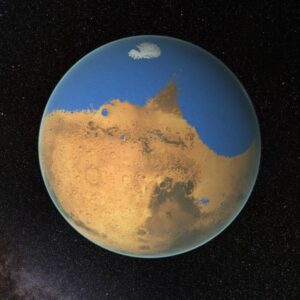
Fictional artwork of Mars with ocean from NASA Astrobiology site in 2016.
Specifically, it is proposed that the ancient Mars must have been warmer, had a thicker atmosphere, a global magnetic field that protected its surface from cosmic radiation, and contained seas and lakes of liquid water.
For reasons that are still debated, Mars supposedly lost its magnetic field and, with it, much of its atmosphere and surface water. The common explanation, which is largely speculative, is that Mars’s smaller size caused its interior to cool down much faster than Earth’s, eventually stopping its molten core motion, which is thought to generate a global magnetic field.
Because Earth is much larger, its core has remained hotter and geologically active for a much longer period. However, this explanation is problematic for several reasons. One difficulty is that an intrinsic magnetic field may not protect a planet against atmospheric escape as was widely believed.[13]
Summary
Critical to the belief that life may have existed, or may still exist, on Mars is the widespread adherence of many secular scientists to methodological naturalism and atheistic evolutionism (evolutionary naturalism.) The fact remains that “one of man’s oldest and most tantalizing questions is: Is there life beyond our world? And of all the heavenly objects of such speculation, the most fascinating has been the planet Mars.”[14] After a long string of failures to find evidence of life, many scientists continue, in hope against hope, to search for it.
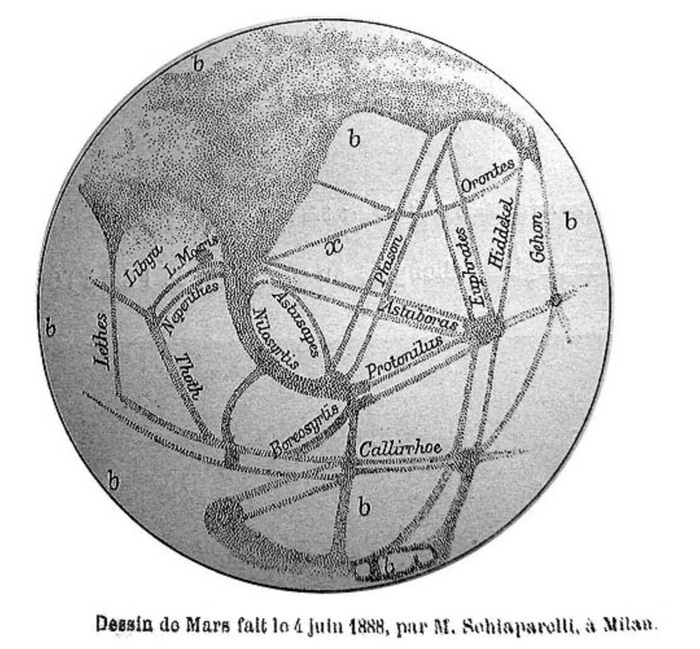
An 1888 map by Schiaparelli of Mars showing “canali” that were interpreted as “canals.” Many believed they must have been built by intelligent beings. Some created myths that the Martians were trying to conserve water with an extensive canal network. Astronomer and benefactor Percival Lowell built the Lowell Observatory in Flagstaff, Arizona, largely to continue the search for evidence of these apparently designed structures. Their existence was disproved by photos taken by the Mariner 4 spacecraft in 1965, to the disappointment of many earthlings. Subsequent missions to the surface of Mars have accentuated the hostile environment. Credit: Wikimedia Commons.
Update Aug 5: “Mars dust is toxic. How will future astronauts deal with it?” (Space.com, 5 Aug 2026). The fine dust of Mars will be poison to astronauts, says writer Leonard David, and must be avoided at all costs. Growing food on Mars, he says, also risks getting toxins into the food supply if a human colony is ever attempted in the distant future. Thought: If Mars dust is toxic to us, it cannot have been conducive to any other life form.
References
[1] Baron, David, The Martians: The True Story of an Alien Craze that Captured Turn-of-the-Century America. W.W. Norton, New York, NY, 2025.
[2] Drake, Nadia, “Has NASA already found life on Mars?,” Scientific American https://www.yahoo.com/news/science/articles/nasa-already-found-life-mars-173000889.html?guccounter=1 2026.
[3] Goldsmith, Donald, The Hunt for Life on Mars. Penguin Books, New York, NY (1997), Preface, p, i.
[4] Lunar and Planetary Institute. https://www.lpi.usra.edu/lpi/meteorites, 2026.
[5] Tessera, Marc, “Origin of evolution versus origin of life: A shift of paradigm,” International Journal of Molecular Sciences 12(6):3445–3458, doi:10.3390/ijms12063445, 2011.
[6] The University of California, “Misconceptions about evolution,” Understanding Evolution, https://evolution.berkeley.edu/teach-evolution/misconceptions-about-evolution/#a1, 2012.
[7] Tirard, Stephane, “Abiogenesis,” Encyclopedia of Astrobiology doi:10.1007/978-3-642-27833-4_2-4, p. 1, 20 April 2015.
[8] Drake, Nadia, 2026.
[9] Drake, 2026.
[10] Walter, Malcolm, The Search for Life on Mars. Perseus Books, Cambridge, MA, 1999.
[11] Drake, 2026.
[12] Drake, 2026.
[13] Gunell, Herbert, et al., “Why an intrinsic magnetic field does not protect a planet against atmospheric escape,” Astronomy & Astrophysics 614https://www.aanda.org/articles/aa/full_html/2018/06/aa32934-18/aa32934-18.html, June 2018.
[14] Cooper, Henry, The Search for Life on Mars. Holt, Rinehart and Winston, New York, NY, 1980; quote is from the inside front cover.
[i] Drake, 2026.
 Dr. Jerry Bergman has taught biology, genetics, chemistry, biochemistry, anthropology, geology, and microbiology for over 40 years at several colleges and universities including Bowling Green State University, Medical College of Ohio where he was a research associate in experimental pathology, and The University of Toledo. He is a graduate of the Medical College of Ohio, Wayne State University in Detroit, the University of Toledo, and Bowling Green State University. He has over 1,900 publications in 14 languages and 40 books and monographs. His books and textbooks that include chapters that he authored are in over 1,800 college libraries in 27 countries. So far over 80,000 copies of the 60 books and monographs that he has authored or co-authored are in print. For more articles by Dr Bergman, see his Author Profile.
Comments
The evolutionist looking for life on Mars is like a cartoon character seeing mirages in the desert. The cartoon character, dismayed by the heat, desperately looks for relief (fancy car, ice cream stand, lemonade stand, lake, swimming pool, waterfall, etc.). The character runs to whatever he or she sees only to see nothing. Evolutionists search in vain for life on heavenly bodies only to see nothing. Something clearly other than science motivates their vain search for life.
Great update at the end of this article. Great point in the article as well. If Mars dust is toxic to humans, how would it support any other life form? One creationist site has an article or two about Mars and how the amount of UV radiation Mars receives would kill microbes (amoeba, bacteria, fungi, mold, viruses, etc.).