


Predators Fear Humans
Two new studies confirm
that large mammal carnivores
“fear” human presence
Genesis 9:22 states that after the Flood, God told Noah and his family,
the fear of you and the dread of you shall be on every beast of the earth, on every bird of the air, on all that move on the earth, and on all the fish of the sea.
Two studies published in Current Biology confirm this to be the case for two powerful mammalian predators: mountain lions and bears.
While the authors had no motivation to support the Genesis account, it is interesting that they used the word “fear” to describe the behavior of two large carnivores in different classes (felids and ursids), both with plenty of muscle to take down a human. Why wouldn’t evolution put the fear on the other foot – on naked apes powerless to outrun or outfight large carnivores looking for meat?
In what follows, we don’t want to exaggerate the findings or extend it to every possible conflict between humans and all animals (see green commentary below). It is interesting, however, to notice that the scientists were a bit surprised by what they found.

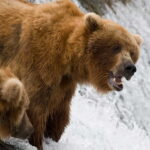
Bear catching salmon (Illustra Media)
Fear of humans disrupts trophic interactions that underpin animal-mediated ecosystem functions (Manlick et al., Current Biology, 8 June 2026). This study on bears focuses on how human presence tends to alter the “ecosystem services” that bears provide by consuming salmon, because bears avoid places where humans are visible or audible (or smellable).
Habitat selection and outdoor recreation help explain human-mountain lion conflict (Morgan et al., Current Biology, 6 July 2026). This study on mountain lions shows that the big cats naturally avoid places humans occupy unless they become habituated to their presence. Even so, they are rarely seen by Californians where the largest population of mountain lions live, often in proximity to cities.*
*See our 24 Jan 2004 article about the fossil “megafauna” found at the La Brea Tar Pits, which included mastodons, mammoths, camels, American lions, sabre-tooth cats, and dire wolves. Many fossil carnivores were larger than those alive today. A debate continues about whether they were wiped out by humans or went extinct for other reasons. Imagine these creatures coexisting with humans today near downtown Los Angeles!
On August 3, Oswald J. Schmitz commented on these two papers, again using the word “fear” in the behavior of the large, “fearsome” predators:
Wildlife ecology: When the fearsome become fearful (Schmitz, Current Biology, 3 August 2026). Oswald J. Schmitz, an environmental scientist at Yale, seemed surprised by the findings of the two papers.
Humans recreating in wilderness areas face a risk of encountering and being harmed by fearsome large wild carnivores. Yet, the risk is exceedingly low, because, it turns out, these fearsome predators become quite fearful when encountering humans.
Schmitz notes that attacks by bears and lions make headlines, but are surprisingly rare.
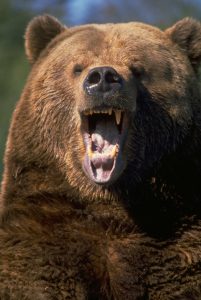
Grizzly (Corel Pro Photos)
A sure-fire way for the media to capture public attention is to report on a hiker who was simply out enjoying nature being mauled by a large carnivore. Such reporting plays to a long-held view that wild nature is a risky place, full of fearsome predators that come seemingly out of nowhere to pounce on any unsuspecting person. This kind of event is highly newsworthy because it is both stark and unusual; so unusual in fact that another rare event — getting struck by lightning — is common by comparison. Given that millions of people live and recreate in wilderness each year, one might guess, however, that the chances for such dangerous encounters should be much higher. Why, then, are they so exceedingly rare? Two complementary recent studies in Current Biology by Philip Manlick and colleagues and by John Morgan and colleagues offer some answers. It turns out that large fearsome carnivores such as brown bears (Ursus arctos), black bears (Ursus americanus), and mountain lions (Puma concolor) are indeed quite fearful of humans.
Schmitz notes that this “fear” behavior is opposite that of typical predator-prey encounters:
A key modern concept in ecology is that the perceived risk of being harmed by carnivores causes prey species to exist in a ‘landscape of fear’. Here, fearful prey individuals continually adjust their behaviors and movements, responding to spatial and temporal variation in the occurrence of their fearsome predators, to minimize the chance of encounters. The two new studies show that humans ‘turn the table’ on the fearsome carnivores, causing them to become fearful, so much so that the carnivore species move and assort themselves spatially to minimize the chance of encountering humans. Their proximity to humans varies, however, calibrated to their individual tolerance of human activity. This helps explain the exceedingly rare occurrences of mauling, despite carnivores continuing to live near human activity.
Aren’t we lucky to have evolved such powerful influences on carnivores to make them afraid of us. Is it our B.O., or what? Whatever it is, it hasn’t worked as well on mosquitos.
 All seriousness aside, Schmitz has no answer to why humans were able to “change the narrative about human–carnivore conflict.” He calls this a “human-induced role reversal,” but how could that evolve? Schmitz and the other researchers don’t know.
Interestingly, none of the authors explain how evolution produced this role reversal for human-carnivore interactions. Only Morgan et al. mention evolution, and that only once—in a negative way. They argue that the policy of removing aggressive animals has backfired on evolution:
Contrary to our findings, some research suggests that carnivores with a reduced fear of humans are more likely to attack people or be responsible for other forms of conflict such as livestock depredations. This belief has driven management decisions such as the lethal removal of human-tolerant individuals, which acts as an evolutionary pressure against habituation. Lethal removal of human-tolerant individuals, which are more likely residents with a territory experiencing multiple exposures to human disturbance, however, creates a territorial vacancy in the carnivore population likely to be filled by a younger, less-predictable, non-habituated individual moving into the area that may undermine coexistence strategies. An increasing body of research suggests that younger, less-experienced animals not yet habituated to people may be the portions of carnivore populations most prone to conflict with people, inclusive of those responsible for attacks on people.
Instead of explaining the fear response of carnivores to humans, all these authors retreat into moralizing—another example of the Genesis Mandate. Humans alone were given the role of stewardship of creation. Environmentalists seem to understand that role in their gut, even without acknowledging that human beings alone are exceptional and morally responsible to be good stewards. Schmitz concludes,
Human–carnivore relationships are customarily seen as adversarial conflicts in which the carnivore is considered the fearsome aggressor that harms human safety and wellbeing. The new research shows that humans are the ones who determine whether the aggression may play out. But more importantly, the science shows that humans have options to proactively mitigate their own risk of harm, and harm to carnivores. By being cognizant of how they shape the landscape of fear experienced by carnivores and their prey species, humans can proactively adjust their behavior and spatial use of landscapes in ways that can transform the human–carnivore relationship from one of conflict to one of coexistence and thereby rebalance the attendant cascading effects that human fear effects have on wildlife communities and ecosystems.
OK, now: is it “good” to favor coexistence? Is it “good” to rebalance the ecosystem to favor peaceful relationships instead of aggression? Is it “good” to think about options for mitigating harm to carnivores as well to as self, for avoiding the cascading effects on wildlife communities and ecosystems? Preach it, brother. Your imago dei is tingling.
As a backpacker and outdoorsman, I found these papers quite interesting, but I want to hasten to add caution about overgeneralizing the findings. Generalizations almost always have exceptions. Clearly, attacks by predators do occur. The point of the authors is that they are surprisingly rare. We have a far greater chance of being struck by lightning than being mauled by a bear or mountain lion. That’s why the rare attacks make headlines. It should cause scientists in either the creation or evolution camp to want to explain the rarity.
Even so, the risk goes up when invading their territory or surprising the animal. And what about all the other animal groups mentioned in Genesis 9:2? What about sharks, snakes, and… dinosaurs?
I had a good phone call with Dr J.Y. Jones today about this. He is one of our CEH contributing authors, an avid hunter with many years’ experience with large animals in the wild. He has written about wild animals in large books about his hunts in North America and other parts of the world.
Dr Jones affirmed the behavior of bears and mountain lions from his own experience and research on predator behavior. Almost always, he said, they run away when they sense a human is in the area. A mother bear is most dangerous because of her instinct to protect her cubs. A solo bear seeing a man will almost always run away, Dr Jones said.
As an aficionado of western American history, I have read first-hand accounts of fierce grizzly bear attacks on mountain men, such as the case of Hugh Glass as portrayed in the 2015 movie, The Revenant. What we don’t hear recorded in the journals is how many grizzly bears ran away. And the worst predators the mountain men had to face were other humans: hostile natives with sometimes genocidal intentions. Even those, however, were not cannibals.
As for other predators, Dr Jones agreed that attacks on humans are rare. Even wolf packs that can collectively overpower a large caribou almost never gang up against humans, despite being ruthless killers that will sometimes kill every sheep, goat, or cow in a ranch just because they can. The harm this causes to ranchers is behind much of the controversy about wolf reintroductions; see 8 April 2025 and Dr Jones’s articles from 6 June 2023 and 11 December 2023.
Snakes, too, prefer to slither away unless threatened, and shark attacks are also rare. Animals with smaller brains, of course, will react instinctively to a threat, and many come equipped to neutralize the threat. But they typically do not hunt down a human for food. Even bears that maul humans do not normally eat them.
Dr Jones said that he thinks this behavioral role reversal is a supernatural thing; why would large, powerful carnivores run away in fear from humans they could easily take down and eat for food? It makes sense in light of Genesis 9:2 that God put the fear and dread of man into animals in general, because after the Flood, it was a dangerous world. God wanted humans to repopulate the earth and steward the creation.
Thinking Critically
There are other thoughts to consider. On the Galapagos, many of the animals have no fear of man and will not run away. The history or rarity of human interactions must be taken into account. In Africa, the most dangerous mammal is not a lion or leopard, but a herbivore—the hippopotamus. These swift runners will attack and kill a human if provoked, but (again) not to eat them for food.
Every continent has animal risks. In Australia, the cassowary is feared for its ability to run up to a man and slash him with its razor-sharp foot claws. There were even larger “terror birds” known from fossils that could have been even more dangerous. But cassowaries do not eat people. Nor do snakes, snapping turtles, and other reptiles – although alligators, crocodiles, and komodo dragons can attack people, and perhaps devour children on rare occasions.
There were even larger crocodiles known from fossils, and, of course, the dinosaurs. If animals were vegetarian before the Flood, as most Biblical creationists believe, pre-Flood animals would not have threatened humans. It leads me to speculate with some jocularity that humans, contrary to the Jurassic Park movies, may have kept velociraptors as pets. Since no one alive today can say otherwise, and dinosaur soft tissue shows that dinosaurs lived in more recent times (thousands of years ago, not millions), we can feel justified in engaging in some unobservable inferences after watching evolutionists do it recklessly all the time.
Summary
In summation, with due consideration to exceptions to the rule, the rarity of predator attacks on humans should strike materialists as surprising. Darwinism has no answer. Genesis 9:2 explains the fear response as God’s protective action for the sake of those He appointed as stewards. Even so, this cursed world poses many risks to sinners destined to die eventually in one way or another, but the promises of God still stand to redeem any human omnivore who will repent and believe in His provision.