


Snake, Bite Thyself
Why don’t snakes die from
their own poison? Easy; ‘they
evolved their own antivenom’
Snakes would probably be less scary if they didn’t bite people with deadly toxins. Many species are quite beautiful, and their modes of travel cause admiration to herpetologists. Living in a wide range of environments, even in the ocean, snakes provide valuable ecological services. In the western states, most of us homeowners learned not to kill every rattler we see, knowing that they help reduce the populations of rats and mice. Animal control specialists will come and relocate them to a safe place.
Snakes have a beneficial role to play… except when they bite humans. Death by snakebite remains a global danger. But why don’t snakes die of their own poison?
My father, an avid outdoorsman, used to wonder about that. He pondered whether eating snake meat (which can be cut into hot dogs!—not suggesting any personal experience, mind you) might confer some protection against their venom. After all, the snake must have some method of protecting itself from the poison it stores in its own glands within its body, and from the poison it ingests in its neutralized prey.
Well, now, science is catching up with that idea, and new findings may help alleviate the suffering of bite victims with newly designed antivenoms derived from proteins in snake blood. These promise to be much more effective than those currently in use.
 Rattlesnakes’ own antivenom could protect humans too (Nature Research Highlight, 12 Aug 2026). This article says, “A mixture of proteins in snake blood can prevent the death of mice injected with an otherwise lethal dose of venom.” It states that the global annual death toll from snakebite is 80,000 to 140,000 people, with multiple times that number becoming injured or disabled from bites. Victims are often unable to get current antivenom treatment in time; thus the push for research into better solutions.
Scientists Discover an Antidote to Lethal Snake Bites that Comes Straight from the Source (University of Maryland, 29 July 2026). Nature was summarizing work by biologist Sean B. Carroll and colleagues at the University of Maryland and Texas Agricultural and Mechanical University reported in PNAS. The UMD press release by Jennifer Holland discusses “a blueprint for the next generation of antivenoms—using snakes’ natural molecular defenses against their own deadly venom.”
The team found that specific combinations of blood proteins from western diamondback rattlesnakes provided unprecedented neutralizing power against the venom of multiple dangerous snake species.
Having a single antivenom that would work on many different snake toxins would be a huge development. Currently, health officials have to “milk” the venom from a snake, insert it into an animal, and harvest the antibodies. This is time-consuming, expensive, and hard to reproduce. The new biomimetic approach overcomes some of those limitations.
“This is one of those great stories when nature has already solved a problem we’ve been grappling with for decades,” said Carroll….
“We’ve known from anecdotes for 100 years that vipers tend to be resistant to their own venom,” Carroll said. “But for a long time, nobody knew what exactly was circulating in their blood that protected them.”
In 2022, Carroll’s lab found part of the answer: a single protein called FETUA-3 that blocked the activity of many metalloproteinase toxins in the western diamondback’s venom. FETUA-3 also bound to and inhibited the toxins of venoms from several other rattlesnakes.
The team has made partial progress looking for the right combinations of proteins, but they have established proof of principle. Once the work is complete, they envision mass production at unprecedented scales.
“We could make train cars-worth of this stuff and help solve a massive global health problem,” Carroll said. “Many of our most important medicines have come from nature. I’m delighted that the components for a better-than-commercial antivenom were in these snakes all along.”
Giving Darwin Credit (Again)
Unfortunately, Carroll’s team kept its Darwin-colored glasses on.
“Here was evolution’s way for snakes to protect themselves from accidental self-envenomation,” he said, which prompted a follow-up question. “Why rely on horse antibodies when nature has packaged an effective antidote right there in the snake?”
Their paper in PNAS is saturated with Darwinese, mentioning evolution 33 times. The authors talk of co-evolution, evolutionary history, evolutionary divergence, evolutionary distant species, evolutionary novelty, evolutionary conservation, and even their own “evolutionary approach to antivenom design” for a trip into cognitive dissonance.
Other researchers remained in an evolutionary trance with them:
 Why snake venom may have evolved to catch dinner, not for defence (The Conversation, 13 Aug 2026). In this Darwin tale, Bálint Üveges and Wolfgang Wüster from Bangor University rhapsodize about the evolutionary kindness of snakes. They don’t want to hurt you. They just want to eat.
Questionable inferences from their data led them to believe that “it appears that European viper venoms, like in most snakes, probably evolved to overcome prey rather than to fend off predators.” I.e., science knows that snakes probably evolved. You can count on that! (Then why is that rattler coiled up and looking at me? I’m too big for it to eat.) They left it for someone else to figure out why injecting poison into its meal would make it more delicious.
Whatever the answer is, it evolved.
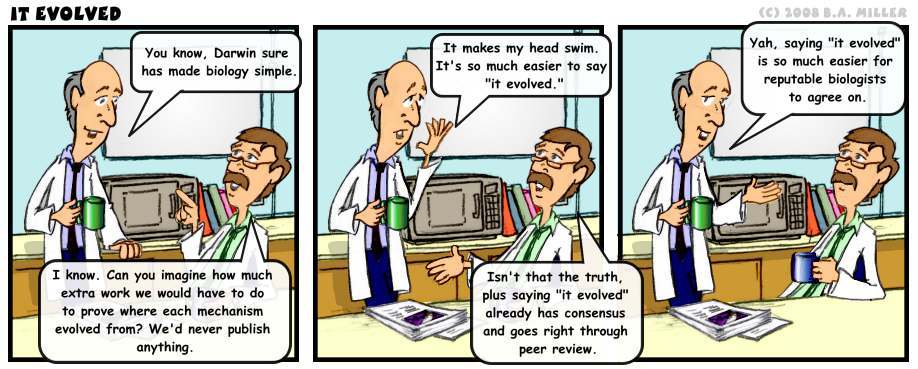
It gets so tiring to hear evolutionists wave this magic wand “it evolved” to explain everything and anything. I predict some day that society will look back at the Darwin Era with disdain and ridicule. It will become hard to understand how so many intelligent people fell for the Stuff Happens Law. There’s precedent for my prediction. Look how educators and scientists feel about the “spontaneous generation” beliefs of the past, like Van Helmont’s 17th-century recipe for spontaneous generation of mice: dirty shirts plus wheat. (We need not reiterate the fact that spontaneous generation has experienced a resurrection these days: it’s called Origin of Life or abiogenesis, with spinoffs into astrobiology and SETI. Dr James Tour can trounce that quickly.)
The Bible has a lot to say about snakes and serpents, most of it acknowledging the pain and suffering they cause (see references to adders, vipers, cobras and other poisonous snakes known in the Middle East). The original “serpent” of course was the one who tempted Eve into disobedience with Satan’s ventriloquism trick. She and Adam decided to follow Satan instead of obey God, and that rebellion was the start of all suffering in the originally “very good” creation. The curse that God pronounced on the world because of sin was the start of painful toil, painful childbirth, thorns, and other agents of suffering (Romans 8:18-24). It most likely included toxic organisms, including snakes. Those toxins could have intensified over the subsequent centuries and millennia.
Nevertheless, there are hints that snakes will return to their originally very good created essence. In a passage about the coming Kingdom of God, Isaiah 11 says,
6 “The wolf also shall dwell with the lamb,
The leopard shall lie down with the young goat,
The calf and the young lion and the fatling together;
And a little child shall lead them.
7 The cow and the bear shall graze;
Their young ones shall lie down together;
And the lion shall eat straw like the ox.
8 The nursing child shall play by the cobra’s hole,
And the weaned child shall put his hand in the viper’s den.
9 They shall not hurt nor destroy in all My holy mountain,
For the earth shall be full of the knowledge of the Lord
As the waters cover the sea.
This promise of a restored creation gives hope to the world. It shows that venomous snakes and other harmful animals are anomalous to the intent of our Creator at the beginning. It suggests that reversals of their harms can be rapid, which implies that the initiation of the curse was also rapid. For anyone who doubts the Word of God, or wants to mock what it says here, I suppose we have no recourse other than to offer this hope to you, and if you don’t want it, leave you to remaining in the swamp of the Stuff Happens Law, content to look at pain and suffering as mere fate in a fine-tuned universe that just happened for no reason, and resign yourself to eventual annihilation. Like Deuteronomy 30 pleads, “choose life.”