


Cities Are Not Causing Evolution
Variation of existing species
around human habitats
is not Darwinism
A Darwinist is like the proverbial guy with a hammer who sees every problem as a nail.
War, politics and religion shape wildlife evolution in cities (The Conversation, 3 July 2025). According to Elizabeth Carlen, a postdoctoral fellow at Washington University in St Louis, evolution is the universal hammer that nails all of biology into a neat, organized temple to Darwin. Are you one of the “people” who has not yet come into the temple to admire the relics?
People often consider evolution to be a process that occurs in nature in the background of human society. But evolution is not separate from human beings. In fact, human cultural practices can influence evolution in wildlife. This influence is highly pronounced in cities, where people drastically alter landscapes to meet their own needs.
Humans, she says, are also relics of evolution who, for better or for worse, mostly worse, are altering the relics in the temple. The Hegelian “process” that Carlen speaks of embraces contradiction as a feature of reality (see 1 May 2025 and 8 May 2025). The contradiction here is that if human rationality evolved, then it is irrational— including the claim that “evolution is not separate from human beings.”
Let’s see what Dr Carlen, a.k.a. Miss Information, says about how “religion” causes evolution:
For example, in Oviedo, Spain, people constructed walls around religious buildings between the 12th and 16th centuries. This division of the city led to different populations of fire salamanders inside and outside the walls. Because salamanders can’t scale these walls, those on opposite sides became isolated from each other and unable to pass genes back and forth. In a process that scientists call genetic drift, over time salamanders on the two sides became genetically distinct − evidence of the two populations evolving independently.
Notice that “scientists” call it genetic drift. Well, then. Better believe it. It’s a type of evolution, according to Miss Information.
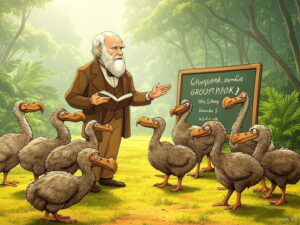
Darwin takes the class on a field trip for another lesson in Groupthink 101.
But, says Johnny raising his hand in DODO class, aren’t they still fire salamanders? For this he gets sent to the principal’s office. One must not ask questions of The New Teacher (see commentary, 21 Dec 2005).
The “evolution” Carlen is proclaiming with religious dogma is mere genetic drift— the outcome of the Stuff Happens Law. No salamanders grew wings or began speaking philosophy. Everyone, Darwinists and creationists alike, accepts variation or “microevolution” such as changes in fur color. But that is not Darwinian evolution (see primer at 2 Sept 2019). Such equivocation over the meaning of “evolution” is used by propagandists to confuse, not to enlighten.
The moral of the story comes at the end of her lesson.
While researchers have documented a number of examples of wildlife evolving in response to human history and cultural practices, there’s plenty more to uncover. Cultures differ around the world, meaning each city has its own set of variables that shape the evolutionary processes of wildlife. Understanding how these human cultural practices shape evolutionary patterns will allow people to better design cities that support both humans and the wildlife that call these places home.

For the quiz, repeat after the teacher:
 Research evolves.
- Documentation evolves.
- Understanding evolves.
- Culture evolves.
- Religion evolves.
- City planning evolves.
- Intelligent design evolves.
- Ethical treatment of animals evolves.
- Reality evolves.
- Evolution evolves.
- Everything evolves.

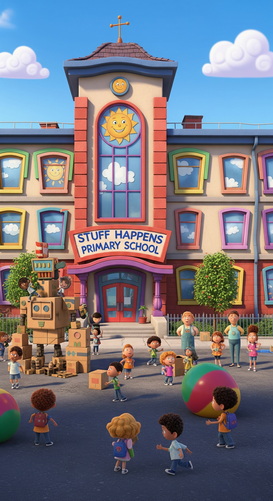
Watch Johnny get in trouble for thinking in Stuff Happens Primary School! Click to watch this Short Reel.
Johnny comes back from the principal’s office, smarting in the rear from his whipping, in order to hear the conclusion of Miss Information’s lesson. He tries to be less confrontational but can’t help himself.
‘But Miss Information, I’m trying hard to understand: is every culture equally good?’ ‘Of course, Johnny. We mustn’t be ethnophobic.’
He thinks for a moment, then asks: ‘Does that include my church that teaches creation?’
Back to the principal’s office he goes.