


Darwinists Insult Human Ancestor Intelligence
The belief that human ancestry
stretches back a million years pushes
evolutionists toward historical racism
Evolutionists have been wising up about early man. They now recognize interbreeding has occurred between Neanderthals, Denisovans, and modern humans. This has elevated those ancestors into the human race—genetically, at least. But they continue to insult our ancestors’ intelligence. They have to; they believe that upright-walking, tool-making, fire-using human beings lived in caves and hunted for a million Darwin Years before inventing smartphones. Does that prove they were stupid? Absolutely not! If you were born in a forest with no books, computers or tools, would you survive as well as they did?
Creationists deny the millions-of-years narrative. They picture our ancestors struggling after a global Flood just a few thousand years ago. As people groups spread far and wide, finding food was a priority. Some groups organized quickly and built villages and cities, but others entered unpopulated areas and could not understand the language of other tribes. It makes sense that they spent most of their time trying to survive another day, stay warm during the Ice Age. Without lumber and metal tools, they found that caves made quick and convenient shelters. They made primitive tools from available materials, but improved quickly. Ideas were shared with other people they encountered. It didn’t take long for more intelligent beings to improve their lives with farming, ranching, and permanent dwellings.
Evolutionists, though, by spreading out human technological progress over 1-3 million years, must conclude that ancestors were too stupid to ride a horse, plant a farm, or build a hut for multiple times all recorded history. In their minds, “primitive” ancestors lived in caves for untold generations, never coming up with better ideas about improving their lives.
Recent discoveries are putting the lie to this historical racism and chauvinism.
 Horse genetics, archaeology, and the beginning of riding (Anthony, Trautman and Heyd, Science Advances, 13 May 2026). These three researchers extend the consensus date of horseback riding a thousand years, from previous estimates of 2300 BC to 3200 BC or into the 5th millennium BC. They go to great lengths to prove their point with archaeological data and horse genes. But they never answer the question of why intelligent ancestors never figured out how to ride any animal for hundreds of thousands of years! Ironically, some early humans were smart enough to build watercraft and migrate to islands. But they couldn’t ride a horse.
It almost seems like they don’t want to think about that question. As a result, they leave an impression that human ancestors were too stupid for almost three million years to realize that riding a horse and inventing a wagon would save them a lot of time and effort. According to their narrative, someone finally tried it in central Asia and then everybody wanted to do it. Does that make any sense?
Neanderthals Insulted
Neanderthals treated a dental cavity by drilling into the tooth (New Scientist, 13 May 2026). Reporter Christa Lesté-Lasserre wants her readers to believe that “the earliest dentistry began at least 59,000 years ago.” But in that story, the earliest dentists, able to drill into a tooth and fill a cavity, were too stupid to ride a horse or plant a farm for another 50,000 years (five times recorded human history). Why don’t evolutionists with their Darwin Years ever think about the implications of their deep-time story? Maybe the mutant-ninja-turtle Neanderthal dentist got hit with the tooth-repair mutation, but not the horseback-riding mutation.
Modern humans share genomic innovations for complex language with ancient Neanderthals (University of Iowa, 23 April 2026). Trying to look as intelligent as possible in a huge photo at the top of this article, U of Iowa Dr Jacob Michaelson attempts to elevate the status of Neanderthals by showing that they had the mutations for complex language before we “modern humans” did. But he still alleges that language evolved by mutations.
While other animals communicate in various ways, humans’ propensity for developing and improvising language is unique to earth’s dominant species. The research, conducted by Michaelson’s team, including first author Lucas Casten, PhD, now a postdoctoral researcher at the Max Planck Institute of Psychiatry in Munich, Germany, aims to understand how the development of human language was shaped by genetic regulatory sequences known as Human Ancestor Quickly Evolved Regions (HAQERs).
“Quickly evolved.” Right; evolutionary time is very flexible. Keep aiming to understand, Dr Michaelson. While you’re at it, ask your colleagues in the coffee lounge why we don’t have Neanderthal books and poetry if they had language for 65,000 Darwin Years. Maybe a cosmic ray will switch on your Understanding gene.
To further understand the impact of HAQERs, the team developed an evolutionary-stratified polygenic score (ES-PGS) that partitioned genetic effects based on their evolutionary origins. Using computational genetics, the team examined 65 million years of evolutionary history.
Sir, please consider verifiable, observable (i.e., scientific) history rather than “evolutionary history” that relies on storytelling and BTQ (Begging the Question).

If you put a Neanderthal in a business suit and had him walk down Broadway, nobody would think he looked unusual. Yet evolutionists have used “Neanderthal Man” as a missing link for over a century. (Grok/XI)
Not Just Neanderthals: Homo Erectus Insulted, Too
Did Homo erectus and Denisovans mate? Tooth proteins hint at ancient trysts (Nature News, 13 May 2026). Evolutionists have been admitting the equality of Neanderthals, Denisovans and modern humans for years now, largely because of genetic evidence that they must have married and had kids. One doesn’t mate with another species. Now, protein evidence is showing that Denisovans mated with Homo erectus.
Homo erectus is a dubious classification whose individuals previously seemed more primitive than Neanderthals. According to the Transitive Law of Equality, if A=B and B=C, then A=C. If Denisovans mated with modern humans, and Homo erectus mated with Denisovans, then Homo erectus are fully human.
Why don’t we just drop the racist labels and welcome all these humans as brethren? Oh, but Homo erectus fossils are said to be much older than Neanderthal fossils (1.9 million to 100,000 Darwin Years ago). If they were fully human that far back, what would that do to deep time? (essay question).
“I think this raises the question of whether we know what Homo erectus even is.”
Homo erectus genetic material sequenced for the first time, and it shows ‘deep genetic links’ with modern humans (Live Science, 13 May 2026). Reporter Kristina Killgrove writes about this surprising finding, but cannot let go of her evolutionary mindset. Deep time must not be questioned!
H. erectus was the earliest human ancestor to travel outside Africa and successfully spread into Europe, Asia and Oceania beginning 1.8 million years ago. With a relatively large brain and the ability to craft complex stone tools, H. erectus was the longest-lasting human ancestor until it disappeared around 108,000 years ago. But paleoanthropologists have long wondered if H. erectus overlapped and interbred with Homo sapiens, which evolved around 300,000 years ago in Africa.
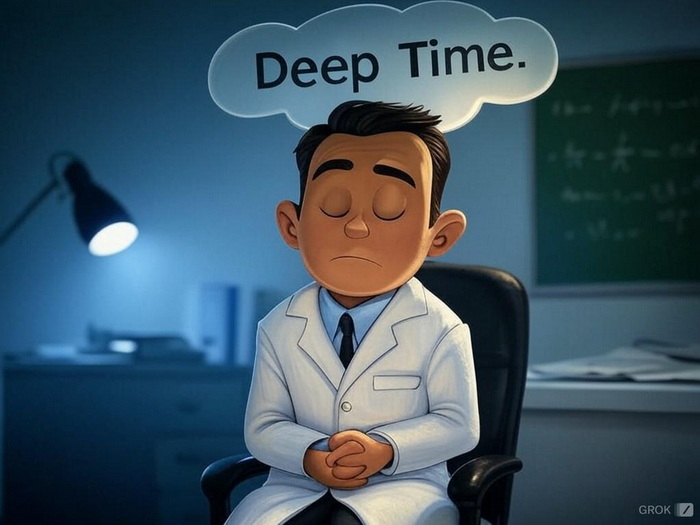
Never attempt evolutionary science without completing the required meditation exercises.
One of her experts, John Hawks, tends to be a little more honest about problems with paleoanthropology narratives, but he can’t let go of deep time, either. He just chalks it up to mystery.
The new study of 400,000-year-old enamel proteins shows that mixing of different evolutionary branches was important to our evolution, “even earlier than DNA evidence can show us,” Hawks said.
But what exactly the new results mean for the evolution of H. erectus — and the possibility that it interbred with modern H. sapiens in Eurasia — is still murky. “I think this raises the question of whether we know what Homo erectus even is,” Hawks said.
See also the paper in Nature by Fu et al., 13 May 2026.
Homo erectus’ tools include stunning geodes and fossils, possibly as a way to connect with the cosmos, study finds (Live Science, 13 April 2026). This article a month earlier shares news about “stunning geodes” found in tools by Homo erectus, with a suggestion that the “stunning” beauty of the tools carved from geodes had religious significance.
Performing divination on these artifacts, researchers from Israel dreamed that their makers were trying to “connect with the cosmos” somehow. Maybe, instead, like humans today, they just liked beautiful things. The only empirical conclusion that should be drawn is that the makers were far more intelligent than evolutionists have long claimed.
Bonus Question
 DNA study challenges thinking on ancestry of people in Japan (RIKEN, 14 May 2026). Just off the press: this study overturns previous thinking about the origins of the Japanese people, and admits that the genomes of 3,000 Japanese have traces of Denisovan and Neanderthal DNA.
By studying the genomes of more than 3,000 people across Japan, researchers have shed light on the population’s complex ancestry.
They gathered whole-genome sequences on the individuals from the north island to the south, finding some “genes inherited from Neanderthals and Denisovans” and “significant incidence of variants” in certain genes associated with disease conditions. Their conclusions challenge earlier theories of two ancestral groups, finding three ancestral populations instead.
My; what would paleoanthropologists of the 1950s have thought. The famous Time-Life “progression” diagram would have to show a wall in the middle, with apes on the left and humans on the right.
This article raises an important question. If scientists cannot deduce the recent ancestry of living human populations, how can we believe their stories about what humans were like one or two million Darwin Years ago?
Evolutionary theory demands that earlier human beings were less evolved than us. Their Hegelian mindset of endless progress demands it. But it leads to historical racism. We moderns, by implication, have had more time to evolve on the endless march of progress.
How can science clean house of this form of racism? First, eliminate Deep Time from scientific plausibility. Second, teach them that God’s word has authority over human speculation. And if they want understanding, let hem read God’s Word—starting from the first verse.
Your hands have made me and fashioned me; Give me understanding, that I may learn Your commandments. (Psalm 119:73)
Through Your precepts I get understanding; Therefore I hate every false way. (Psalm 119:104)
The entrance of Your words gives light; It gives understanding to the simple. (Psalm 119:130)