


Do Spiders Sleep? Ay, Perchance to Dream
Jumping spiders exhibit
REM-like behavior previously
associated mainly with vertebrates
When Spiders Sleep
Evidence of Unexpected Biological Sophistication
by Dr. Sarah Buckland-Reynolds
When thinking of examples of intelligent design among spiders, one often considers the magnificent aesthetic appeal of their webs and their ability to weave them. However, recent research in biology has placed another intriguing aspect of spiders in the spotlight: their apparent ability to dream.
 Behavioral evidence for two-stage sleep in spiders (Geiger et al., Proceedings of the National Academy of Sciences, 26 October 2026). The findings surprised the scientists. For decades, scientists largely associated complex sleep states, particularly REM (rapid eye movement) sleep, with vertebrates such as mammals and birds. However, emerging evidence shows that the complexities required for dreams are also present in a tiny spider.
In their words, their findings provide “the strongest evidence to date for an REM-like sleep substate in a terrestrial invertebrate.”
This article reflects on these findings and discusses the observations and their implications and challenges on an evolutionary framework.
Spider Portia Also Dreams…
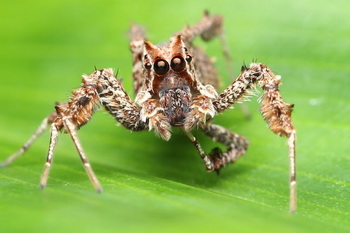
The fringed jumping spider (Portia fimbriata) can grow up to 10 millimetres long. (iNaturalist fringed spider/Kurtese Templeton/CC BY-NC 4.0), from ABC.
Geiger et al’s work investigated the Australian jumping spider Portia fimbriata with the objective to determine whether these species of spiders merely became inactive at night or whether they experienced genuine sleep.
To answer this question, they applied several independent criteria commonly used to identify sleep, including characteristic sleeping posture, behavioural inactivity, reduced responsiveness to stimuli, circadian organization, and homeostatic rebound after sleep disruption. This focus made the study significant, as, historically, measuring brain activity in tiny invertebrates presented major difficulties leaving many smaller groups of animals unexplored.
After assessing each of these criteria, they found overwhelming behavioural evidence that these spiders experience regulated sleep with at least two distinct stages, including a REM-like state characterized by retinal movements, leg curling, and body twitches.
In describing their observations, the authors mention the word “complex” at least three times, including to characterise the spider’s cognition, their lifestyle, and their environment. The spiders exhibited clear daily rhythms, becoming active during daylight hours, and entering prolonged sleep windows at night. As darkness approached, they would search for resting sites, engage in grooming behaviour, and adopt a distinct sleeping posture.
Specifically, the researchers observed that the spiders’ bodies gradually drooped; their pedipalps folded beneath the body, and movement largely ceased. These sleep periods were consistent, typically lasting over ten hours each night.
In elaborating further on measured aspects of the spider’s sleep state, the researchers describe how the spiders rebalance their system during sleep, including regulating their own temperature, and hemolymph pressure despite changes in their environment while they sleep. In their words, Portia exhibits:
“…a sleep state that is homeostatically regulated, structured, and possibly also functionally differentiated… Based on multiple independent experiments, we show that Portia met all established behavioral criteria for sleep, including a characteristic posture, consolidated quiescence, circadian organization, elevated arousal thresholds, and homeostatic rebound after disruption. Taken together, these findings provide comprehensive behavioral evidence for sleep in a spider.,”
Why REM-Like Sleep Regulation is Surprising from an Evolutionary Framework
A key aspect to consider from the paper by Geiger et al (2026) is that 109 REM-like bouts among the spiders studied were recorded, averaging approximately eleven episodes per night. Typical sleep regulation patterns found in vertebrates were also found in the spiders, e.g., sleep rebound (spiders compensating with longer sleep durations after sleep disturbance).
Why is this Surprising?
Sleep regulation is only possible if multiple physiological systems are already present and functioning together. Given the small size of spiders’ nervous systems, and expected lower cognition, as well as REM sleep in spiders being unnecessary from an evolutionary perspective, the researchers were not expecting their observations. To elaborate further, these three and other reasons raise further questions to evolutionary assumptions:
1. How can spiders’ tiny nervous systems sustain sophisticated neural architecture? REM sleep has long been associated with animals possessing relatively more complex nervous systems, making the discovery of REM-like sleep in a small-brained jumping spider particularly surprising. For instance, documenting the controlling mechanisms required for REM sleep, another article titled: Cracking the complexity of REM sleep by Dong and Liu, published in Trends in Neuroscience just last year (2025), asserted that:
“REM sleep is controlled by a hierarchical neural network, in which brainstem executive centers are modulated by hypothalamic and cerebral inputs and tuned by neuromodulatory signals. Studies leveraging component- and circuit-specific manipulations are beginning to reveal causal roles of REM sleep in memory, emotion, and higher-order cognition.”
Due to the numerous moderators required for REM, many scientists assumed that this complex sleep state would require large, highly developed brains. Contrasting the estimated number of neurons in human brains (around 86 billion neurons) with jumping spiders (estimated as less than 100,000), the difference would be around 860,000 more times!
Despite this significantly lower number, finding REM-like sleep in Portia fimbriata suggests that sophisticated sleep architecture may not depend on a large vertebrate-style brain. The authors note that spiders possess a “considerably different neural architecture” from vertebrates, making the discovery unexpected.
2. How do jumping spiders experience REM sleep when it has often been associated with higher cognition? Since in humans and many mammals, REM sleep is linked to memory consolidation, learning, emotional processing, neural reorganization, and dreaming, finding the same mechanism in jumping spiders raises the question as to whether REM functions in a similar way for jumping spiders. The paper itself suggests that REM-like activation “may indicate a brain state that supports synaptic plasticity, sensory recalibration, or the integration of experience.” In other words, the spider may be processing information during sleep in ways previously thought unlikely for such a small creature.
3. Why would the jumping spider evolve REM-like sleep when it appears unnecessary from a simplistic evolutionary perspective? If sleep merely evolved as inactivity to conserve energy, one might expect a spider simply to become motionless. Instead, Geiger et al (2026) found distinct sleep stages, internal circadian timing, specialized sleeping postures, alternating REMlike episodes, sleep rebound after deprivation, and reduced responsiveness during REM-like states. This reveals a highly organized physiological program rather than simple rest.
Geiger et al’s findings add to many similar arising questions for evolution as a recurring pattern in biology, where organisms once thought to be simple repeatedly turn out to possess unexpected levels of organization and sophistication with interdependent functionality of their systems.
Despite these observations, these findings were published in an evolutionary framework (filed under the ‘Evolution’ landing page of PNAS). Since evolutionary interpretations often emphasize the gradual emergence of increasingly sophisticated traits through long periods of modification, the origin of such integrated functionality remains a significant challenge for unguided evolutionary mechanisms.
More Questions for Darwinian Explanations
Portia’s Multiple Converging Complexities
Geiger et al’s (2026) study not the first study on this spider showing complexities. In fact, Portia has been renowned for other behavioural complexities including detour planning, having a “sophisticated visual system”, object recognition, and flexible problem solving. Although many of these tactics are presently applied in hunting in the context of a fallen world, these capabilities could have easily been designed for constructive purposes in the original creation.
Other design features, including amazing depth perception, have also been documented and modeled, with proposed applications to serve as a blueprint for an economical version of a sensor, less expensive than LIDAR.
 As Charles Darwin himself acknowledged regarding complex organs, the appearance of systems requiring multiple interacting parts can be difficult to explain through stepwise pathways if intermediate stages provide little or no advantage. With the authors stating multiple times various aspects of the Portia spider being “complex”, why would these still be interpreted in an evolutionary framework?
Evidence Consistent with Intelligent Design
From a creationist perspective, discoveries such as this are entirely unsurprising. The Biblical worldview starts with the expectation that living organisms were created with purposeful functionality and extraordinary engineering. As science advances, researchers should therefore expect to uncover levels of sophistication that were previously hidden.
For Portia’s case, we now see that even spiders’ neural capacity allows their systems to undergo complex simultaneous processes that enable REM sleep. This pattern of ‘surprising’ findings appears to now be a mainstay of biology, as structures and organisms once regarded as simple frequently reveal deeper levels of information processing, regulation, and coordination.
Even though much is left to be discovered, and direct measurements of brain activity remain unavailable in spiders, what is now known places more questions that challenge evolution, rather than align with such explanations.
In contrast, Scripture frequently directs our attention to the smaller creatures of creation as sources of wisdom and wonder. For example, Proverbs 30:28 observes:
“The spider taketh hold with her hands and is in kings’ palaces” (KJV).
The Biblical writers repeatedly present living organisms as testimonies to divine wisdom. The small, sleeping Portia spider therefore serves as a modern reminder that creation still contains countless mysteries waiting to be uncovered. Despite its small size (small enough to fit on a coin), Portia’s organism consists of a world of coordinated systems, behavioural sophistication, and finely regulated processes that scientists are only beginning to understand. May we continue to stand in awe at the enduring wonder of God’s creation, from the largest to the smallest organisms around us.
 Dr. Sarah Buckland-Reynolds is a Christian, Jamaican, Environmental Science researcher, and journal associate editor. She holds the degree of Doctor of Philosophy in Geography from the University of the West Indies (UWI), Mona with high commendation, and a postgraduate specialization in Geomatics at the Universidad del Valle, Cali, Colombia. The quality of her research activity in Environmental Science has been recognized by various awards including the 2024 Editor’s Award from the American Meteorological Society for her reviewing service in the Weather, Climate and Society Journal, the 2023 L’Oreal/UNESCO Women in Science Caribbean Award, the 2023 ICETEX International Experts Exchange Award for study in Colombia. and with her PhD research in drought management also being shortlisted in the top 10 globally for the 2023 Allianz Climate Risk Award by Munich Re Insurance, Germany. Motivated by her faith in God and zeal to positively influence society, Dr. Buckland-Reynolds is also the founder and Principal Director of Chosen to G.L.O.W. Ministries, a Jamaican charitable organization which seeks to amplify the Christian voice in the public sphere and equip more youths to know how to defend their faith.