Jerry Bergman
January 3, 2022
Let's start 2022 by honoring one of our frequent article contributors: Dr Jerry Bergman. His experience as a scientist, professor and speaker is impressive, and his credentials deep and wide. Yet he also has suffered the brunt of Darwinist intolerance, after documenting the mistreatment of dozens of others in three thick volumes about scientists whose reputations have been slaughtered, silenced and censored by Darwinist bigots. This has given him a sensitivity to the importance of the creation-evolution issue that imbues his writing with a sense of urgency. In person, though, his gentleness and humility explains his good relationships with virtually all the key creation leaders.

Henry Richter
January 2, 2018
On January 31, 2018, our Creation Scientist of the Month, at age 90, celebrated the 60th anniversary of Explorer 1: America's first satellite. He was not only present at Jet Propulsion Laboratory (JPL) on the historic day of January 31, 1958, he was a key figure in its success. Dr Henry Richter managed the satellite, its instruments, and its ground communications, and was the first to confirm that it had reached orbit.
This was before America even had a space agency. The National Aeronautics and Space Administration (NASA) was formed as a result of the success of the Explorer satellites, which had imbued Americans with a renewed sense of pride after the Russians had beaten them to space with Sputnik 1 (October 4, 1957) and Sputnik 2 (November 3, 1957). Richter continued advancing space technology as America began the race to the moon. But his own trajectory would not be smooth. Henry Richter (not to be confused with Charles Richter of 'Richter Scale' fame) would experience a series of mishaps and failures before understanding the true secret of success. Along the way, he would also find satisfying explanations for the amazing designs he grew to appreciate on his own vessel: 'Spacecraft Earth.'
Samuel F. B. Morse
May 1, 2017
Though an artist by profession, not primarily a scientist or inventor, Samuel F. B. Morse brought a scientific principle to practical use and changed the world. When the grand idea of instantaneous communication across great distances hit him, Morse caught an obsession that cost him every last penny and earned him scorn and snubbing for […]
Mystery Character
February 28, 2014
This month’s great scientist is a character from ancient history, predating even the Greeks by a long shot. Yet in many ways, he exceeded them all.
Richard Lumsden
December 28, 2012
Dr. Richard D. Lumsden was fully grounded in Darwinian philosophy, and had no reason or desire to consider Christianity. Science was his faith: the facts, and only the facts. His life took a dramatic turnaround, from Darwinist to creationist, and from atheist to Christian.
Raymond Damadian
December 28, 2012
This scientist warrants a place in our hall of fame. In fact, millions owe their life and health to him. His name is Dr. Raymond V. Damadian. He invented the MRI scanner.
James Irwin
December 28, 2012
James Irwin was not a scientist in a professional sense; he was an astronaut, and not just an astronaut, but one of the 12 people in history who has walked on the moon. But what is a scientist? If we mean by the word a seeker for truth about the universe and earth, Irwin qualifies more than most.

George Washington Carver
December 28, 2012
You have to be someone to get a National Monument named after you, and George Washington Carver was someone – not in his own estimation, but by universal acclaim. His own estimation of himself was summed up in his words, “Without my Savior, I am nothing.” He sought his Creator for guidance in all things, and gave God the credit for all his discoveries. Rightly does a National Monument deserve to be named for him, because his story is an inspiration to all Americans. It is one of overcoming odds and serving one’s fellow man, achieving greatness by good works, and devoting oneself to serving others. It is a great American success story for which black Americans, and all Americans, can justly find inspiration.
All who knew George Washington Carver were impressed by his spirituality. Carver would often rise at 4:00 in the morning and go into his favorite woods to pray. Each day he would ask, “Lord, what do you want me to do today?“ and then do it. The goodness of God and the richness of creation was often on his lips. He said, “I love to think of nature as an unlimited broadcasting station, through which God speaks to us every hour, if we will only tune in.”
Henrietta Swan Leavitt
December 28, 2012
Henrietta Leavitt was a remarkable woman astronomer, whose scientific work has been, and continues to be, of the utmost significance for our understanding of the universe. She not only overcame the gender barrier to achieve greatness in science, but physical disability as well. Her life exemplified the fruit of Christian character, and her discovery continues to expand our appreciation for the glory of God in creation.
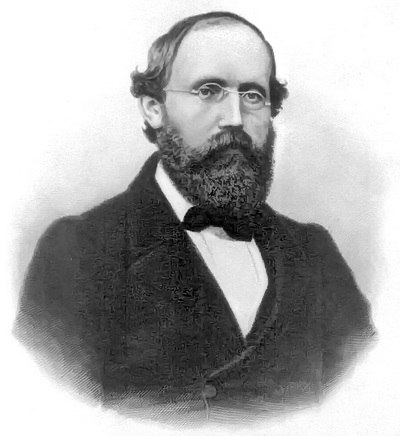
Bernhard Riemann
December 28, 2012
Here's a story about another remarkable Christian mathematician who, like Blaise Pascal, changed the world but never reached his 40th birthday: Georg Friedrich Bernhard Riemann.
John Napier
December 28, 2012
Who was the first prominent scientist from the British Isles? Who, in the early 17th century, stands in the line of pioneers of calculating machines? Who doubled the productivity of early scientists? Who according to David Hume was one of the greatest men Scotland ever produced, yet would have argued against Hume’s skepticism? A man who studied the Bible seriously, and fervently defended Biblical Christianity against error. A man whose most famous discovery would have profound impact on the sciences, yet considered his Christian faith primary and his mathematics secondary. A man most students never heard of, John Napier.

James Prescott Joule
December 28, 2012
If any principle in science deserves to be called a “law,” what would it be? Undoubtedly, the law of conservation of matter and energy: neither of these fundamental entities can be created or destroyed. Also known as the first law of thermodynamics, this law has no known exceptions anywhere in the universe. Whoever discovered this law must have been a scientist of the highest rank, a PhD, director of a reputable university research department, respected the world over, and interred in Westminster Abbey, right? Actually, he was none of the above. For him, science was just a hobby. He had trouble getting his ideas published. Professional scientists looked down on him, and were it not for the help of a friend, his work might have been lost in obscurity. Yet his experimental procedures and measurements were of the highest caliber, and the principles he deduced from them are of fundamental importance. They helped shape our modern world, and every housekeeper is a beneficiary of the discoveries he made. Units and laws of physics were named after this somewhat reserved, unassuming, serious-minded citizen scientist by the name of James Prescott Joule.
Joseph Henry
December 28, 2012
Question: Which of the following institutions is led by a born-again, Bible-believing Christian who prays for guidance and accepts the Biblical creation account as true?
Smithsonian Institution
American Association for the Advancement of Science
Princeton University science department
National Academy of Sciences
If it’s the 19th century, it is “all of the above.” These distinguished positions were held by one man: Joseph Henry. Remarkably, these honors are less important than the scientific contributions made by one of America’s foremost early scientists.
Charles Babbage
December 28, 2012
Babbage was a man trapped in the wrong century, because he envisioned the first general purpose computer– in 1832! This is one of history’s classic “if only” stories. If only the British government had approved the funding he needed, then computers might have been household items a century earlier. Despite this failure, Charles Babbage did succeed in many things, and was always strong in his Christian faith during a period of tremendous intellectual and social change in Britain. Click "Read More" to learn about his unique story, with its achievements and also with some lessons for us today.
Scroll down and click "See All" for more biographies.
Carolus Linnaeus
December 28, 2012
The convention of using two Latin names (binomial nomenclature), denoting genus and species, is the foundation of taxonomy, the science of classification of living things. It comes straight out of the work of Carl Linnaeus, a Christian and creationist, who set out on his life's quest to elucidate the Genesis kinds. He traveled far and wide on his hobby to collect, describe, and classify species, even though his profession was in medicine. His father was a Lutheran minister. The Linnaean classification scheme has survived the test of time, and the Linnaean Society continues today.