


Darwinism Dumbs Down Science
Darwinese short circuits the requirement
for rigor in scientific explanations
—Critics have been complaining about Darwinian laziness for 160 years, but it continues—
Evolutionary biologists should be forced to wear a shock collar. Every time they say “evolved,” they should get a jolt, like dogs being trained to stop barking. Maybe then they would get off their sofas and into the lab. And no fair using synonyms, like arose, emerged, or developed: rigorous scientific explanation demands connecting necessary and sufficient causes to effects, supported by observational evidence and tests that are repeatable. Evolution is not a cause; it is an assumption! Darwinians use it as a convenient magic wand to get around having to think. Peer reviewers, do your job!
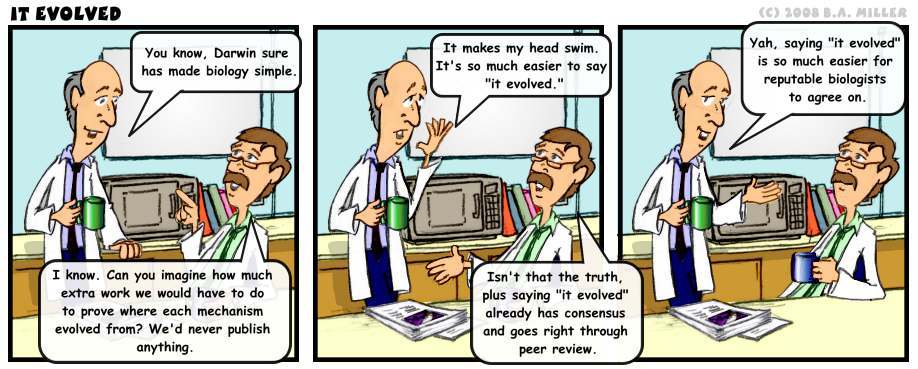
Evolution Is a Driverless Car
Long-lived lakes as a driving force behind the evolution of freshwater snails (SNSB via Phys.org, 14 Sept 2023). Lazy German scientists tossed around evolution so many times in this short press release, perhaps they thought the repetition would lull their readers to sleep. But the Darwinese in the article is nonsensical. Lakes do not drive snails to evolve! Nothing drives evolution. Did the lead researcher flunk Darwinism 101? Darwin’s car rusts on the ground, driven by earthquakes, wind and avalanches. There is no other force driving snails to evolve upward out of snaildom, unless one personifies a “struggle for existence” within material objects, like snails, who don’t care. Notice before reading these quotes that all the snails in the study started as snails and remained snails. Variation is not evolution as Darwin taught it. His disciples believe that snails had bacteria ancestors!
- A new study by SNSB paleobiologist Thomas A. Neubauer now shows the importance of these ecosystems for the evolution of freshwater snails on a global and deep-time scale.
- Neubauer has summarized the evolutionary history of snails in freshwater ecosystems over the past 340 million years. [This is a funny dangling modifier. It’s highly doubtful that Neubauer has spent 340 million years researching snails.]
- Analysis of literature and available data on distributions and diversity of species through time led to a new understanding of long-lived lakes as islands of evolution. [For more on Darwinian “understanding” see 28 May 2021.]
- Neubauer… has compiled the most extensive data set to date for fossil freshwater snails in a review to identify patterns and relationships in their evolutionary history.
 The new study on the evolutionary history of freshwater snails has now shown, among other results, that so-called long-lived lakes were the driving force behind the evolution of snails.
- During the more than 7 million years of its existence, Lake Pannon was home to about 580 species and produced many unique evolutionary lineages.
- “These rare ecosystems are archives of evolution,” Neubauer says.
- Time plays the decisive role in evolution. Only in long-lived ecosystems [do] species have enough time to ‘experiment.’

Nine jolts from the shock collar would hopefully get Neubauer’s attention. That last claim deserves a double jolt. Time has nothing to do with evolution; many Darwinians have claimed that evolution works at “warp speed” sometimes (7 Feb 2018). In other cases, Darwinians claim that no evolution occurred for billions of years (4 Feb 2015). That’s a major bad habit among Darwin storytellers: they can stretch or squish evolutionary rates as much as required to spin their myths. (Get your Darwin Gumby Action Figure here.)
Neubauer’s paper in Biological Reviews is no better, committing the same fallacies and using the e-word 7 times. Without the assumption of Deep Time, it would all unravel. Adding to those flubs, Neubauer personifies snails as needing “enough time to ‘experiment’ on their evolution. By this he projects his job onto snails! Neubauer is the one who should be running experiments.

Vocal learning linked to problem solving skills and brain size (Rockefeller University, 14 Sept 2023). An interesting article about starlings, those birds that perform huge collective aerobatic dances called murmurations (see video* at bottom), begins innocently enough:
The European starling boasts a remarkable repertoire. Versatile songbirds that learn warbles, whistles, calls, and songs throughout their lives, starlings rank among the most advanced avian vocal learners. Now a new study published in Science finds that starlings, along with other complex vocal learners, are also superior problem solvers.
Ornithologists at Rockefeller worked hard. For years, they worked to collect songbirds. They gave them a battery of tests to measure their problem solving abilities, and also measured their brain sizes as well. This was fine; it’s legit scientific research. But then they ruined it all by using the e-word evolved as a cop-out for rigorous explanation.
The suspect this time is Erich Jarvis, leader of the Jarvis Lab at Rockefeller, who cranks up the perhapsimaybecouldness index as an excuse for laziness:
Overall, the findings suggest that vocal learning, problem solving, and brain size may have evolved in tandem, perhaps as a way of increasing biological fitness. Based on these findings, as well as earlier work on the ability of vocal learners to dance to a rhythmic beat, Jarvis is now calling this collection of traits the “vocal learning cognitive complex”.
“Our findings help support a previously unproven notion: that the evolution of a complex behavior like spoken language, which depends on vocal learning, is associated with co-evolution of other complex behaviors,” Jarvis says.
Since Darwin’s mechanism equates to the Stuff Happens Law, this is equivalent to saying that traits “may have happened by coincidence” and that “the accidental happening of a complex behavior coincided with another accidental happening.” Lazy! Since when do complex traits like vocal learning, problem solving and brain size happen by accident? Jarvis just indicted himself. If his own brain happened that way, then nothing he says has any credibility.
The paper by Jarvis and his pals in Science commits the same fallacies, but puts them behind a facade of respectability by using Jargonwocky.
To explain our and these ecological findings, we suggest that a selective factor links these traits within a “vocal learning cognitive complex.” This selective factor could be a genetic component that drives coevolution of vocal learning complexity, problem-solving, and relative brain size.
What is a “selective factor” other than a made-up, nonsense Darwinian storytelling phrase? How can a mythical phrase like selective factor “drive coevolution” of brain size, problem solving and learning complexity? Has this driver passed his driving test? Where are the readings on the select-o-meter? Did the evolutionists forget that association is not causation? If three traits “co-evolved” to make some birds smarter than others, which traits were the most decisive, and by what percentage? Did they consider species that don’t follow the script? Why are some songbirds with the most vocal complexity not problem solvers? Why are some tiny birds (like hummingbirds) just as smart as big birds? Is brain size the prime measure of fitness? That notion has a long, dark history in human evolution studies. Are these guys ornithological racists, claiming that some songbirds are more evolved than others?
There are so many flaws in their reasoning, the peer reviewers at Science must have been asleep at the wheel. Either that or the journal editors are acting as co-conspirators in a long-running plot to make Darwinism look scientific. As evidence of the latter, this vapid claim made Science magazine’s cover story.
It’s reminiscent of the evolutionist who watched partridge chicks running up a hill and imagined they were replaying their evolution from dinosaurs (19 July 2016). Remember that one? It made the storyteller famous, and remained a leading hypothesis for the origin of bird flight till it was falsified 13 years later.
 Evolution wired human brains to act like supercomputers (University of Sydney, 15 Sept 2023). This article has nothing to do with evolution. It’s about the human brain’s innate capacity to perform Bayesian inference, a logical process of reasoning about probabilities of causes for effects. The very idea that Darwin’s Stuff Happens Law “wired” our brains “to act like supercomputers” is laughable.
The paper in Nature Communications behind this headline also says almost nothing about evolution. It only assumes it:
Sensory representations are thought to be tuned to behaviourally relevant statistics of natural environments over evolutionary and developmental timescales.
Who thought so? The four papers cited as reference appear to say little or nothing about evolution or deep time. Like this paper, they merely assume it. Whoever thought that “evolution wired human brains to act like supercomputers” was not thinking very hard. Did supercomputers emerge without intelligent design?
Darwin’s Fallacy Lives On
Charles Darwin notoriously conflated human acts of domestication (“artificial selection” which is a form of goal-directed intelligent design) with “natural selection” (the mindless, aimless, blind Stuff Happens Law). Critics have pointed out this logical fallacy ever since Darwin was alive, but students at universities commit it still. Are professors failing to educate their students about this fallacy?
 You Say Tomato, These UMass Amherst Scientists Say Evolutionary Mystery (University of Massachusetts at Amherst, 11 Sept 2023). Everybody loves a mystery. The mystery here is how a grad student could be so dumb.
This press release uses the e-word eight times, confusing artificial selection and natural selection into a jumbled mess. Jacob Barnett, a recent inductee into the Darwin Party, has kept busy growing all 14 known wild tomato plants in an enclosure along with a cultivated tomato plant, which grows larger, tastier fruit. That’s fine as a science project, but does it explain anything about evolution?
“Have you ever held a fresh tomato in your hand and wondered why it looks good, smells good and tastes delicious?” asks Jacob Barnett, graduate student in organismic and evolutionary biology at UMass Amherst and the papers’ lead author. It turns out that the juicy, red tomatoes with their unique flavor have a long and circuitous evolutionary history.
An embedded video clip shows Barnett holding up domestic tomatoes and a few wild species, many of which are green. Barnett suspects that some unknown critters like the taste of the green ones, even though humans don’t. A small red-colored tomato, he speculates, was chosen by humans for domestication. Thus we have big, beefy, tomatoes in our supermarkets. Great. We know about domestication that gave us poodles from wolves and sweet corn from teosinte. Now tell us what on earth this has to do with Darwinian evolution. For that, Barnett says, we need futureware!
The small, green, melon-smelling fruit may be preferred by small mammals, while the sweet, colored tomatoes are likely the favorites of birds. How humans wound up preferring tomatoes loved by birds is a mystery yet to be unraveled. Indeed, as the authors point out, we need more in-the-field studies to confirm which animals are eating which fruits: “there is currently no systematic data on which animals eat wild tomato fruits.”
The evolution-talk in this press release is fruitless. All these plants in Barnett’s garden are varieties of tomatoes. Every young-earth creationist accepts variation within species, genera, and even up to the family level. Nothing about his work distinguishes creation from Darwinian evolution. In the second place, Barnett didn’t answer the “evolutionary mystery” but tossed it like a hot potato to unspecified biologists in the future. In the third place, the bulk of his work and talk concerned intelligent design: human goal-directed domestication of tomatoes, so why even use the e-word evolution at all? Why speak of the “evolutionary history” of the tomato, when all he demonstrated was domestication? “History” without the adjective “evolutionary” would have sufficed.

It’s sad to think of Barnett getting his PhD and dumbing down the next generation of impressionable students about Darwinism. This self-perpetuating racket is a symptom of all totalitarian systems. The lack of shame, and the lack of debate, lowers standards and leads to laziness. A system free of debate rewards lies. Once flush with power, totalitarians always work to keep their culture isolated from alternative voices. In the Soviet Union, control over messaging was achieved both by creating state-certified media and by jamming radio messages from outside. In academia, it is achieved by D.O.P.E. as pictured in the cartoon above, and by rewarding students who wear their “I’m with D.O.P.E.” uniforms.
It seems hopeless. But you can help. You can promote our messages on X (formerly Twitter) at @crevinfo, and try to get more students to read our exposés of the Darwin storytelling racket. Help make it cool for rising students to question the official D.O.D.O. narrative. Maybe the Design Revolution will gain momentum, and finally snowball into lasting change.
*For relief from Darwin storytelling, watch some real science about starlings. This gem is from Illustra Media. It shows how to bring awe and wonder back into biology, which, in response, can stimulate quality scientific research.