


How the Body Cleans Itself
Although marketing today
implies otherwise, the body
is very well-designed.
Things I Wish I Had Known When I Taught Anatomy
by Jerry Bergman, PhD
I taught human anatomy at the college level for over 20 years. In the past decade, anatomists have learned so much that, if I taught anatomy today, I would cover several topics very differently than I once did. An example is a new article by Michelle Spear, an anatomy professor at the University of Bristol. She has opened up a totally ignored topic: “Whole-body deodorants: A solution to a non-existent problem.”[1]
Whole-body deodorants, the marketing people claim, negates the need to buy different deodorants for different parts of the body. Instead of buying a shelf full of deodorants, a single one is less costly and more efficient. In response, Spear says in her article,
Whole-body deodorants are marketed for areas beyond the armpit, most commonly feet and intimate areas – but the premise that these areas are inherently dirty is misleading. In fact, the body is a finely tuned biological system that has been self-regulating for millennia. The notion that you need expensive products to achieve basic hygiene is a fallacy rooted in marketing, not science.[2]
Furthermore, the now widely marketed
Whole-body deodorants have joined the lineup of intimate washes, douches, and steaming kits, with internet searches for these deodorants massively increasing since 2023. All promise to do what your body is already masterfully equipped to handle: keeping itself clean and functioning.[3]
The fact is that design is evident in every part of the body, even in some parts that appear to have nothing to do with survival, such as preventing body odor. In this case our creator has paid attention to the smallest details.
The Cause of Body Odor

Our skin has self-cleaning properties.
The major cause of body order is microbes, specifically malodor-producing bacteria. A minor cause occurs when apocrine sweat gland secretions, usually odorless, are metabolized by normal skin flora, resulting in malodor. [4] One approach to deal with this issue is deodorants, most of which “including aluminum antiperspirant salts, inhibit the growth of malodorous bacteria. These metallic salts also reduce sweat by blocking the excretory ducts of sweat glands [see Figures 1. and 2.], minimizing the water source that supports bacterial growth.”[5] Blocking the excretory ducts of the sweat glands is a problem because sweating is critical for thermoregulation control to keep the body at the correct temperature. Both hypothermia and hyperthermia can be lethal.
The Contact Dermatitis Problem
The topic of deodorants has a special interest to me because I learned many years ago that I was allergic to almost every over-the-counter deodorant. My dermatologists advised me that I did not have a problem that a daily shower would not fix. He was ahead of the time. In fact, deodorants are a leading cause of contact dermatitis.[6] One study of participants (N = 17,716) that were consecutively patched-tested with fragrance markers found 10.1 percent had fragrance allergies, of which 42.1 percent were caused by a cosmetic product. Deodorants accounted for 25 percent, and scented lotions, 24.4 percent. Deodorants were significantly more likely to be listed as the cause of fragrance allergies in men compared to women.
The Human Body Is Well-Designed, Largely Negating the Need for Deodorants
Deodorants promise to achieve “what your body is already masterfully equipped to handle: keeping itself clean and functioning.”[7] Apocrine sweat glands in the armpits and feet produce lipid-rich secretions that can lead to body odor when broken down by bacteria. Although the sweat is odorless, when trapped in moist, warm environments such as socks or shoes, the skin bacteria break down sweat components, releasing compounds that cause odor.
The feet are equipped with the highest concentration of sweat glands in the body– about 250,000. The moisture from sweat serves several important functions including reducing friction between the skin and footwear, and preventing skin cracking by keeping the skin supple. Cracking creates entry points for infections.[8] After a workout that causes profuse sweating, a quick shower is all that is required to deal with the problem.
Examples of Good Design
An example of design to reduce the problem of body odor includes the female reproductive organ. In fact, the
vagina is one of the most misunderstood parts of the body when it comes to hygiene. Despite its remarkable ability to maintain its own health through a delicate balance of pH and beneficial bacteria, an entire industry exists to sell products that disrupt this natural system. … these products often cause the very issues they claim to solve, such as infections or irritation.[9]
Furthermore, central to its self-cleaning process is a built-in function called vaginal discharge. The discharge consists of water, mucus, and cells shed from the vaginal lining which flushes out bacteria and dead cells.[10]
For men, intimate washes and deodorizing sprays are claimed to be essential for modern grooming. In fact, the scrotum is “more than just a protective pouch for the testes; it is also a thermoregulatory organ designed to maintain an optimal temperature for sperm production. To achieve this, the scrotum is equipped with eccrine sweat glands.”[11] These small, coiled structures are located within the dermis that “function by releasing sweat through ducts that open directly onto the surface of the skin. This sweat evaporates, dissipating heat and helping to cool the scrotum.”[12] Odor is not a problem in healthy men because, in contrast to the apocrine sweat glands, eccrine glands do not produce lipid-rich secretions that can lead to body odor when broken down by bacteria. For this reason, unless infected with pathogenic bacteria, scrotum sweat is typically odorless.
Summary
Dr Spear focuses on how the body is designed to keep it self clean with only minimal help. These few examples illustrate the fact that, for healthy men and women, complex systems have been designed to reduce odor and promote cleanliness. Natural selection is used to explain the design of major body organs. but does not explain the design employed to deal with what are often relatively minor issues, such as unpleasant odors. Actually, these systems are very difficult to explain by natural selection. These designs are not survival issues but largely comfort concerns.
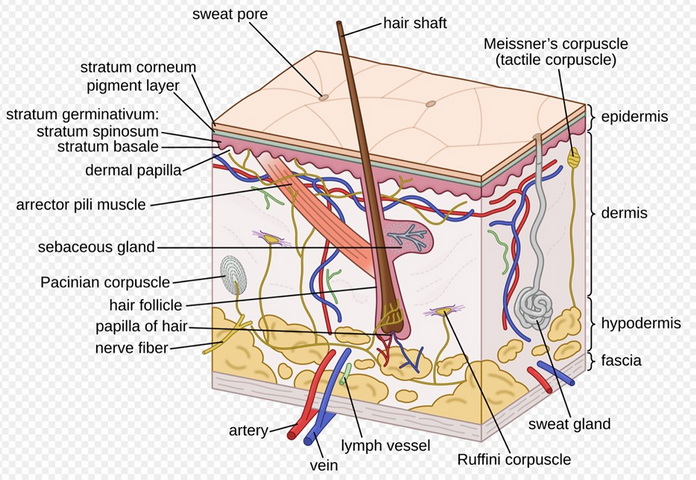
Figure 1. A diagram of a typical sweat gland illustrating its complexity. From Wikimedia Commons.
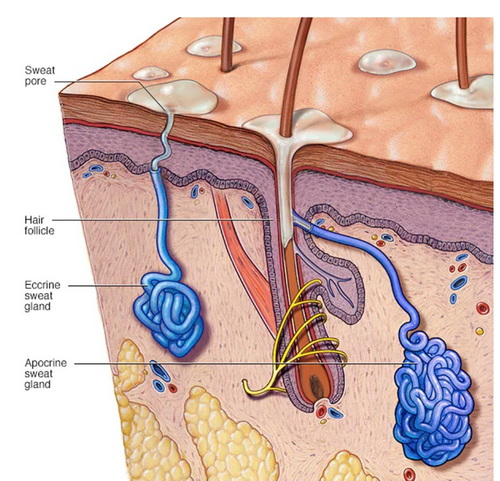
Figure 2. Sweat gland showing both the eccrine and apocrine glands. Notice that the apocrine empties into the hair shaft and the eccrine glans opens up in a sweat pore. From Wikimedia Commons.
References
[1] Spear, Michelle, “Whole-body deodorants: A solution to a non-existent problem.” https://theconversation.com/whole-body-deodorants-a-solution-to-a-non-existent-problem-247726, 2025.
[2] Spear, 2025. Emphasis added.
[3] Spear, 2025.
[4] McManus, K., et al., “Terminalia ferdinandiana Exell. Extracts inhibit the growth of body odour-forming bacteria,” International Journal of Cosmetic Science 39(5):500-510, October 2017.
[5] Kanlayavattanakul, M., et al., “Body malodours and their topical treatment agents,” International Journal of Cosmetic Science 33(4):298-311, 15 March 2011.
[6] Andersen, K.E., et al., “Deodorants are the leading cause of allergic contact dermatitis to fragrance ingredients,” Contact Dermatitis 64(5):258–264, May 2011.
[7] Spear, et al., 2025.
[8] Spear, et al., 2025.
[9] Spear, et al., 2025.
[10] “Vaginal discharge,” https://www.nhs.uk/conditions/vaginal-discharge/, 15 February 2024.
[11] Spear, 2025.
[12] Spear, 2025.
 Dr. Jerry Bergman has taught biology, genetics, chemistry, biochemistry, anthropology, geology, and microbiology for over 40 years at several colleges and universities including Bowling Green State University, Medical College of Ohio where he was a research associate in experimental pathology, and The University of Toledo. He is a graduate of the Medical College of Ohio, Wayne State University in Detroit, the University of Toledo, and Bowling Green State University. He has over 1,900 publications in 14 languages and 40 books and monographs. His books and textbooks that include chapters that he authored are in over 1,800 college libraries in 27 countries. So far over 80,000 copies of the 60 books and monographs that he has authored or co-authored are in print. For more articles by Dr Bergman, see his Author Profile.