



Human-Chimp Similarity Drastically Reduced
A stunning overturn of
evolutionary dogma
has been announced
The Human and Chimp 98% Similarity Reduced to 84% [1]
by Jerry Bergman, PhD
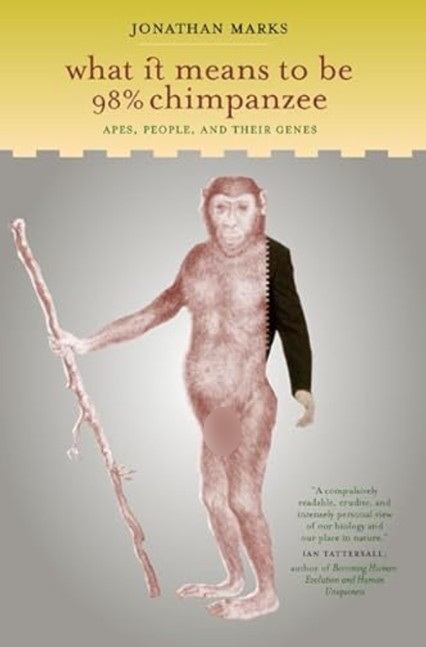
Illustration of the cover of a popular book arguing for the two percent difference between the genomes of chimps and humans.
A major argument for human evolution is the claim that human and chimp similarity is 97 or 98 percent. For example, Bill Nye ‘the Science Guy’ wrote this in his bestselling book Undeniable: “Since scientists and engineers developed machines and chemical reagents that can determine the exact sequence of chemical bases in strands of DNA, we have discovered that humans and gorillas share 97 percent of their genetic code.” He then added that “the genetic separation between humans and chimpanzees… [is] just 1.2 percent different.”[2] The graphic shows the cover of a book written by Jonathan Mitchell Marks, a professor of biological anthropology at the University of North Carolina at Charlotte. Another example is the Human Origins exhibit at the Smithsonian Institution’s National Museum of Natural History, which explores the degree of genetic difference between humans and apes. Museum exhibits A, B, and C claim the following statements are fact:
- Humans and chimpanzees are “98.8% genetically similar,”
- Humans and gorillas are “98.4% genetically similar,”
- Humans and orangutans are “96.9% genetically similar.”[3]
Google’s Artificial Intelligence Is Both Intelligent and up to Date.
I have long been skeptical of Google’s artificial intelligence (AI) conclusions because, from my experience, it assumes that human evolution is an undisputed proven fact. I typed in “human and chimp similarity is 98 percent, proving human evolution” into the search bar and was surprised at the unbiased accurate response which was produced. The following answer (italics added, bold was in the original) was produced by AI:
While it’s true that humans and chimpanzees share a high degree of genetic similarity, often cited as 98%, this number is not a universally accepted figure and is often misrepresented. The 98% figure is generally understood to refer to the similarity of aligned regions where the DNA sequences can be compared directly, but it doesn’t account for differences in non-aligned regions or larger-scale genetic changes like insertions and deletions. More recent studies suggest that the actual genetic similarity between humans and chimpanzees is closer to 84% or 96%, depending on the method of calculation.[4]
For those unfamiliar with Google AI, it completes a comprehensive survey of the relevant literature, which is revealed by the long URL shown in the footnote below. Even if we assume that the 98 percent similarity between humans and chimps is a documented fact, there are still major problems with the claim that this 98 percent number proves evolution. This is illustrated by the following observations:
- Similarity does not prove causation. All it proves is that humans are very similar to chimps. Other examples include Nye’s claim that we are 97 percent similar to gorillas, quoted above, which does not prove we evolved from gorillas, which was once held by some paleontologists in the past. Similarly, the fact that we share 95 percent of our genes with mice does not mean that humans evolved from mice. If research proved we are 98 percent genetically similar to mice and 94 percent similar to chimps, it still would not suggest that mice are our closest ancestors instead of chimps.
- Geneticists naturally expect a large genetic similarity between humans and chimps. Most of their internal organs, muscles, enzymes, and bones are close to, if not identical to, humans.
- A major problem with comparisons of human and chimp DNA stems from the evolutionary idea that humans and chimpanzees share a common ancestor rather than direct evolutionary lineage. For this reason, the only truly valid comparison is between modern humans and our “common ancestor.” The problem with this option though, is that our supposed common ancestor is a hypothetical. No agreement exists among paleontologists on this hypothetical pre-human primate. To be more specific, even if we include the Homo group, the Australopithecus group, the Paranthropus group, and the Ardipithecus group, there is no scientific consensus even as to which primate family our ancient common ancestor belonged to. Currently, genetic comparisons are based on hypothetical groups presumed to resemble modern chimpanzees, complicating our understanding of human evolution.
- A few genes can make an enormous difference in the adult organogenesis. Females are XX and males are XY. XO genetic females are still clearly females (I know because I have worked with Turner’s syndrome clients), although some health problems result from Turner’s syndrome. The Y chromosome contains only about 100 protein-coding genes, while the X chromosome is closer to 1200. Although the X chromosome produces large phenotype differences, some minor differences exist in every body part in males, including bones, muscles, hormones, enzymes, and all body organs due to the Y chromosome.
- The main problem with genetic comparisons is that only 1 to 2 percent of the human genome codes for proteins. The uncertainty about the exact number of protein-coding genes highlights how much about the genome is still unknown.[5] Two is twice the number of one. The rest of the genome has regulatory functions and other functions, such as that of telomeres which are chromosome “caps”. The remaining 98+ percent of the human genome does not code for proteins. A single protein can be modified in myriad ways after being produced, consequently producing great non-genetic controlled diversity. Contrary to earlier evolutionary assumptions, the rest of our DNA is not junk. Non-coding regions serve structural purposes, or are essential for complex gene regulation. Many of the large-scale differences between humans and chimps include insertions, deletions, duplications, inversions, and other large-scale differences. Biochemists now realize the critically important complex non-coding RNA transcriptome which is not directly compared in gene comparisons. Every week, more is learned about the genomes’ roles. The problem is that, since much of the genome remains poorly understood, such comparisons can be both problematic and misleading. A big problem is we are often attempting to compare DNA sections that are so different that they are uncomparable.

Click to see the Short Reel on this article on our YouTube channel!
Comparison differences also depend on the method used to make the comparisons. A new software package called Progressive Cactus is far more accurate than most older systems on the market. The study cited in this review by Yoo et al. (Department of Genome Sciences, University of Washington School of Medicine, Seattle, WA, USA) used complete, de novo, telomere-to-telomere genome sequences of somatic genes from the primates examined. This method identified a human–chimpanzee difference of 14.0% to 14.9%, indicating a maximum similarity of approximately 85.1%. There are three billion nucleotide base pairs in human DNA, so a 15% difference would equal 450,000,000 base pairs. In short, the Yoo et al. study of genetic comparisons documents that a genetic chasm exists between humans and chimps that evolutionists believe was somehow bridged by genetic mutations.
Another comparison using the Progressive Cactus alignment for diploid comparisons produced a 79.88 percent similarity for a 1:1 correspondence between the human and chimp X chromosome nucleotides. The resulting 20.12 percent difference is an even greater difference than the somatic chromosome comparisons which found a 15 percent difference.[6] These “complete” genome drafts used methods that are vastly improved over previous ape genome drafts, producing far more accurate comparisons.
Conclusions
The Yoo et al., study is proving to be one of the most significant challenges to the evolutionary model of human origins in recent decades. It directly undermines the long-held claim that humans and chimpanzees differ by only 1–2% at the genetic level—a figure that has been repeated as scientific dogma for over 30 years. While concerns about this estimate existed from the start, the new findings support the view held by many creationists and proponents of Intelligent Design: that an unbridgeable gap exists between human and chimp genomes. This is yet another example where objective science appears to have falsified evolution dogma. Despite the profound implications, the study’s key results were not highlighted in the main text, or on the cover of Nature, but instead were buried in a 178-page supplementary section accessible only to those with advanced expertise in genetics.
Illustration of the cover of a popular book arguing for the two percent difference between the genomes of chimps and humans.
References
[1] Yoo, D., Rhie, A., Hebbar, P. et al. Complete sequencing of ape genomes. Nature 641, 401–418 (2025). https://doi.org/10.1038/s41586-025-08816-
[2] Nye, B., Undeniable. Evolution and the Science of Creation, St. Martin’s Press, New York, NY, p. 259, 2014.
[3] Luskin, C., “Letter to the Smithsonian: Correct your signage on human-chimp genetic similarity!,” https://evolutionnews.org/2025/05/letter-to-the-smithsonian-correct-your-signage-on-human-chimp-genetic-similarity/, 2015.
[4] https://www.google.com/search?q=human+and+chimp+similarity+is+98+percen%2C
[5] Piovesan, E.A., et al., “Human protein-coding genes and gene feature statistics in 2019,” BMC Research Notes 12(315):1-5, https://link.springer.com/article/10.1186/s13104-019-4343-8, 4 June 2019.
[6] See Luskin, C., “Additional method of analysis confirms human-chimp genomes are about 15 percent different.” https://evolutionnews.org/author/cluskin/, 2025.
 Dr. Jerry Bergman has taught biology, genetics, chemistry, biochemistry, anthropology, geology, and microbiology for over 40 years at several colleges and universities including Bowling Green State University, Medical College of Ohio where he was a research associate in experimental pathology, and The University of Toledo. He is a graduate of the Medical College of Ohio, Wayne State University in Detroit, the University of Toledo, and Bowling Green State University. He has over 1,900 publications in 14 languages and 40 books and monographs. His books and textbooks that include chapters that he authored are in over 1,800 college libraries in 27 countries. So far over 80,000 copies of the 60 books and monographs that he has authored or co-authored are in print. For more articles by Dr Bergman, see his Author Profile.
Comments
Thank you for mentioning this specific point in the “Complete sequencing of ape genomes” paper. It does seem like it would be of interest to many people. I admit I would’ve appreciated a more precise pointer to the data in question considering you mention that they “were buried in a 178-page supplementary section.” I had to dig through the supplementary material (https://static-content.springer.com/esm/art%3A10.1038%2Fs41586-025-08816-3/MediaObjects/41586_2025_8816_MOESM1_ESM.pdf) myself and see that the methods behind the estimates and the estimates themselves are on pages 25-27.
The study used two different metrics of divergence, one with single-nucleotide variants and one with nucleotide gaps. The former method gives the usual 1-2% divergence estimate between humans and chimps and the latter gives the 14-16% estimate. So as Google AI said, different methods give different results and it’s not just that one method is “objectively” better but arguably a semantic issue over the time “difference”. The authors also caution that the gap estimate doesn’t just represent real mutations but also “missing data, or technical problems (e.g., alignment failure due to SVs, repetitive elements, etc.)”. Additionally, the gap difference within humans was estimated at about 3-4%. So with those factors in mind the 14-16% may be an overestimate if we’re interested in only true species differences. I’m sure the value is still higher than 1-2% by any reasonable definition though and I’m sure people will keep doing studies of this sort.
Hello Nick; thanks for your concern. You may wish to read Casey Luskin’s articles about the comparison, where he not only studied the Supplementary Material but found additional independent evidence for a difference on the order of 15%.
https://evolutionnews.org/2025/05/additional-method-of-analysis-confirms-human-chimp-genomes-are-about-15-percent-different/
Response from Dr Bergman: “Thanks for the note which again shows how difficult it is to make the comparisons. I did not include the material you noted because, again, problems exist in all conclusions attempting, as I noted, comparing data that is not fully comparable! This is clear in your noting that the gap estimate doesn’t just represent real mutations (I assume you mean gene differences) but also missing data, or technical problems (e.g., alignment failure due to SVs, repetitive elements, etc.). More research is needed. Thanks for the feedback. When we know more about the genome this will help us understand these differences.”