


Is Scientific Objectivity a Complete Myth?
It is better to assume
objectivity and be wrong,
than deny it and be forever lost
Of Myth and Man: The Dialectic Dominants
by John D. Wise, PhD
In my last article, I called out the “Disney Effect” in anthropology—how scientific-sounding stories smuggle in mythical narratives. This week, a professor writing at The Conversation offers another specimen:
Scientific objectivity is a myth: cultural values and beliefs always influence science and the people who do it” (The Conversation, 4 September 2025).
At one level, this is old news. Christians, philosophers, and skeptics of scientism have been saying it for decades: scientists are not neutral arbiters. Like everyone else, they bring assumptions, values, and cultural baggage to the lab, the field, and the lecture hall. For pointing this out in the past, we were labeled “anti-science.” But now, dressed up in postmodern academic robes, the very same critique is suddenly wise and sophisticated—at least in its own eyes.
Stop here and there is little more to say. But if last week’s book review in Science evoked comedy, this article is tragedy, the heart-rending death of something I’ve held dear my whole life.
The article begins with a promising nod to Thomas Nagel’s critique of the “view from nowhere.” Yes—science is human, scientists are biased, objectivity is never perfect. On our side we have reason to welcome this recognition echoing from Science’s own proud halls. Take, for instance, this thought, which Creation scientists and others have pointed out for decades:
Every experiment also has assumptions baked in – things that are taken for granted, including definitions. Scientific experiments can become self-fulfilling prophecies.
The first clause is true enough. But watch the slippage: from “assumptions baked in” (which every honest philosopher of science concedes) to “self-fulfilling prophecies.” What began as recognition of bias, a local critique often leveled at specific scientific conclusions, suddenly becomes a global denial of discovery itself. In this context (as we shall see), this is not just an admission of fallibility—it is the suggestion that science is little more than sanctioned divination.
Might we just take it as ‘at last, a little humility?’ A breath of fresh air after last week’s Disney dogma?
Hardly. Almost immediately, the article veers off the Socratic middle path into relativist fogma.
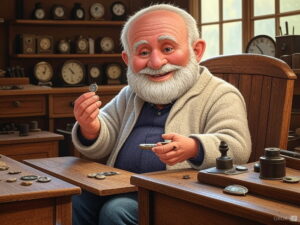
Blind Watchmaker seeking to combine incompatible causes: chance and function.
Blindness as Willful Ignorance
Here those cherished insights collapse into blindness. For the article insists: if “pure objectivity is impossible,” it must be illusory. If we cannot achieve perfect neutrality, then knowledge is not discovered but created. The author writes:
If removing all bias is impossible, then, how do people create knowledge that can be trusted? The understanding that all knowledge is created through cultural processes does allow for two or more differing truths to coexist.
Pause on that.
Two or more “truths” coexisting? If truth can be plural, contradictory, and culture-bound, then “truth” has been emptied of meaning. Once truth is a matter of manufacture, it ceases to be truth. It is just a product, endlessly customizable to fit the tastes of the moment. Science, reduced to this level, becomes indistinguishable from myth-making which, excepting physics and technology, it has been slouching toward since the 19th century.
This is the false dilemma: objectivity is either divine purity or social construction, either omniscient neutrality or total relativism. By rejecting the regulative ideal of objectivity because we cannot embody it perfectly, the very possibility of truth collapses.
And here irony piles on irony: the very logic that sneers at “binaries” ends up enthroning one of the starkest binaries of all—objectivity as fantasy, or objectivity as omniscience. Nothing in between. Once again, a reasonable insight—some binaries are false—refuses to stay within its banks, sweeping away the branch it sits on.
Without genuine distinctions, science cannot even begin. Eliminate categories, and you don’t liberate knowledge—you abolish it.
The Binary That Devours All
The article takes aim at categories such as rationality vs. emotion, or male vs. female, declaring them modern “inventions”:
For example, billions of dollars have been spent on trying to delineate sex differences. However, the definition of male and female is almost never stated in these research papers. At the same time, evidence mounts that these binary categories are a modern invention not based on clear physical differences.
Watch and share this Short Reel about this article! Click to view it now.
If male and female are mere cultural inventions, why stop there? Atom vs. molecule? Cause vs. effect? True vs. false? By dissolving binaries, the author dissolves the very substance of science. Without boundaries, there is no inquiry—only flux. The pre-Socratic Cratylus said ‘you cannot step in the same river twice,’ because the river is always flowing. Heraclitus went further: ‘you cannot step in the same river even once’: there is no river, no stepping, no you—only unending change. Stasis, category, fact – all are fictions. This is the logic (Hegel’s) the article now embraces—and it eats science alive.
History Rewritten
The willing blindness deepens as history is pressed into service:
Science grew to be synonymous with objectivity in the Western university system only over the past few hundred years.
Really? Plato and Aristotle wrestled with objectivity. So did Augustine, Aquinas, Descartes, Hume, Kant, Newton, Faraday, Maxwell—all of them struggled with bias, method, and the limits of human reason. No serious thinker ever believed science, the human investigation of causal structures, descended from heaven shrink-wrapped in neutrality. Yet here the author’s retelling erases two millennia of philosophy in order to install postmodernism as the liberator from a naïve myth. When science embraces history as human construct, myth has triumphed not over science, but through it.
Are we seeing a pattern?
The Final Self-Contradiction
The coup de grâce arrives in the concluding paragraph of the article:
With this knowledge, researchers can more carefully consider their own assumptions, and the ways those assumptions might influence their work.
“With this knowledge”? What knowledge? By their own standard, “knowledge” is just another cultural artifact. The author cannot finish a sentence without collapsing into contradiction. They deny the ground of truth even as they try to stand on it. Regrettably, this is a metaphor for much that passes for science today.

The Fatal Exchange
By adopting Methodological Naturalism to bar the “divine foot,” science enthroned a counterfeit deity in its place: Hegel’s Spirit, the dialectic of flux, the immanent Absolute of Mother Earth. This was not forced upon science from outside—it was science’s own self-inflicted wound. Excluding transcendence, it deified Immanence.
This is also a prime example of what I’ve called the Haidt Effect. (See Part 1 and Part 2). Science admits local problems—bias, assumptions, cultural baggage—but treats them as glitches to be patched. The deeper rupture caused by its Hegelian-Darwinian logic remains untouched. Each “fix” worsens the disease, even when it puts its finger on a very real problem.
It is death by a thousand cuts.
The Asymptotic Irony
Yet the irony is inescapable: the infinite complexity promised by Hegel’s dialectic cannot be contained in immanence. The more science uncovers reality at all scales, the more it asymptotically points beyond itself—toward the Transcendent it tries to banish. By rejecting God, science invited a counterfeit god in His place—impersonal and remorseless—that now consumes it, demanding absolute fealty.
The Only Path Forward
It is better to assume objectivity and be wrong, than deny it and be forever lost. An answer, however imperfect, can be corrected if Reality is stable. But if there is no right or wrong, no true or false, no objectivity, then progress is impossible, and freedom illusory. We are flotsam borne along by the flow.
The Socratic path—the Christian path—is different. Ideals guide us even when we fall short. Justice is never perfect, yet we pursue it. Holiness is never achieved, yet by God’s grace it remains our calling. So too with truth.
We fail, but the ideal stands.
For Whom the Bell Tolls
The Conversation article is not an outlier. It is the logical fruit of a tree planted long ago. Once science embraced Methodological Naturalism to exclude the “divine foot,” it crowned another god in its place: the dialectical Spirit of Progress, immanent and self-justifying. But this god cannot sustain the very enterprise it pretends to underwrite.
And now, at last, the mask has slipped. The article openly admits what has long been denied: objectivity, truth, even reality itself have been reduced to cultural manufacture. Science has not banished myth. Science, insofar as it embraces this vision, has become myth.
But unlike Disney’s fairy tales, this myth does not charm. It consumes. It erases the distinction between truth and error, discovery and invention, male and female, reason and fantasy. It abolishes the very categories that make science possible.
Here is the watershed. Either science recovers the Socratic-Christian ideal—that truth exists, even if we only approximate it—or it dissolves into self-consuming relativism. The pretended neutrality that banished God was never neutral. It was a suicide note, written in the name of “objectivity,” and its logical promise has now come due.
This is not a bug in the system. It is the system.
 John Wise received his PhD in philosophy from the University of CA, Irvine in 2004. His dissertation was titled Sartre’s Phenomenological Ontology and the German Idealist Tradition. His area of specialization is 19th to early 20th century continental philosophy.
He tells the story of his 25-year odyssey from atheism to Christianity in the book, Through the Looking Glass: The Imploding of an Atheist Professor’s Worldview (available on Amazon). Since his return to Christ, his research interests include developing a Christian (YEC) philosophy of science and the integration of all human knowledge with God’s word.
He has taught philosophy for the University of CA, Irvine, East Stroudsburg University of PA, Grand Canyon University, American Intercontinental University, and Ashford University. He currently teaches online for the University of Arizona, Global Campus, and is a member of the Heterodox Academy. He and his wife Jenny are known online as The Christian Atheist with a podcast of that name, in addition to a YouTube channel: John and Jenny Wise.