


‘Hobbit’ Research Is Forcing a Revision of Human Evolution
Well-proportioned small
humans can be fully
explained biologically
by Jerry Bergman, PhD
The “Hobbits” (Homo floresiensis), also known as “Flores Man,” are an extinct human people group once theorized by some researchers to be an evolutionary transition toward modern humans. This was partly because, like Australopithecus sediba, they appeared to show a unique combination of both primitive and advanced human-like features.[1]
However, many paleoanthropologists now regard Homo floresiensis as anatomically human individuals affected by genetic mutations or environmental factors associated with life on small islands—a phenomenon known as insular dwarfism. These mutations are thought to have slowed the growth of both their bodies and brains.
History of the Fossil Discoveries
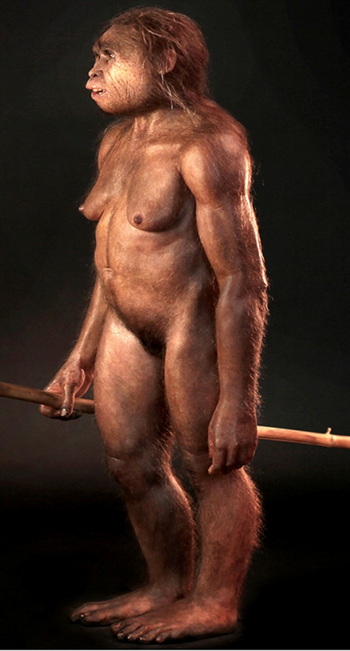
An artist’s conception of the Hobbit. The artist portrayed this female with an ape-like face and a body build like a male weightlifter. From Alex, Bridget, Science, 6 August 2024.
Partial Hobbit skeletons, including leg bones, hands, feet, a partial pelvis, and one complete skull from 15 individuals, were recovered in 2003. The Hobbits inhabited the small Indonesian island of Flores. They stood about 3 feet 6 inches tall, and their skull volume was roughly one-third that of an average modern human. They were considerably shorter than even the smallest modern human populations, such as the Mbenga and Mbuti tribes, whose average adult height is about 4 feet 11 inches.
The first discovered skull was initially thought to belong to a child. However, further analysis—such as the presence of erupted wisdom teeth and fully developed brow ridges—led researchers to conclude that the remains were those of an unusually small adult human.
Interpretating With an Evolutionary Lens
This case illustrates how new human fossil discoveries are often interpreted within an evolutionary framework. Researchers often attempt to fit such finds into general evolutionary expectations or use them to support specific theories of human evolution.
Nonetheless, despite the modern human features, some still argue for an evolutionary link, arguing that the evidence “strongly supports the idea that H. floresiensis evolved from H. erectus on Java.”[2] In a press release in Science by Bridget Alex last year, evolutionists admit that
the exact lineage [of the Hobbits] is debated. The most prominent theory is that they evolved from a larger hominin, like Homo erectus, that became isolated on the Indonesian island of Flores and underwent a process called island dwarfism, becoming progressively smaller due to limited resources. However, some recent studies have challenged this theory, suggesting they may have evolved from a more primitive, pre-erectus ancestor.[3]
Placing Hobbits in Evolutionary Time
This speculation argues that the Hobbits represent a “missing link” in human evolution that eventually stopped evolving, surviving for ages in an unchanged form. In the words of Peter Brown, a paleoanthropologist at the University of New England in Australia, and archaeologist Michael Morwood, they were a “previously undiscovered species of archaic human that had survived for thousands of years after the Neanderthals had died out.”[4]
The proposed dates for when the Hobbits lived are enormous guesstimates. One anthropologist suggested that they evolved their small stature about 700,000 years ago. They descended from a much taller human ancestor, Homo erectus, who had migrated from neighboring islands and then gradually shrank to hobbit size over roughly 300,000 years.[5] Another estimate notes that archaeologists later recovered stone tools in the same area the Hobbits lived that “were at least 1 million years old, indicating some member of the human evolutionary branch, or hominins, made it to Flores by then.”[6]
A New Opinion on the Hobbits Is Biological, Not Evolutionary

Another artist’s concept of the Hobbit, which illustrates tremendous evolutionary bias and artistic license. Both of these illustrations are based on the same fossils. From Wikimedia Commons.
The latest research by paleoanthropologists Monson and Weitz, presented in The Conversation on 24 September, argues that the small stature of the Hobbits from Flores was due to a slowdown in growth that occurred during childhood.[7] In other words, their size was likely an anomaly caused by abnormal hormonal variations that can be explained biologically.
Specifically, their reduced size is thought to have resulted from disruptions in the regulation of human growth hormones. These growth hormones (GH) include GH-binding protein (GHBP) and insulin growth factor-I (IGF-I). They explained that the
formation of the brain and the teeth are[is] inextricably connected during gestation. And for most species, larger brains are correlated with smaller wisdom teeth…. There are two primary ways for brain size to decrease: by slowing down growth during gestation before birth or by slowing down growth after birth, during childhood. Because teeth develop early in gestation, slowing down growth rates during pregnancy tends to affect tooth shape and size, or even whether the teeth develop at all. Slowing growth later, during childhood, influences skeletal shape and size in other ways, because different parts of the body develop at different times.[8]
Here is their explanation for the small body size of Homo floresiensis: The Hobbits
likely shrank from a larger-bodied Homo ancestor by slowing down growth during childhood. The Hobbits’ small wisdom teeth suggest that, at least in utero, they were on track for the proportionally bigger brains that are the trademark of humans and their relatives. Any brake that slowed down brain growth likely occurred after birth. … this is the same mechanism through which some short-statured modern human populations have adapted to their local ecological conditions.[9]
Other research on Pygmies and other small-bodied human populations has supported this theory.[10]
Efforts to Maintain an Evolutionary Story
Still wanting to Darwinize these humans, evolutionists are trying a reassessment of certain evolutionary assumptions:
Until Homo floresiensis was discovered, scientists assumed that the evolution of the human lineage was defined by bigger and bigger brains. Via a process called encephalization, human brains evolved to be relatively more massive than would be expected based on corresponding body size. This proportionally bigger brain is what anthropologists argued enabled us and our relatives to perform more complex tasks such as using fire, forging and wielding tools, making art, and domesticating animals. But these theories had to be thrown out the window when archaeologists announced our fossil cousins Homo floresiensis via scientific publication in 2004. Homo floresiensis lived from about 700,000 to 60,000 years ago in the rainforests of Indonesia, partially contemporaneous with our own species.[11]
The discovery of Homo floresiensis motivated researchers to look beyond Africa for evidence of early human evolution. As one study noted,
“Although some of the first hominid remains were recovered from southeast Asia, the vast majority of paleoanthropological expeditions since have been focused on sites in Africa and Europe. More and more attention is now being turned back towards Asia as a major scene for hominid evolution.”[12]
The reason for this renewed interest is that
“within recent decades, two fossil site discoveries have upended the historically linear assumptions about body and brain size evolution in fossil hominids. Homo floresiensis, first described by Brown et al. was discovered on the island of Flores in Indonesia alongside evidence for tool use and butchery.”[13]
Summary

Watch and share the Short Reel about this article! Click to view it now.
Despite the many evolutionary claims made about Homo floresiensis, the Pygmies, Homo luzonensis (from the Philippines), and other examples, the traits of well-proportioned small humans can be fully explained biologically. The evolutionary speculations largely serve as a distraction. The Hobbits’ reduced stature appears to result from slowed growth during childhood caused by variations in hormone regulation —specifically the growth hormones (GH) which include GH-binding protein (GHBP) and insulin growth factor-I (IGF-I).[14]
In short, a biological explanation—not an evolutionary one —best accounts for the Hobbits’ diminutive size. Once again, the late paleontologist Gunter Bechly argued, fossils have defied Darwinian predictions (or expectations).[15]
References
[1] Alex, Bridget, “‘The Hobbit’ may have shrunk early, evolved from a tall human ancestor,” Science, https://www.science.org/content/article/hobbit-may-have-shrunk-early-evolved-tall-human-ancestor, 6 August 2024;
Charles Choi 2011. Closest Human Ancestor May Rewrite Steps in Our Evolution. https://www.livescience.com/15952-closest-human-ancestor-rewrite-evolution.html. September 8, 2011.
[2] Alex, 2024.
[3] Alex, 2024.
[4] Gugliotta, Guy, “Were ‘Hobbits’ Human?,” Smithsonian Magazine, https://www.smithsonianmag.com/history/were-hobbits-human-14768/, July 2008.
[5] Monson, Tesla, and Andrew Weitz, “The latest research concluded that Hobbits of Flores’ small size was the result of slowing down growth during childhood,” The Conversation,
https://theconversation.com/hobbits-of-flores-evolved-to-be-small-by-slowing-down-growth-during-childhood-new-research-on-teeth-and-brain-size-suggests-261257, 24 September 2025.
[6] Alex, 2024.
[7] Monson and Weitz, 2025.
[8] Monson and Weitz, 2025.
[9] Monson and Weitz, 2025.
[10] Bozzola, Mauro, et al., “The shortness of Pygmies is associated with severe under-expression of the growth hormone receptor,” Molecular Genetics and Metabolism 98(3):310-313, https://www.sciencedirect.com/science/article/abs/pii/S109671920900136X?via%3Dihub, November 2009.
[11] Monson and Weitz, 2025.
[12] Monson, Tesla A., et al., “Molar proportions, endocranial volume, and insular nanism in fossil Homo,” Annals of Human Biology 52(sup1), https://www.tandfonline.com/doi/full/10.1080/03014460.2025.2512027#abstract, 30 June 2025.
[13] Monson et al., 2025; emphasis added.
[14] Monson, Tesla, and Andrew Weitz, “Ancient Hobbits slowed down growth during childhood, showing that humans didn’t always grow ‘bigger and bigger brains’,” https://www.livescience.com/archaeology/human-evolution/ancient-hobbits-slowed-down-growth-during-childhood-showing-that-humans-didnt-always-grow-bigger-and-bigger-brains, 29 September 2025.
[15] Bechly, Günter, “Fossil Friday: Hobbits Thwart Darwinian Predictions Again,” Science and Culture Today, https://scienceandculture.com/2024/10/fossil-friday-hobbits-thwart-darwinian-predictions-again/, 4 October 2024.
 Dr. Jerry Bergman has taught biology, genetics, chemistry, biochemistry, anthropology, geology, and microbiology for over 40 years at several colleges and universities including Bowling Green State University, Medical College of Ohio where he was a research associate in experimental pathology, and The University of Toledo. He is a graduate of the Medical College of Ohio, Wayne State University in Detroit, the University of Toledo, and Bowling Green State University. He has over 1,900 publications in 14 languages and 40 books and monographs. His books and textbooks that include chapters that he authored are in over 1,800 college libraries in 27 countries. So far over 80,000 copies of the 60 books and monographs that he has authored or co-authored are in print. For more articles by Dr Bergman, see his Author Profile.
Comments
This is not the only article that forces an evolutionary revision. While surfing the net, I saw one regarding a revision of dog evolution. If evolutionists have this many revisions, what does it say about the theory itself?