

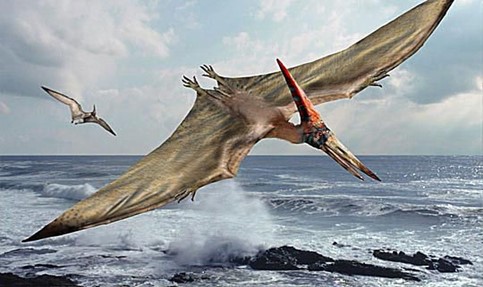

Pterosaurs Could Fly from Creation
Clever scientific language in service to a false
theory may be great salesmanship,
but it makes for poor science.
by Jerry Bergman, PhD
 Neuroanatomical convergence between pterosaurs and non-avian paravians in the evolution of flight (Current Biology, November 26, 2025). This new study was led by evolutionary biologist Mario Bronzati et. al., at Johns Hopkins Medicine. The Bronzati et. al., paper, which I review below, assumed the evidence for evolution was valid. Evolution proposes a gradual transition from terrestrial travel to flight.
The data the researchers uncovered, however, is actually more consistent with creation. The authors never consider that possibility. Although the authors interpret their findings through an evolutionary lens, the evidence aligns much better with intentional design than with evolution. Yet Professor Bronzati, in contrast to orthodox evolution, does admit that the evidence showed the pterosaurs evolved “very rapidly.”
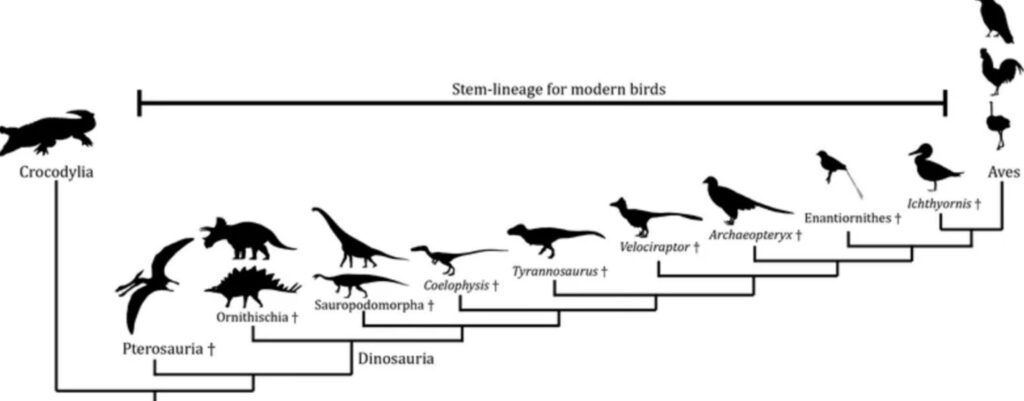
Alleged steps in the evolution of flight in tetrapods (Wikimedia Commons)
Darwinian Sales Method: Use clever terminology to hide evidence of creation
Selling anything physical, from cell phones to semi-trucks, is a skill. The same is true when selling a belief system. Persuading people to accept ideas that are totally wrong often involves using carefully chosen wording. A common example is claiming that a product is “American-made” when much of it is manufactured overseas, exploiting consumer patriotism. For instance, companies may say a product is “assembled in America with components made overseas,” even though 90 percent of the product may be made in China—a fact conveniently omitted from the ad.
This same technique is used to sell evolution, as the paper by Mario Bronzati makes clear. A clear and striking example is the animal that evolutionists claim was the earliest and most primitive pterosaur. The researchers conducted fossil “brain scans” to assess the animal brain’s development for powered flight.
The Challenge to Darwinians: Gradual Flight
Evolutionists believe that the earliest pterosaurs existed as primitive, flightless animals that evolved over millions of years, and then, by natural selection over additional millions of years, gradually evolved flight. A similar claim is made for birds, which are said to have evolved from small, terrestrial theropod dinosaurs. To explain this stepwise development, evolutionists propose three main theories:
- The Ground-Up (Cursorial) theory, in which running and leaping gradually evolved into wing-assisted lift and control.
- The Trees-Down (Arboreal) theory, in which gliding from trees evolved by natural selection into powered flight.
- Flapping-based models, such as Wing-Assisted Incline Running (WAIR), which proposes that early proto-birds used flapping motions to climb steep surfaces that eventually, due to mutations and natural selection, evolved into flight.
All of these hypotheses require terrestrial animals to gradually evolve flight, something evolutionary theorists believe took many millions of years. Over that same span, the brain would have had to co-evolve to enable the shift from ground-based movement to gliding and, ultimately, to powered flight. These explanations are used to explain how all flying animals—from songbirds to pterosaurs—evolved the ability to fly.
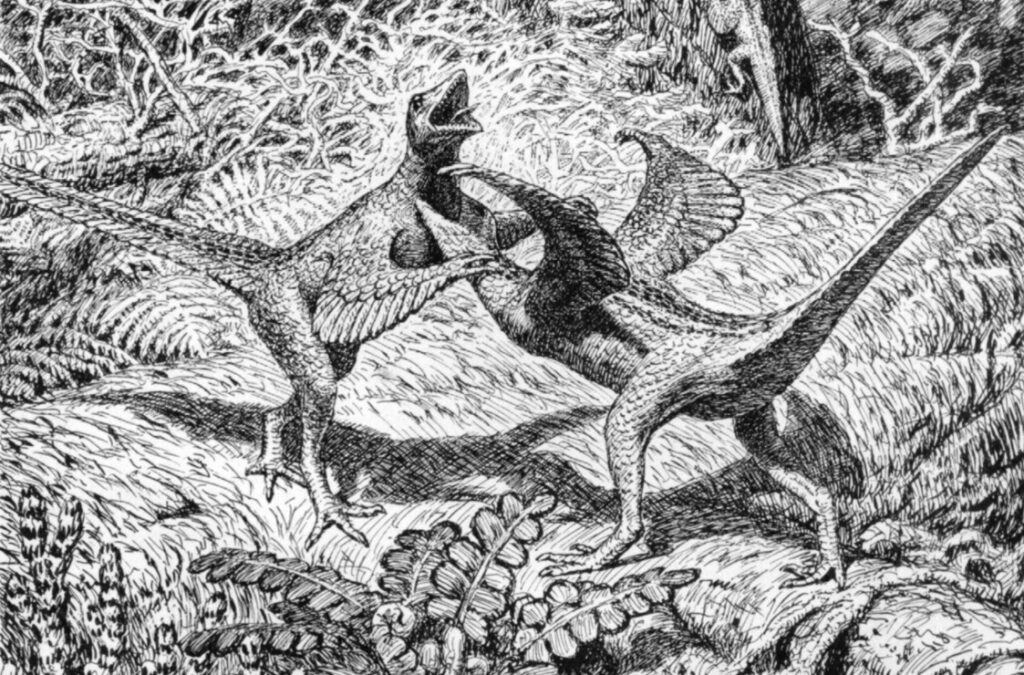
Heilmann’s 1916 illustration depicts one proposed step in the evolution of flight in terrestrial animals’—in this case, front limbs gradually evolving into wings. [Wikimedia Commons]
 Fossil brain scans show pterosaurs evolved flight in a flash (Science Daily, 9 December 2025). After stating the evidence revealed by the brain scans, which showed that pterosaurs were “evolving flight at their very origin,” the authors summarized what was found:
Ancient pterosaurs may have taken to the skies far earlier and more explosively than birds, evolving flight at their very origin despite having relatively small brains. Using advanced CT imaging, scientists reconstructed the brain cavities of pterosaur fossils and their close relatives, uncovering surprising clues—such as enlarged optic lobes—that hint at a rapid leap into powered flight. Their findings contrast sharply with the slow, stepwise evolution seen in birds, whose brains expanded over time to support flying. [Italics added.]
Evolutionary theory requires pterosaurs to have evolved flight gradually over millions of years. Yet the CT scan uncovered a supposedly primitive pterosaur whose brain anatomy indicates it was already fully capable of flight. The research team concluded that pterosaurs could fly right from their very origin.
The creationist explanation, which is obvious but never mentioned in any of the articles about the Bronzati research findings, is straightforward: pterosaurs did not evolve at all, nor did they gradually evolve the ability to fly. They were created with the capacity for flight from the start—on Day Five of Creation Week.
In the Current Biology paper, the authors accurately described the enormous complexity involved in evolving flight:
Flight is a complex locomotory mode that requires physiological adaptations and a dramatic transformation of the body plan, including changes in body proportions, specialized integument, and acquisition of novel neurosensory capabilities.
Summary
Bronzati et al., asserted that “clear evidence of the evolutionary transition from non-flying archosaurs to pterosaurs” does exist. However, they offered no fossil or other support whatsoever for this alleged rapid transition to flight. Yet the peer-reviewed Bronzati scientific paper mentioned evolution 53 times. The evidence offered for the claim that “brain evolution in pterosaurs seems to have unfolded rapidly at the origin of flight” is, in reality, evidence that the pterosaur’s brain was fashioned to enable flight from its beginnings.
Pterosaurs were equipped for flight from the start. A more accurate headline, therefore, would read: “Fossil brain scans show pterosaurs had the ability to fly from the moment they were created.”
 Dr. Jerry Bergman has taught biology, genetics, chemistry, biochemistry, anthropology, geology, and microbiology for over 40 years at several colleges and universities including Bowling Green State University, Medical College of Ohio where he was a research associate in experimental pathology, and The University of Toledo. He is a graduate of the Medical College of Ohio, Wayne State University in Detroit, the University of Toledo, and Bowling Green State University. He has over 1,900 publications in 14 languages and 40 books and monographs. His books and textbooks that include chapters that he authored are in over 1,800 college libraries in 27 countries. So far over 80,000 copies of the 60 books and monographs that he has authored or co-authored are in print. For more articles by Dr Bergman, see his Author Profile.
Comments
Oh, I saw the later article on the Bronzati et al. paper first; they make a good pair of responses.