


Pterosaurs Fly “In a Flash”
The narrative takes flight, even
as the evidence remains
on the ground.
Pterosaurs Evolve Flight In A Flash
By John Wise, PhD
Let Flying Things Fill The Skies
ScienceDaily, “Fossil brain scans show pterosaurs evolved flight in a flash,” December 9, 2025.
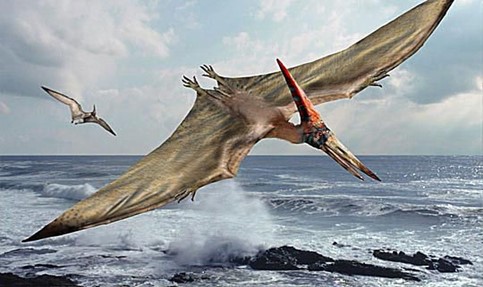
A research group led by an evolutionary biologist at Johns Hopkins Medicine reports that giant reptiles living as far back as 220 million years ago may have developed the ability to fly at the very start of their evolutionary history.
Pterosaurs have once again performed Paleontology’s most reliable trick: appearing in fossil form fully-fitted for function, in this case flight. Watch as evolutionary biologists scramble to explain how this is further proof of slow, aimless evolution.
 According to the new University of Bristol study in the journal Current Biology, “Neuroanatomical convergence between pterosaurs and non-avian paravians in the evolution of flight,” December 15, 2025: early pterosaurs were perfectly adapted for powered flight the moment they show up in the fossil record. Not gradually. Not experimentally.
Not even awkwardly, like penguins trying parkour. No, fully operational from day one. A reasonable person might observe: It’s almost as if Someone said, ‘Let flying things fill the skies.’
And it was so.
But this is “evolutionary science,” so … the narrative must be fed,[1] data be damned.
Evolution Must Supply the Explanation[2]
The researchers quickly assure us that evolution possessed everything required to deliver flight “in a flash.” Hard to swallow? Not anymore. Evolution performs these feats daily, at least on paper in popular science pressers. Yet no one has ever demonstrated how a terrestrial creature[3] acquires reinforced wing bones, tensioned membranes, precision hinges, and Stradivarius-grade musculature “in a flash.” But the narrative must be satisfied. The fossils show a finished aircraft. Respect the data.
The narrative will supply the missing factory.
This contradiction, like the Great Wall of China, is visible from space. But this story does what evolutionary “science” always does. It leans in, tightens the circle, and baptizes the problem with a confident magical phrase:
“Rapid evolutionary change.”
This is what biologists say when the data contradicts the timeline. The mechanism, the pathway, and the story arc all at once. It is a miracle formula. No, really! It means “Everything happened instantly, for reasons we cannot specify, and this proves it was gradual evolutionary change.” In more rational fields, this is called a contradiction.
In evolutionary biology, that’s the price of admission.
Pterosaurs appeared fully formed. The prototypes never arrived. The intermediate klunkers never crashed. The design leaps into the skies without even a running start. And the narrative obediently tags after it, arms flailing, shouting convincingly, and with conviction to whomever will listen:
“Evolution explains this!”
It Would Be Funny If It Weren’t So Tragic
At this point CEH readers know what comes next. The narrative takes flight, even as the evidence remains on the ground.
The humor writes itself. What is it, class, that
… brings flight from non-flight, mind from non-mind, complexity from simplicity, engineering without engineers, life from non-life, even being from nothing, and through it all demands with the jealousy of a jilted lover – “you shall have no other explanations before me”?
That’s right, Evolution.
It is remarkable – as all this new evidence rolls in – how astonishingly like God evolution, creator of all things visible and invisible, becomes.
Innit?[4]
[1] Another example of legerdemain: call your metaphysical story “science,” et voila, it ceases to be metaphysics. Never forget, CEH readers, that in Hegelian philosophy Spirit is the narrative.
Besides, I couldn’t help thinking of Audrey 2 in “Little Shop of Horrors.” Forgive me.
[2] This is the Compulsion to Closure (C to C) in action. Alternative explanations must be excluded, so the story must close around itself.
[3] In the ScienceDaily article is an artist’s rendering of an earth-bound lagerpetid, the close relative of the pterosaur flying above it’s head. Presumably he’s wondering “what happened to Basil? We were just chatting up the weather and poof! – he suddenly takes to the skies.”
Then wistfully, “lucky chap.”
[4] Again, please forgive the famous villain reference from Disney’s “The Little Mermaid,” Ursula. The phrase, of course, means “isn’t it?” in popular slur.
 John Wise received his PhD in philosophy from the University of CA, Irvine in 2004. His dissertation was titled Sartre’s Phenomenological Ontology and the German Idealist Tradition. His area of specialization is 19th to early 20th century continental philosophy.
He tells the story of his 25-year odyssey from atheism to Christianity in the book, Through the Looking Glass: The Imploding of an Atheist Professor’s Worldview (available on Amazon). Since his return to Christ, his research interests include developing a Christian (YEC) philosophy of science and the integration of all human knowledge with God’s word.
He has taught philosophy for the University of CA, Irvine, East Stroudsburg University of PA, Grand Canyon University, American Intercontinental University, and Ashford University. He currently teaches online for the University of Arizona, Global Campus, and is a member of the Heterodox Academy. He and his wife Jenny are known online as The Christian Atheist with a podcast of that name, in addition to a YouTube channel: John and Jenny Wise.
Comments
“Rapid evolutionary change”. “Evolution explains this”. More jargon from evolution. Shouldn’t this be a sign that the theory is faulty?
Excellent article on a perfect example of faith being disguised as science. Ever since Darwin, evolutionism has been floating on a fog of magical rhetoric, loosely attached to what could be a solid “science of evolution” if “evolution” were limited to the strict definitions sometimes given, involving the variations in genetics and their expression that have been observed.
In this case, what struck me most was the computer imaging that showed the great difference between the brains of the so-called “closest relatives” (lagerpetids) and pterosaurs, matching the huge difference in overall form.
Bats also show this striking gap between flying forms and all the rest, living and fossil. I think comparing these three cases illuminates why birds seem to be the one exception.
One reason is that it’s much easier for birds to have flightless forms as bipedal vertebrates. They can locomote easily with reduced wings. Flightless birds can also get along with simple feathers, which makes it easier to claim that various similar fibers on dinosaurs are “protofeathers.” There are also bipedal dinosaurs with various bird-like features, making it easy to imagine (vaguely) how they might have evolved wings and flight — if you don’t think about the other changes needed and the challenges involved, etc. There isn’t anything, living or fossil, that looks anything like a flightless pterosaur or bat.
It’s not that there are transitional fossils for birds, it’s that you can take some birds and some dinosaur fossils and imagine there was a transition. With pterosaurs and bats (and insects), it’s all imagination.
One thing that often gets overlooked on this subject is the fact that there are lots of gliding animals, living and fossil, but nothing that seems to be an intermediate between cursorial or arboreal and powered flight — again, with birds being a supposed exception, but the fossils don’t show a gradual progression in that direction, so with Archaeopteryx being a powered flyer (if a poor one) so early on, other early creatures that are similar but perhaps less capable might be examples of degeneration, or simply separate forms with gliding or flight capability, such as Microraptor, Yi qi, Ambopteryx, and Scansoriopteryx.