


Experts Were Wrong About Fossil Deposition
They assumed how bones would
move in stream flow conditions.
Then some scientists ran experiments.
One would think that paleontologists, with help from top geologists and physicists, would have figured this all out by now. There are flumes at major universities for testing things. Why did experiments at the University of Minnesota suggest a rewrite of textbooks on fossil deposition is overdue?
 How floodwaters impact fossil formation (University of Minnesota, 12 Jan 2025). Just yesterday, this university published a bombshell announcement, saying, “A new study by the University of Minnesota challenges previous classifications paleontologists use to determine how the fossil record is formed.”
“Paleontologists try to piece together the stories of how fossil sites actually came to be, sort of CSI style,” said Michael Chiappone, a Ph.D. candidate in the College of Science and Engineering and lead author of the study. “So we asked ourselves: ‘Are fossil organisms preserved in the places where they died? Or are we finding them after they’ve been moved some distance after death by scavengers or water flow?’”
This new information encourages paleontologists to look for additional variables when reconstructing extinct animals and the environments they lived in.
Thousands of papers have assumed that fossils are buried in place or, when evidence of water flow is indicated, have asserted that skeletons move as a unit in steady-state flow conditions. That is unrealistic, this team found. In the real world, flow velocity differs from place to place. And real bones travel different ways depending on their densities and shapes. So why not test what happens?
The study, published in Paleobiology, tested bone movement under unsteady flow dynamics, such as those found in floods. Previous research relied on steady-state flow conditions, which differ significantly from how water moves in a natural flood.
Using the unique facilities at the University of Minnesota’s St. Anthony Falls Laboratory, the team reproduced surging waves of water that simulated real-world floods and river features like ripples, dunes and bars. From these tests they were able to determine how bones in water flow by their sizes, shapes and densities.
The tests broke assumptions. A seasonal flood moves bones differently than a rare catastrophic flood.
By simulating actual flood conditions, the researchers found that factors like flow dynamics and interactions with the environment lead to bone movement that does not always align with previous research methodologies.
Does the phrase “previous research methodologies” include assumption and storytelling? Sir Francis Bacon would be appalled at what scientists have been assuming for decades without testing by experiment.
When the levee breaks: experimentally testing dinosaur and mammal bone transport in unsteady flows (Chiappone et al, Paleobiology, 12 Jan 2025).
This is the research paper. Steady-state flow is not how floods work. Levees break, shorelines collapse, plant roots hold some sediments together while locations without plants move quickly: this is how nature really operates when water comes down a channel. Those facts can be observed. Those facts can be tested in large flumes, testing water velocity, bed angle, sediment load, and density of bones and sediments. That’s how science is supposed to work! Observe, test, and measure before giving your explanation. Without that, science degrades to storytelling.
The subject matter of the new experiments is not trivial.
Bones preserved in fluvial sediments make up the majority of the terrestrial vertebrate fossil record, and unsteady flows (overbank floods, levee breaches, debris flows, etc.) are often invoked as agents of bone transport and burial. Experiments exploring transport of mammal bones under steady-state flow led to the development of Voorhies Groups, which are used as indicators of winnowing and transport at fossil sites. Some studies have raised concerns about the use of transport groups beyond the scope of the original experiments, especially regarding untested taxa and flow conditions. Here we investigate transport of hadrosauroid dinosaur bone models and modern sheep bones in experimental sheet floods. We find that evolving flow dynamics in unsteady flows can influence bone mobility behaviors. Factors such as bedforms and interactions with other bones caused shorter transport distances than might be expected in some elements, which would be heightened in real flooding situations where trapping mechanisms are common.
Previous assumptions have been overly simplistic and generalized.
Terms to Know
Paleontologists use the Latinized words autochthonous (“self native”) to describe bones that were buried in place, and allochthonous (“other native”) to describe fossils transported from elsewhere. It’s like comparing native citizens to visitors on vacation, or native plants to invasive species. “Establishing a taphonomic history of a given site, including degrees of allochthony versus autochthony,” the researchers say, “is an important step in interpreting fossil data.”
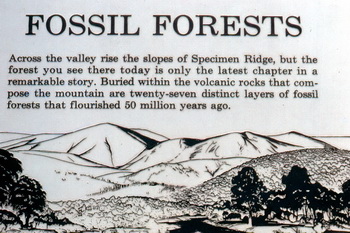 Can an interpretation change from autochthonous to allochthonous? Yes. A prime example is the fossil forests in Yellowstone. For decades, the park taught that the layers of fossilized trees were buried in place where they grew (autochthonous). Subsequent studies after the eruption of Mt St Helens in 1980 (including important work by creation geologist Dr Steve Austin in Spirit Lake) convinced secular geologists that the logs, though buried mostly upright, were allochthonous deposits—carried into place by catastrophic mudflows. See our Sept 28 2015 report about this spectacular case of re-interpretation.
Many other paleontologists have relied on Voorhies’ 1969 experiments. His team only tested what happens in unrealistic steady-state flow conditions. It was about time that someone tested what happens in the real world, where complex factors predominate. “Our experiments aimed to examine this in the context of disarticulated vertebrate material in unsteady flows.”
And so they tested. They found that “the relationship between critical mobility and distance traveled is complex”— more complex than could be captured by Voorhies’ 50-year-old categories.
In this open-access paper, readers can see how the research team placed bones on sediment and released simulated flood waters with differing velocities. When a simple flash flood starts, the steady-state sheet flow does not last long before other dynamics become important: channelized flow, logjams, shoreline collapse, and more. Previously untested factors can speed up or slow down bone transport: the wetness or dryness of bones, and especially their densities, affect transport. For instance, a dense skull might sink into the sediments while a leg or arm bone drifts downstream a considerable distance due to shape and density. How would those bones from a single animal be interpreted when examined by a paleontologist studying a fossil bed? The words “interpret” or “interpretation” are found 14 times in this paper.
Still Not the Whole Story
While the Chiappone et al research advances understanding of fossil sorting and burial, the authors realize more testing must be done. They had experimented on some factors. What unknown factors remain to be tested?
In conclusion, bone transport and burial in unsteady flows are driven by a complex set of variables relating to both characteristics of bones themselves and to the flow conditions they encounter. Many of these are shared with more well-studied steady-state flow conditions, but some factors, such as the initiation of motion via an advancing, high-energy flood front and the stabilizing effects of bone reorientation, bedform trapping, and bone jamming leading to stability over the course of multiple floods, may have significant effects on transport and burial. Considering the geographically small size of many overbank flow deposits (like crevasse splays), most bones found within may not be ecologically out of habitat, but preservation bias of less mobile elements may exist due to localized sorting in a given deposit. Voorhies Groups address some broad aspects of bone transport, but due to the limited scope of the original study relative to real-world flow conditions and bone morphologies, applying these broadly qualitative metrics to the fossil record is problematic. More experimental studies on the relationship between transport potentials, bone characteristics, and pathways of accumulation and burial are needed to untangle the factors influencing bone mobility and fossil preservation in fluvial depositional environments.
The lesson: “we thus advise caution in interpretations of fossil site taphonomic history” based on previous assumptions and categories.
We recommend creation paleontologists and geologists study this paper to see how faulty assumptions may have biased the interpretations of fossil beds toward evolutionary deep time. Consider that there are massive fossil graveyards around the world where thousands of dense bones are found jammed together in disarticulated conditions. What high-energy processes were required to form such graveyards? Seasonal floods or occasional catastrophic floods (i.e., those that have been observed throughout human history) seem grossly inadequate to explain the observations such as these we have reported in the past:
-
- A Whale of a Tale: How Evolutionists Turn Global Flood Evidence into Arguments for Evolution (23 July 2025)
- Fossil Graveyard of Giant Amphibians Found in Wyoming (2 April 2025)
- Fossil Graveyard Explanation Ridiculous Without a Flood (3 Jan 2023)
- Dinosaur Bone Bed Indicates Underwater Graveyard (8 Jan 2021)
- Unusual Fossils Call for Unusual Explanations (15 May 2019)
- Misinterpreting Fossil Graveyards (30 March 2019)
- Most Armored Dinosaurs Found Upside Down (2 March 2018)
- World’s Largest Dino Graveyard Found (30 December 2008)
This new research from the University of Minnesota should remind Darwin skeptics that simplistic explanations about evolution, deep time and fossils are often deficient in experimental support.
Comments
The Worldwide Flood as described in Scripture remains and is still the best explanation for fossil deposition.