


Debunking Birth Canal Evolution
Human brain size did not
pose an evolutionary dilemma
for bipedal walking
Another Icon of Evolution Exposed:
The Obstetrical Dilemma Falsified
by Jerry Bergman, PhD
One of the most widely cited pieces of evidence for evolution was called “The Obstetrical Dilemma.” It described the conflict between the requirement for a narrow pelvis for efficient bipedal walking versus the requirement for a large birth canal for human’s evolving large-brained babies.
The obstetrical dilemma was a hypothesis that sought to explain why humans often require assistance from other humans during childbirth. In contrast, rarely do non-human life-forms give birth unassisted with relatively little difficulty. The rare exceptions are animals with breeding-related pelvic issues, including certain dog breeds (e.g., bulldogs, pugs), cattle, and horses.
For modern humans, the problem occurs due to the tendency of the tight fit of the fetal head to the maternal birth canal. In contrast to all other primates, the infant can normally slip through the birth canal without requiring any help. The mother squats, and her child normally easily passes through the canal onto the ground without requiring help. But the human infant’s head is larger than ideal, and the birth canal is smaller than ideal.
History of the Notion
The obstetrical dilemma was first described by the prominent physical anthropologist, Sherwood Washburn, in 1960.[1] The term describes what he believed was the evolutionary development of the human brain and pelvis and its relation to childbirth and pregnancy in hominids compared to non-humans.[2] Washburn concluded that humans are the only primate that have a problem with childbirth because of the biological trade-off imposed by two opposing evolutionary pressures: to give birth to humans and to walk bipedally. This theory has now been challenged on several fronts, including an article this month by Colin Barras in New Scientist.[3]
 Why is childbirth so hard for humans—and is it getting even harder? (New Scientist, 4 February 2026). Reporter Colin Barras only looks at the problem with evolution glasses on:
Untangling whether this bold and controversial claim [that the birth canal is shrinking] has merit means exploring one of human evolution’s most famous – and most eyebrow-raising – hypotheses: the obstetrical dilemma. The idea is that an evolutionary battle has been raging over the female pelvis for millions of years, with the structure being simultaneously under pressure to be narrower to assist with walking on two legs and wider to make childbirth easier.
Ironically, Barras repeats the obstetrical dilemma only to debunk it later in his article.
What Is the Obstetrical Dilemma?
The Obstetrical Dilemma claims that evolution produced larger brains in humans over the millennia, requiring a larger skull. The larger skulls in human babies resulted in the problem. Conversely, the evolution of bipedal locomotion resulted in a decrease in the size of the birth canal and sacrum to produce narrow hips, which allowed for much more effective bipedal movement. Women required wider hips to give birth, and these wider hips made women inherently less able to walk or run than men.
One result was that babies must be born earlier to fit through the birth canal, resulting in the so-called fourth trimester period for newborns. The result was that the baby was born when it was less developed than in other primates. The difference is shown in the picture, which illustrates the problem:
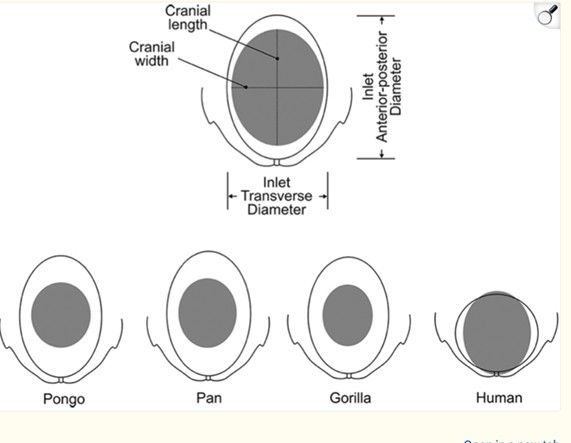
Figure From Mihaela PavliČev, 2020.
This theory was widely taught for decades, both in textbooks and colleges, because it provided an intuitive picture of what was believed to be a compelling evolutionary explanation for the human childbirth difficulty compared to other primates.[4]
Problems With the Obstetrical Dilemma Hypothesis
In a review of the literature, Barnes explains that
Over the past 15 years, some researchers claim to have found evidence against the [obstetrical dilemma] hypothesis…. [Others] have broadened it out to incorporate surprising factors, from the advent of farming through to changes in our modern diet. The big question is, have their efforts brought us any nearer to explaining why childbirth is often so difficult – and to predicting whether it will become even more so in future?”[5]
As will be explained, our efforts still have not brought us any nearer to explaining, from an evolutionary perspective, why childbirth is often so difficult.
One major question asked by evolutionists is “Why did evolution not lead to a greater safety margin, as in other primates?” as documented by the obstetrical dilemma. [6] As Cincinnati Children`s Hospital Medical Center, University of Cincinnati, Human Genetics Professor PavliČev explains, Washburn’s theory is that this “obstetrical dilemma” theory was an evolutionary compromise between two functions, bipedal gait and childbirth.
However, recent biomechanical and kinematic studies indicate that pelvic width does not considerably affect the efficiency of bipedal gait and thus is unlikely to have constrained the evolution of a wider birth canal. Instead, bipedalism may have primarily constrained the flexibility of the pubic symphysis during pregnancy, which opens much wider in most mammals with larger fetuses than in humans. We argue that the birth canal is mainly constrained by the trade-off between two pregnancy-related functions: while a narrow pelvis is disadvantageous for childbirth, it offers better support for the weight exerted by the viscera and the large human fetus during the long gestation period.
The Design Has a Reason
 In short, more evaluation into the obstetrical dilemma question indicates that the human pelvis was well-designed, and was not botched due to human evolution. It further illustrates the fact that, again, evolution has misled researchers. Because evolutionary glasses have misled researchers, removing those assumptions has now allowed them to determine the real reason for the existing design. As PavliČev demonstrates, problems exist in documenting evidence for the pelvis’s evolution, including the following:
Studying pelvic evolution throughout this time is difficult for several reasons. First, the pelvis is prone to fragmentation and thus poorly represented in the paleontological record. Second, the pelvis is a highly integrated structure, in which selection on any one part results in changes to many others in order to preserve anatomical and functional integrity. Finally, the human pelvis encountered multiple episodes of different selection pressures, each one leaving traces in the shape of the pelvis that are contingent on previous changes; this challenges the separate reconstruction of these selective forces.[7]
Not Your Mother
The main evidence for the evolution of the pelvis in humans comes from comparing it to that of Australopithecus. The problem with this comparison is it assumes that Australopithecus was a human evolutionary ancestor. Recent intensive investigation has documented that Australopithecus was not a human ancestor, but only an extinct ape species.[8] (See my interview with David Rives on this topic, aired 16 Feb 2026).
 Why Some Problems Occur
Although 92 to 99 percent of births are not problematic, what about the 1 to 8 percent of cephalo-pelvic disproportion (CPD) and obstructed labor problems? It turns out that among the reasons for these problems are poverty, diet, vitamin D deficiency, the health of the women, and significant size differences between the birthing female and the male mate. For example, one study population, which included 7,361,713 women with a singleton stillbirth or live birth, found that short, petite women had an increased risk of adverse child delivery outcomes, whereas tall, non-petite women had a significantly lower risk relative to average-statured women.[9]
Conclusion
Significant reasons exist to reject the evolutionary-based obstetrical dilemma. It is another example of new research falsifying another former icon of evolution.
References
[1] Washburn, Sherwood, “Tools and human evolution,” Scientific American 203(3):62-75, 1 September 1960.
[2] Wells, J.C.K., J.M. Desilva, and J.T., “The obstetric dilemma: An ancient game of Russian roulette, or a variable dilemma sensitive to ecology?,” American Journal of Physical Anthropology 149 (Suppl. 55):40–71, 8 November 2012.
[3] Barras, Colin, “Why is childbirth so hard for humans—and is it getting even harder?”, New Scientist, 4 February 2026.
[4] PavliČev, Mihaela, “Evolution of the human pelvis and obstructed labor: New explanations of an old obstetrical dilemma,” American Journal of Obstetrics and Gynecology 222(1):3–16, doi:10.1016/j.ajog.2019.06.043, 25 January 2019.
[5] Barras, 2026.
[6] PavliČev, 2019, p. 2.
[7] PavliČev, 2020, p. 3.
[8] Dawson, Gowan, Monkey to Man: The Evolution of the March of Progress Image, Yale University Press, New Haven, CT, 2024. Bergman, J. Apes as Ancestors: Examining the Claims About Human Evolution. Bartlett Publishing, Tulsa, OK. 2020.
[9] Yearwood, Luren, et al., “The association between maternal stature and adverse birth outcomes and the modifying effect of race and ethnicity: A population-based retrospective cohort study,” AJOG Global Reports 3(2):100184, https://pmc.ncbi.nlm.nih.gov/articles/PMC10024135/, 18 February 2023.
Editor Comment: While Dr Bergman has done a good job showing that there is not a case to be made for evolution of the birth canal as a tradeoff between brain size and bipedal walking, every woman knows that childbirth is often one of the most painful experiences in her life. Science cannot answer “why” that is. One must turn to theology, specifically to Genesis, where God pronounced curses on Adam, Eve and the Serpent for their sin. Adam learned he would sweat and toil to get food from an Earth where previously abundance was free.
To the woman, He said,
“I will greatly multiply your sorrow and your conception;
In pain you shall bring forth children;
Your desire shall be for your husband,
And he shall rule over you.” (Genesis 3:16)
The Old Testament often speaks of the “labor pangs” endured by pregnant women about to give birth (e.g., Isaiah 13:8). Jesus spoke of the pain of childbirth as a channel of blessing:
A woman, when she is in labor, has sorrow because her hour has come; but as soon as she has given birth to the child, she no longer remembers the anguish, for joy that a human being has been born into the world. (John 16:21)
The Apostle Paul also honored childbirth as a means of grace through pain:
And Adam was not deceived, but the woman being deceived, fell into transgression. Nevertheless she will be saved in childbearing if they continue in faith, love, and holiness, with self-control. (I Timothy 2:14-15).
The whole creation groans like a woman in labor pains because of the Fall into sin (Romans 8:18-25). Nevertheless, God’s goodness shines through the pain, and 8 billion people alive today have a mother to thank. The living God, Paul said to pagan people in Lystra, “did not leave Himself without witness, in that He did good, gave us rain from heaven and fruitful seasons, filling our hearts with food and gladness.” (Acts 14:17). Indeed, the “seed of the woman” was part of God’s promise on the very day of Adam and Eve’s disobedience: He would crush the serpent’s head, even though it would result in excruciating wounds for the Savior (Genesis 3:15). That promise was fulfilled at the Cross. For those who believe and receive Him (John 1:12), “by His wounds we are healed” (Isaiah 53:5)
 Dr. Jerry Bergman has taught biology, genetics, chemistry, biochemistry, anthropology, geology, and microbiology for over 40 years at several colleges and universities including Bowling Green State University, Medical College of Ohio where he was a research associate in experimental pathology, and The University of Toledo. He is a graduate of the Medical College of Ohio, Wayne State University in Detroit, the University of Toledo, and Bowling Green State University. He has over 1,900 publications in 14 languages and 40 books and monographs. His books and textbooks that include chapters that he authored are in over 1,800 college libraries in 27 countries. So far over 80,000 copies of the 60 books and monographs that he has authored or co-authored are in print. For more articles by Dr Bergman, see his Author Profile.