


Hidden Force that Helps Wire the Brain Revealed
This discovery is so significant that it
represents a “paradigm shift” in
neurobiology—one that may require
textbooks to be rewritten
Scientists discover a hidden force that helps wire the brain
by Jerry Bergman, PhD
The trend continues: as we learn more about the body, we realize it is even more complex than we once assumed.
Basic anatomy and physiology used to require a one-semester course. Now it typically requires two semesters, and in the near future, even covering the basics may require three. The research reviewed below on the discovery of a new neural system called the Piezo protein system is yet another example of this trend.[1]
 Long-range chemical signaling in vivo is regulated by mechanical signals (Pillai et al., Nature Materials, 19 Jan 2026). This paper explains how brain development proceeds with touch-sensitive channels called Piezo proteins. The Abstract ends,
in vivo stiffening of soft brain regions induces ectopic Sema3A production via a Piezo1-dependent mechanism. Overall, these findings demonstrate that tissue mechanics locally modulates the availability of diffusive, long-range chemical signals, thus influencing cell function at sites distant from the mechanical cue.
 Appreciating the Wonder in Our Skulls
The human brain is described by neurologists as the most complex machine in the universe.[2] One reason is that several hundred-million-dollar research projects have failed to fully map the brains’ 86 billion neurons, roughly 85 billion other cells and over 100 trillion connections.[3]
These “other cells” include glial cells—non-neuronal nervous system cells that outnumber neurons and provide essential structural support, insulation (myelin), and metabolic regulation (see diagram). The function of the brain is judged/considered by neuroscientists to be even more complex than its cellular composition because it gives rise to perhaps its greatest mystery: consciousness.
The challenge lies in understanding how cells composed of protoplasm enable us to be conscious beings with thoughts, ideas, memories and the ability to form mental images. How the brain accomplishes this remains unknown.
How the Brain Develops in the Embryo
Neurologists now, as a result of new research, recognize that the human brain is even more complex than once thought. As the brain grows and develops, neurons grow long extensions, projections called axons, which connect to different regions of the brain. On average, each one of these neurons connects to thousands of other neurons, resulting in an estimated 100 trillion connections.[4]
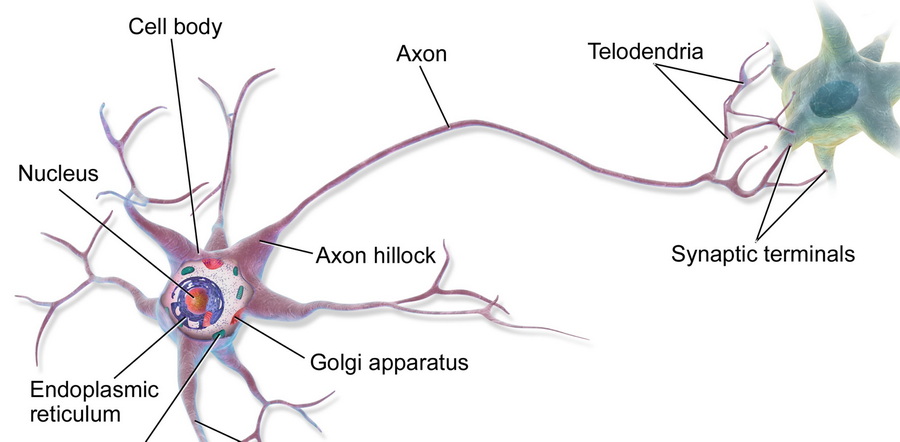
A diagram of a nerve cell showing the axon in the right of the illustration. From Wikimedia commons.
A helpful comparison for illustrating the brains’ interconnections is the modern computer chip. These chips consist of integrated circuits that manage electrical signals designed to process information. Like the brain, they contain billions of microscopic transistors that function as switches, performing logic, memory, and processing functions/tasks. These chips operate our computers, smart TVs and even our cars. However, the circuit boards in computers are designed by highly trained electrical engineers, whereas how the brain’s “neural circuitry” is designed and formed remains largely unknown.
Although scientists understand aspects of these biological mechanisms, how these guidance systems work together is still not fully understood. This is where the new research becomes especially significant. Scientists have recently identified a previously unrecognized mechanism that plays a role in guiding neural development: the Piezo protein system. Unlike traditional guidance systems that rely primarily on chemical signals, Piezo proteins respond to mechanical forces—such as pressure or stretching within tissues. This suggests that developing neurons may not only “follow” chemical signals but also “feels” their physical environment as they form precise connections.[5]
Physics Guides Brain Cell Connections
It is well known that neuron growth relies on chemical cues to help guide neurons to their targets.[6] However, new research has shown that the system directing neurons to their destinations is more complex than previously assumed: the brain’s physical properties help to shape these signaling pathways.[7] For example, the physical characteristics of tissue can trigger the production of “guidance molecules” through a force-sensing protein called/known as Piezo1. This protein “not only detects mechanical forces but also helps maintain the structure of brain tissue. The discovery reveals a powerful link between the brain’s physical environment and how its wiring is built.”[8]
This discovery adds an entirely new dimension to our understanding of brain development. It indicates that neural wiring may be influenced by an intricate combination of chemical signals, physical structures, and mechanical forces working together. Far from simplifying our understanding, this finding highlights yet another layer of complexity in how the brain is formed—underscoring how much remains to be discovered.
Its influence is far from minor:
“Piezo1 influences the physical stability of brain tissue itself. When the amount of Piezo1 is reduced, levels of important cell adhesion proteins including NCAM1 and N-cadherin drop. These proteins are crucial for maintaining cell to cell contacts — which glue cells together… Piezo1 doesn’t just help neurons sense their environment — it helps build it.”[9]
Furthermore,
“The stability of the environment in turn, influences the chemical … the brain’s mechanical environment is not just a backdrop — it is an active director of development [and it] “It regulates cell function not only directly, but also indirectly by modulating the chemical landscape. This study may lead to a paradigm shift in how we think about chemical signals, with implications for many processes from early embryonic development to regeneration and disease.”[10]
An example of this added complexity is the role of physical factors—such as tissue stiffness—in influencing cell growth behavior. As the researchers themselves admit,
“the relationship between these mechanical cues and chemical signals has remained unclear. Understanding how the two interact is critical for explaining how complex tissues such as the brain form during development.”[11]
Each new layer of complexity raises further questions about how such an integrated system arises. Notably, evolution was not mentioned in either the study itself or in the related scientific reports—an omission that is noteworthy given the significance of the findings.
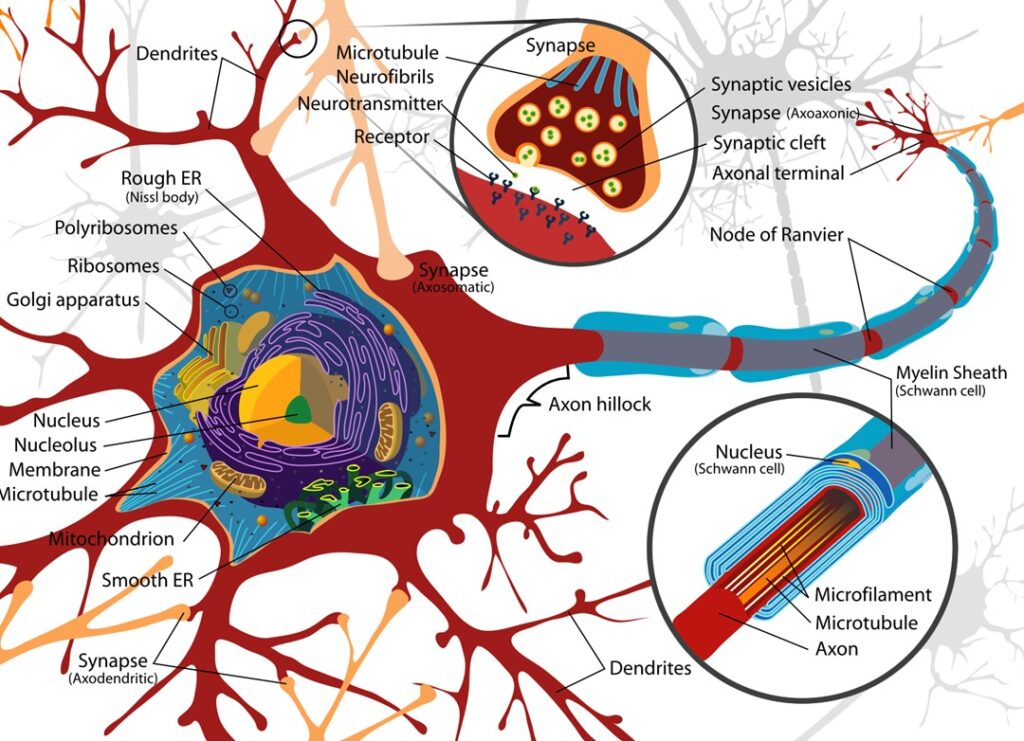
A diagram of a nerve cell showing the some of the many support cells. From Wikimedia commons.
Summary
According to the authors, this discovery is so significant that it represents a “paradigm shift” in neurobiology—one that may require textbooks to be rewritten. So far the research team has avoided attempting to explain this newly identified system in evolutionary terms. As they wrote, “Despite the tremendous progress that has been made in understanding the brain, its staggering complexity means that we are still a long way off from fully understanding its structure and even further away from fully understanding the way it functions.”[12] In light of this, it follows that we are now even further from being able to explain how such a system could have originate by some mutation natural selection driven evolutionary process.
References
[1] Eva K. Pillai, et al. Long-range chemical signaling in vivo is regulated by mechanical signals. Nature Materials, 19 Jan 2026; DOI: 10.1038/s41563-025-02463-9.
[2] Dolan, B. (2007). Soul searching: A brief history of the mind/body debate in the neurosciences. Neurosurgical Focus, 23(1), 1–7. https://doi.org/10.3171/FOC-07/07/E2.
[3] Pang, Damian. 2023, The Staggering Complexity of the Human Brain. Why our brains are the most complex structures in the known universe. Psychology Today. September 2.
[4] Caruso, C. (2023, January 19). A new field of neuroscience aims to map connections in the brain. Harvard Medical School News & Research. https://hms.harvard.edu/news/new-field-neuroscience-aims-map-connections-brain.
[5] Eva K. Pillai, et al., Long-range chemical signaling in vivo is regulated by mechanical signals. Nature Materials, 2026; DOI: 10.1038/s41563-025-02463-9
[6] Pillat et al. 2026.
[7] Max Planck Institute for the Science of Light. “Scientists discover a hidden force that helps wire the brain.” ScienceDaily. ScienceDaily, 5 March 2026. <www.sciencedaily.com/releases/2026/03/260304184233.htm>.
[8] Max Planck Institute.
[9] Max Planck Institute
[10] Max Planck Institute
[11] Max Planck Institute.
[12] Pang, 2023.
 Dr. Jerry Bergman has taught biology, genetics, chemistry, biochemistry, anthropology, geology, and microbiology for over 40 years at several colleges and universities including Bowling Green State University, Medical College of Ohio where he was a research associate in experimental pathology, and The University of Toledo. He is a graduate of the Medical College of Ohio, Wayne State University in Detroit, the University of Toledo, and Bowling Green State University. He has over 1,900 publications in 14 languages and 40 books and monographs. His books and textbooks that include chapters that he authored are in over 1,800 college libraries in 27 countries. So far over 80,000 copies of the 60 books and monographs that he has authored or co-authored are in print. For more articles by Dr Bergman, see his Author Profile.
Comments
It appears the protein is poly functional.
If so reminds me how DNA can have poly functional coded segments.