


Early Diversity of Rediscovered ‘Sea Monsters’ Surprises Scientists
Paleontologists find ‘evidence of a
surprisingly diverse community of
early ocean predators’, challenging
simplistic evolutionary narratives
by Dr. Sarah Buckland-Reynolds
Sea monsters have long been relegated to the realm of mythology in the field of natural history, despite numerous ancient records of direct sightings across a variety of cultures. Biblical references to ‘sea monsters’ such as Leviathan and Rahab have met similar skepticism, as some mythbusters interpret these descriptions as merely metaphorical, or even borrowed from Near Eastern mythology.
Not Laughing Any More
Amidst such longstanding skepticism, new palaeontological findings have reopened conversations about the possible existence of literal sea monsters. But could amphibians be classified as monsters? Most of us know amphibians as small, delicate creatures like frogs and salamanders. In times past, some were large apex predators of their community.
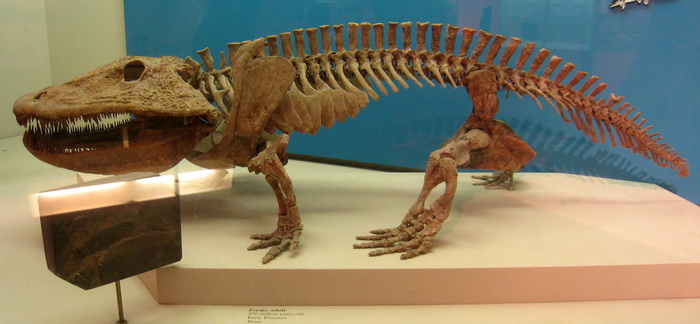
Eryops, a terrestrial temnospondyl tetrapod, thought to be a “primitive” amphibian. Smithsonian Museum via Wikimedia Commons.
 Revision of the trematosaurid Erythrobatrachus noonkanbahensis confirms a cryptic marine temnospondyl community from the Lower Triassic of Western Australia (Kear et al., Journal of Vertebrate Paleontology, February 2026).
Commentary on these findings was published in February 2026 in the popular ScienceDaily outlet titled: “Lost fossils reveal sea monsters that took over after Earth’s greatest extinction.”
In addition to reigniting discussion on these rarely acknowledged creatures, the authors noted that the fossils found were “surprisingly diverse”, despite being classified as “early predators”. This early diversity of sea monsters, challenges long-held assumptions about species classification and evolutionary mechanisms and prompts a reconsideration of cultural and Biblical records describing such creatures.
Editor note: The largest extinct marine creatures that could be called “sea monsters” were reptiles such as mosasaurs, ichthyosaurs and plesiosaurs, which appear later in the evolutionary timeline. The amphibians described in this paper were limited to two meters in length, according to ScienceDaily: “Erythrobatrachus belonged to a group known as trematosaurid temnospondyls. These animals were ‘crocodile-like’ relatives of today’s salamanders and frogs and could reach lengths of up to 2 m.” The authors do, however, refer to marine reptiles appearing after the Permian extinction along with amphibians: “During this critical window, the earliest sea-going tetrapods (limbed vertebrates), including amphibians and reptiles, emerged and quickly became dominant aquatic apex predators.” Lead author Benjamin Kear has written about marine reptiles in other papers indicated in the references.
To Biblical creationists, the varieties of sea creatures were created simultaneously on Day 5 of Creation Week.
Critique of the Evolutionary “Tree of Life”
The rediscovery of “sea monster” fossils by Kear et al. occurred in Blina Shale in Western Australia. From early in the abstract, the authors classify the discovered fossils as amphibians that lived during the “earliest Triassic”, immediately following the end‑Permian extinction (~252 Ma).
In evolutionary dating, this was very early in Earth’s geological history. Geologists believe Pangaea was still intact as a single supercontinent at the time. Referring to the hypothesized habitat of these creatures, the authors note:
“.. Blina Shale temnospondyl assemblage apparently included some widely distributed marine taxa that may have used the contiguous Pangean coastal fringes to facilitate long‑distance dispersal.”
In other words, these predators could move along continuous coastlines without the barriers created by separated continents.
What makes these discoveries especially challenging to evolutionary assumptions is not only the preservation of such fossils over vast ages, but also the sudden appearance, diversity, and rapid distribution of these amphibians in the fossil record. The ScienceDaily commentary summarizes the findings as follows:
“…researchers uncovered evidence of a surprisingly diverse community of early ocean predators. One of these creatures had relatives stretching from the Arctic to Madagascar, showing that some of the first sea-going tetrapods spread across the globe with remarkable speed.”
These observations challenge some fundamental assumptions of the hypothesized evolutionary “tree of life.” Rather than a single root species slowly branching into complexity, the evidence shows multiple distinct predators coexisting almost immediately after the so‑called “Permian extinction”—an extinction so large it has been called “The Great Dying” by some.
The rapid redistribution and dispersal further confound evolutionary interpretations, since conventional models predict slow ecosystem recovery after a mass extinction. Instead, the record shows sudden and early diversity and global distribution.
From a Biblical creationist perspective however, this rapid spread and diversity are not surprising, but consistent with creatures created fully formed, capable of filling the earth rapidly, and later preserved in the fossil record by catastrophic burial. Instead, of a slow and linear evolutionary tree of life, the data fits better with the creation view of “orchards” of life, each created fully formed and distinct. Such early diversity aligns with the Genesis account, in which God created creatures “according to their kinds” (Genesis 1:21).
Sea Monsters in Scripture and Natural History
As we reflect on these intriguing findings, it is worth noting that, for centuries, natural historians dismissed sea monsters as myth. Yet the Bible repeatedly refers to great sea creatures as real – not only in poetic contexts of wrath or victory (e.g., Job 26:12-13; Psalm 74:13-14), but also in straightforward descriptions of creation:
- Genesis 1:21: “So God created the great sea creatures and every living creature that moves, with which the waters swarm, according to their kinds.”
- Psalm 104:24-26: “O Lord, how manifold are your works! In wisdom have you made them all; the earth is full of your creatures. Here is the sea, great and wide, which teems with creatures innumerable, living things both small and great. There go the ships, and Leviathan, which you formed to play in it.”
It is also notable that many ancient cultures depicted sea monsters in carvings, artwork, and storytelling traditions. These depictions, once dismissed as imagination, now deserve careful consideration in light of fossil evidence revealing giant marine predators with comparable features. Could this be yet another example of science discovery catching up with longstanding Biblical knowledge?
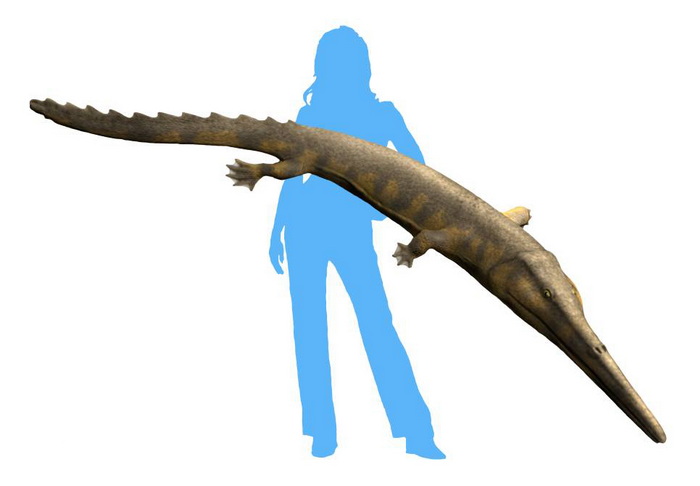
Aphaneramma is an extinct genus of marine temnospondyl amphibian. According to evolutionists, it lived during the Early Triassic epoch, approximately 252–247 million Darwin Years ago, and had a global distribution.
Fossil Preservation and the Problem of Deep Time
Another important consideration is the extent of the preservation of these fossils. If, according to evolutionary timelines, these creatures existed ~250–350 million years ago, several questions arise:
- Fossil preservation: Fossils require rapid burial under sediment to prevent decay. The exquisite preservation of detailed skull fragments suggests sudden, catastrophic processes rather than slow accumulation. How does gradual geological time account for this requirement? Does this not align more closely with a global Flood model, in which creatures were buried suddenly in massive sedimentary deposits?
- Global distribution: If creatures such as Aphaneramma spread across continents at such remarkable speed, does it better fit slow evolutionary dispersal, or organisms created with inherent mobility and adaptability?
- Coexistence of creatures: According to evolutionary chronology, amphibians, reptiles, and early fish would all appear very early in the Triassic period. This raises the question of how such diversity could appear so quickly after a supposed mass extinction?
If we approach these questions from a Biblical perspective, these questions are easily resolved:
- Diversity existed from the beginning of creation.
- Creatures were designed to fill the earth rapidly.
- Most fossils were formed during catastrophic events such as the Flood.
A New Monster Haunts Evolution
Amidst the long-standing claims of mythology, Kear et al.’s findings rediscovering diverse ‘sea monsters’ broils fierce challenges to evolutionary assumptions, highlighting sudden early diversity, rapid distribution, and evidence of catastrophic burial: all consistent with the Biblical creation model. While the authors interpret their findings within an evolutionary framework, the data seem to be more consistent with the Biblical record, pointing to the reliability of Scripture which has long described such creatures as real.
Ultimately, the findings raise significant questions for evolutionary models, while reinforcing the coherence of the Biblical worldview. The “surprising” diversity of early marine life is only surprising within an evolutionary framework. From a creation perspective, it is exactly what one would expect: diversity from the beginning, creatures created according to their kinds, and fossils preserved by catastrophic events.
 Dr. Sarah Buckland-Reynolds is a Christian, Jamaican, Environmental Science researcher, and journal associate editor. She holds the degree of Doctor of Philosophy in Geography from the University of the West Indies (UWI), Mona with high commendation, and a postgraduate specialization in Geomatics at the Universidad del Valle, Cali, Colombia. The quality of her research activity in Environmental Science has been recognized by various awards including the 2024 Editor’s Award from the American Meteorological Society for her reviewing service in the Weather, Climate and Society Journal, the 2023 L’Oreal/UNESCO Women in Science Caribbean Award, the 2023 ICETEX International Experts Exchange Award for study in Colombia. and with her PhD research in drought management also being shortlisted in the top 10 globally for the 2023 Allianz Climate Risk Award by Munich Re Insurance, Germany. Motivated by her faith in God and zeal to positively influence society, Dr. Buckland-Reynolds is also the founder and Principal Director of Chosen to G.L.O.W. Ministries, a Jamaican charitable organization which seeks to amplify the Christian voice in the public sphere and equip more youths to know how to defend their faith.