


Interpreting Smudges to Solve Darwin Troubles
Dates ascribed to new Chinese fossils, with ample
amounts of interpretation, let evolutionists allege
a slower rise to the Cambrian explosion
Interpreting Carbon Films as Transitional Forms
by Jerry Bergman, PhD
Both creationists and intelligent design supporters point to the Cambrian explosion to support their worldview. Before the Cambrian explosion most organisms were relatively simple, composed of individual cells or small multicellular organisms. After the Cambrian explosion, the immense diversity of life included complex, hard-shelled organisms, specialized predators, including crustaceans, starfish, sponges, mollusks, worms, even some chordates.[1]
Creationists believe the Cambrian explosion was not an evolutionary event, but rather the supernatural creation of complex animal life as explained by the Genesis record. Creationists argue that the abrupt appearance of fossils with no precursors demonstrates special creation rather than gradual evolution.[2] Evolutionists, by contrast, try to explain away the sudden arrival of many new life forms as innovations that occurred over many millions of years.[3] Modern explanations describe the event as follows
the first 3.7 billion years after it originated, life was small, simple and largely confined to the oceans. This microbe-dominated world … appears to have changed about 538 million years ago (mya) during the Cambrian period. This critical juncture in the history of life saw animals bursting on to the scene in an event known as the “Cambrian explosion”… This seemingly abrupt appearance of animals in a geological “blink of an eye” has puzzled scientists from Charles Darwin onwards.[4] (Emphasis added.)
To preserve the evolutionary picture, they are constantly on the lookout for putative transitional forms.
The Jiangchuan Biota
The new study, published in the journal Science, claimed that several new terminal Ediacaran fossil assemblages was preserved as carbonaceous films from the Jiangchuan Biota, Yunnan, Southwest China.[5] Details about the terminal Ediacaran fossil assemblage, Burgess Shale-type (BST) preservation uses dark, 2D layers of carbon to capture anatomical details like guts, feeding structures, and locomotory organs. These are found in abundance after the Cambrian explosion.
The new study claims that complex animal groups actually appeared 4 million years earlier in the “terminal Ediacaran,” the last stage of the Precambrian fossil record.[6]
The new fossils, dated on their timeline at around 535 million years ago, “marked the apparent beginning of complex animals.”[7] The problem for evolution is fossils from southwest China were discovered in rocks much older than the previous timeline allowed. The fossils would be expected to be simple algae or colonial, sessile creatures, not animals with complex body plans. They found a few that appear to show a mouth and a body built to feed. If so, it would imply that complex animals with internal organs existed millions of years earlier than the current evolutionary timeline accounted for.[8] My concerns include the reliability of the dating methods used.
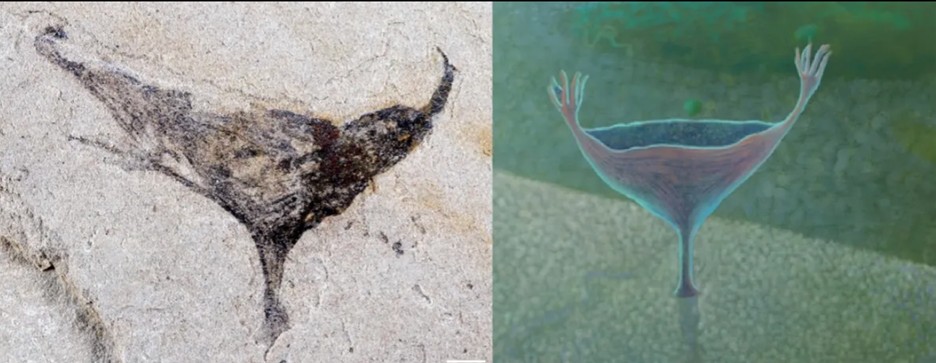
A fossil find from the Jiangchuan Biota. Image from Gaorong Li & Xiaodong Wang. The authors interpret this as a “cnidaria-like” organism, as depicted by an artist in the second drawing.
Researchers analyzed more than 700 fossils from the Jiangchuan Biota in southwest China, dated by evolutionists to between 554 million and 539 million years ago. The site preserves a “treasure trove” of creatures preserved as carbonaceous films, including what some are claiming to be the oldest known relatives of the vertebrates.
Evolutionists use this new fossil bed to say that some life forms evolved into more complex levels before the Cambrian explosion: a “longstanding question for paleontologists has been whether this astonishing diversification event happened all at once during the Cambrian explosion – or if ancestors of Cambrian and modern animal groups can be traced further back in time.” Recent studies suggest that new fossil finds, including some uncovered in China, are helping to resolve the question of whether this was a quick event or a longer, drawn-out process.[9]
In order to retain the progressive evolutionary story, reporters are claiming that these indistinct creatures push back the appearance of complex animals into the late Ediacaran Period for the first time. If so, it would suggest that the lineage leading to backboned animals had evolved much earlier than the previous evolutionary timeline indicated, by about 4 million years. But as David Coppedge wrote in his article about the Jiangchuan fossils, this story involved a great deal of interpretation.
The lead author Gaorong Li told Discover Magazine that “Once those more complete fossils appeared, it became clear that we were not just looking at unusual algae or isolated fragments, but genuine animal body fossils from the terminal Ediacaran. That was the moment we realized these fossils could have much bigger implications for the timing of early animal evolution.”[10] (Emphasis added).
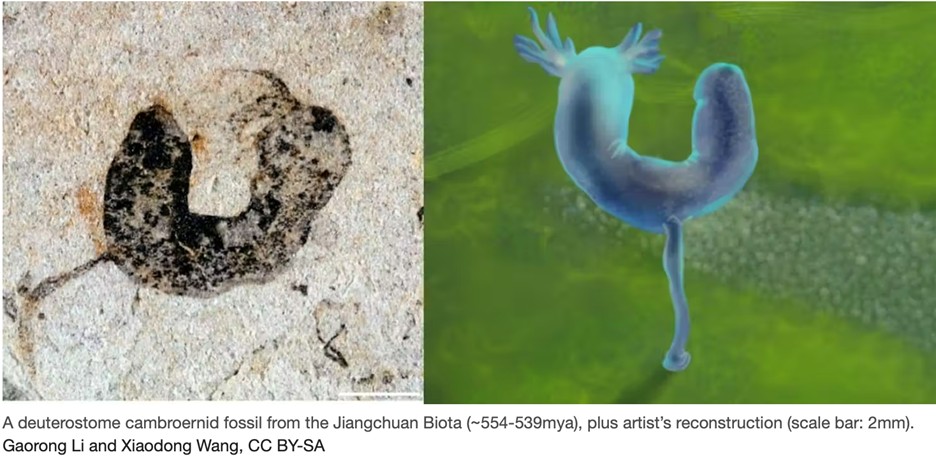
The Jiangchuan fossils like this alleged deuterostome look nothing like any other fossils, modern or extinct, and so are being interpreted through an evolutionary lens.
Time Dilation
Evolutionists readily adjust their timelines to fit the narrative of molecules-to-man evolution. This is another example of adjusting new fossil discoveries to the narrative. The timeline is flexible. When I was in middle school, the earth was said to be two billion years old. Now it is considered to be 4.6 billion years old.
Another example of maintaining an evolutionary narrative involves stasis. The problem of the “first appearance” of all kinds of fossils is being pushed farther and farther back in the supposed geologic time – often dramatically so. For example, in January of 2008, Rudkin and his colleagues, including Graham Young of the Manitoba Museum, spotted fossils of horseshoe crabs buried in rocks in central and northern Manitoba from the Ordovician period thought to be 445 million years old. They describe the discovery in the January issue of the journal Paleontology. Previously, these creatures were thought to exist no farther back than 350 million years in the Carboniferous period. This discovery pushed them back another 100 Ma to 445 Ma.
Both the Carboniferous and the Jurassic fossil discoveries indicate the “ancient” horseshoe crabs greatly resembled their modern-day counterparts. And, analysis of the recent finds also indicates that the ocean creatures have not changed over eons of time. “We wouldn’t necessarily have expected horseshoe crabs to look very much like the modern ones, but that’s exactly what they look like,” Rudkin said. “This body plan that they’ve invented, they’ve stayed with it for almost a half a billion years. It’s a good plan,… They’ve survived almost unchanged up until the present day.”[11]
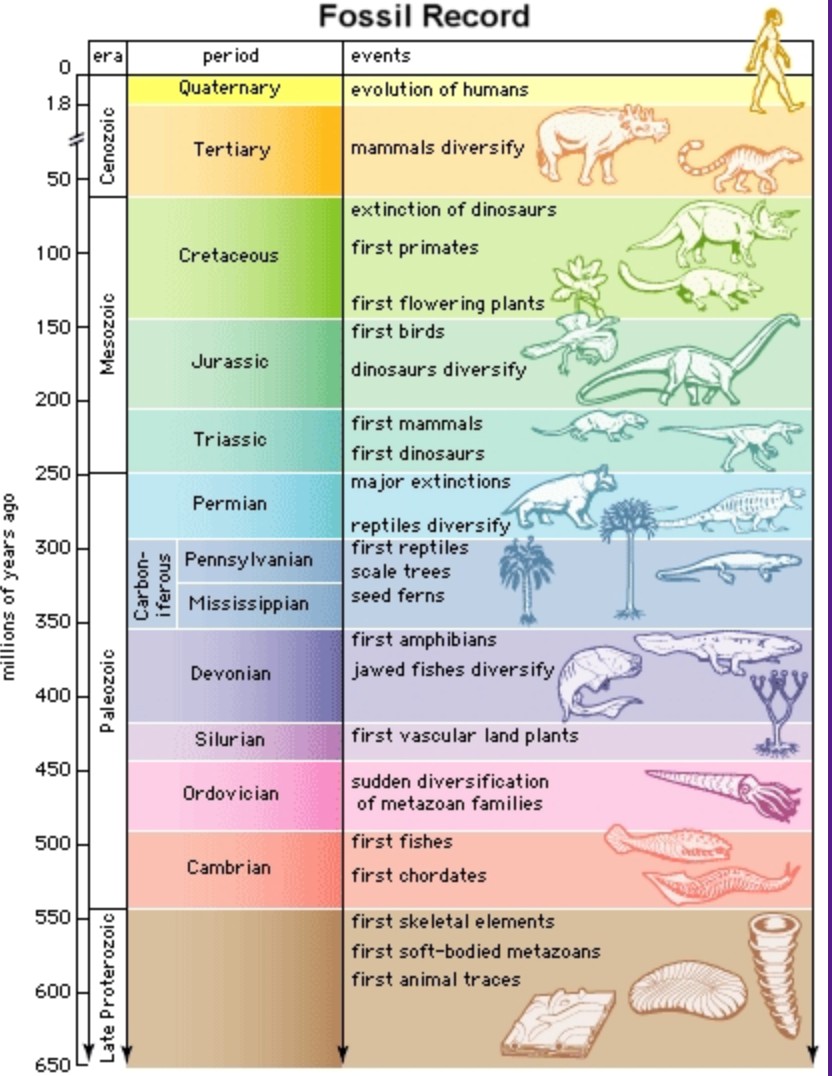
The Fossil Record proposed by Evolutionists. From Sean Pitman. 2015. The Fossil Record.
Summary
Evolutionary dates are often calculated not by rigorous analytical methodology but rather by determining to fit the evidence into the evolutionary timeline. The methods that yield millions of years are unreliable, often conflicting, and believed only by consensus when they can be forced into the story of progressive evolution. Carbon dating (which only works back a few thousand years, and requires organic material) sometimes yields dates that can be corroborated by historical sources or archaeological evidence. Carbon dating is not possible for deep time (millions and billions of years). The dates ascribed to the Jiangchuan fossils, with ample amounts of interpretation, gave these evolutionists a way to allege a slower rise to the Cambrian explosion, which has been and remains a deep problem for evolution, as it was for Darwin himself.
Update 20 May 2026: Casey Luskin at the Discovery Institute reports on a secular paleontologists who has even more doubts than he did about the interpretation of these fossils. He doubts that ctenophores or any bilaterians are present in the formation, and even doubts the dates given; they could be closer to the base of the Cambrian than claimed. Read Casey’s report here.
See also:
- David Coppedge, “Much Ado About New Chinese Ediacaran Fossils,” 9 April 2026.
- Casey Luskin, “Science Paper Overstates Case for Diverse Assemblage of Bilaterians in the Ediacaran,” Science & Culture Today, 20 April 2026.
- Casey Luskin, “Beach Stroll Casts Further Doubt on Some Supposed Ediacaran Bilaterian Fossils,” Science & Culture Today, 20 April 2026.
- Casey Luskin, “The Prescient Gunter Bechly: New Paper Doesn’t Negate the Cambrian Explosion,” Science & Culture Today, 23 April 2026.
- Casey Luskin, “More Challenges to Ediacaran Animal Fossils,” Science & Culture Today, 17 May 2026.
References
[1] University of California, Berkeley. Understanding Evolution. https://evolution.berkeley.edu.
[2] Elizabeth Mitchell. 2015. Cambrian Explosion or Creation Week—Key to Vertebrate Success? March 15. https://answersingenesis.org/theory-of-evolution/evolution-timeline/cambrian-explosion-or-creation-week-key-to-vertebrate-success/?srsltid=AfmBOopVjjTM8Inf0QJpS8pNrP48JDR-kF0bE0nn3dIiKG7D4ilZtGfR
[3] Daily, Beth. 2026. Humans’ closest invertebrate ancestors date back much further than thought – how we discovered the fossils that show this. The Conversation. April 2, https://theconversation.com/humans-closest-invertebrate-ancestors-date-back-much-further-than-thought-how-we-discovered-the-fossils-that-show-this-279793
[4] Daily, Beth 2026. Humans’ closest invertebrate ancestors date back much further than thought – how we discovered the fossils that show this. The Conversation. April 2.
[5] Li. Gaorong et al The dawn of the Phanerozoic: A transitional fauna from the late Ediacaran of Southwest China. Science Apr 2026 392(6793): 63-68 DOI: 10.1126/science.adu2291.
[6] Scott, Anastasia. 2026. 539-Million-Year-Old Ediacaran Fossils Push Complex Animal Life Back 4 Million Years https://www.discovermagazine.com/539-million-year-old-ediacaran-fossils-push-complex-animal-life-back-4-million-years-48910
[7] Scott, Anastasia. 2026.
[8] Scott, Anastasia. 2026.
[9] Daily, Beth, 2026.
[10] Scott, Anastasia. 2026.
[11] Pitman, Sean. 2015. The Fossil Record. https://www.detectingdesign.com/fossilrecord.html.
 Dr. Jerry Bergman has taught biology, genetics, chemistry, biochemistry, anthropology, geology, and microbiology for over 40 years at several colleges and universities including Bowling Green State University, Medical College of Ohio where he was a research associate in experimental pathology, and The University of Toledo. He is a graduate of the Medical College of Ohio, Wayne State University in Detroit, the University of Toledo, and Bowling Green State University. He has over 1,900 publications in 14 languages and 40 books and monographs. His books and textbooks that include chapters that he authored are in over 1,800 college libraries in 27 countries. So far over 80,000 copies of the 60 books and monographs that he has authored or co-authored are in print. For more articles by Dr Bergman, see his Author Profile.