



Sense of Smell Uses a Barcode System
New Cell study reveals that smell
is governed by a hidden spatial code,
with ~1,100 receptors arranged in
precise maps that align nose and brain
The Nose Knows
New Research Finds the Nose has a Hidden Map Architecture
by Dr. Sarah Buckland-Reynolds
What if I were to present to you the innovation of a hidden striped barcode map that allows you to detect thousands of distinct sensorial markers connected to a centralized control system? Sounds like science fiction? Smell a rat? Well, actually, this is how a rat smells you!
 A spatial code governs olfactory receptor choice and aligns sensory maps in the nose and brain (Brann et al., Cell Press, 28 April 2026). Researchers created a detailed diagram of smell receptors in the nose that fills in missing details of how olfaction works.
In this paper, researchers Brann and colleagues made a groundbreaking discovery that overturned decades of assumptions that the neurons carrying olfactory receptors were randomly distributed. The press release from Harvard Medical School, reproduced at ScienceDaily, describes the discovery in the following way:
“By mapping millions of neurons in mice, researchers discovered that smell receptors in the nose aren’t random at all—they’re arranged in neat, overlapping stripes based on receptor type, forming a hidden structure scientists never knew existed. Even more striking, this layout mirrors how smell information is mapped in the brain, revealing a coordinated system from nose to neural circuits.”
“What they found challenges long-standing assumptions. Instead of being randomly distributed, the neurons that carry these receptors are highly organized. They form horizontal bands, or stripes, running from the top of the nose to the bottom, grouped by receptor type.”
This well organized and structured olfactory system now joins the list of other sensory organs (for vision, hearing, and touch) where receptor maps have been charted as highly organised, and also testifies as yet another example of something thought to be random now being revealed as exquisitely ordered. We will discuss implications for evolutionary assumptions. From a Biblical creationist perspective, though, this discovery is not surprising.

Randomness Assumptions Overturned
How Evolution Has Been Leading Scientists by the Nose for Decades
As with other core assumptions, evolutionary models assume that organ development is primarily contingent upon what is deemed to be “sufficient for survival”. There was no evidence that odour detection required strict spatial order. It was assumed that the structure was mostly random.
According to evolutionary models, olfactory sensory neurons (OSNs) randomly selected one of ~1,100 receptors, with only vague “zones” in the nasal epithelium offering minimal order. Evolutionary accounts emphasized that olfactory receptor (OR) diversity arose through repeated rounds of duplication, deletion, and pseudogenization. Mutations in duplicated genes were assumed to gradually expand the repertoire of receptors, even if their distribution in the nose was haphazard.
For decades, evolutionary assumptions about smell shaped how olfactory science was studied and understood. Because researchers believed receptor choice was largely random within broad nasal “zones”, they treated the olfactory system as less ordered than vision or hearing. This had several long‑lasting influences, particularly a fragmented research focus. Scientists mostly chose to study only a handful of receptors at a time, assuming no fine‑grained spatial order existed. This fragmented technique (called in situ hybridization and microdissection) was selected as they expected randomness.
These methodological limitations from previous studies were admitted by the authors. In their own words:
“Most of what we know about spatial patterning of OR expression arises from in situ hybridization… which typically can query only a few genes at once and are difficult to align across samples.”
Adding to the assumptions, comparisons of adaptations among species in evolutionary theory (like dolphins losing olfactory receptor genes or primates relying more on vision) were explained as ecological trade-offs, reinforcing the idea that smell was evolutionarily dispensable and would be messy. Additionally, evolutionary theory suggested functional overlap made randomness tolerable; searches for precise maps were further discouraged.
Order in Odour: The Spatial Code for Smell Discovered
By sequencing millions of neurons, Brann et al. (2026) discovered that each type of nasal receptor occupies a unique, stereotyped position along a dorsoventral (DV) axis in the nose (from the back/top to the front/bottom of the nasal cavity). This hidden map aligns seamlessly with the olfactory bulb in the brain.
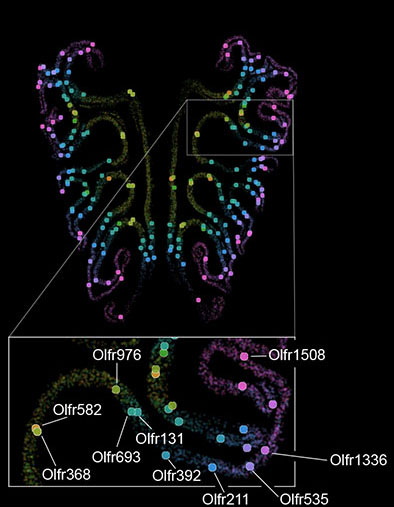
A map of the thousand types of smell receptors in the olfactory tissue of a mouse nose, labeled by a color gradient. The bottom inset shows the precise spatial positions of a tagged subset of receptors. Image: Datta Lab.
The researchers found that there was a chemical at the center of this order: retinoic acid. This chemical controls how genes turn on and off and forms a gradient (meaning its concentration changes gradually from one end of the tissue to the other). This gradient acts like a set of instructions similar to a barcode, where neurons “read” their position in the gradient and then switch on the correct olfactory receptor gene. This reading happens in the thin sheet of tissue lining the inside of the nose (olfactory epithelium). Each sensory neuron in the epithelium chooses one receptor out of about 1,100 possible options. But instead of choosing randomly, each receptor is expressed at a specific position along the dorsoventral axis, forming a reproducible “map” of receptors.
Behind this precision is a transcriptional program, consisting of a coordinated set of about 250 genes. These include transcription factors (proteins that control which genes are active) and axon guidance molecules (signals that direct the neuron’s wiring toward the brain). These neurons carry early instructions that predetermine which receptor they will express.
The result of these intricate processes forms a receptor map in the nose that aligns seamlessly with the map in the brain’s olfactory bulb. Odours are detected by receptors in the epithelium, and those signals are routed to matching locations in the brain. This alignment ensures that thousands of odour channels are processed with precision.
What is equally intriguing is the evidence of anticipatory coordination. As Brann et al (2026) desribe:
Thus, the transcriptional identity of OSN precursors is defined by spatially organized gradients of gene expression, which are then transformed into discrete and predictable OR choices and glomerular targets; this mechanism coordinately organizes the first two stages of the peripheral olfactory system by constructing a detailed receptor map in the nose aligned with the precise receptor map apparent in the OB.
Given this discovery, involving the convergence of chemical gradients, gene networks, and spatial codes, the sense of smell is now seen as an irreducibly complex system. If you remove one piece, whether the retinoic acid gradient or the transcription factors, the whole system collapses.
How could random mutations coordinate retinoic acid gradients, transcription factors, and axon guidance simultaneously? Even if such coordination were possible over time, why would evolution “wait” millions of years for these systems to align, when any delay would leave organisms vulnerable? It seems more reasonable to see these interdependent systems as evidence of purposeful design.
Even more remarkable is that these nasal maps are not unique to mice. In the press release, Sandeep Datta, a co-author of the study, stated that:
“We show that development can achieve this feat of organizing a thousand different smell receptors into an incredibly precise map that’s consistent across animals…”
This consistency across individuals further defies evolutionary theory as it would expect variability, yet the system is stereotyped. As Brann et al. report, “The rank ordering of OSN subtypes based on their DV scores was nearly invariant (p = 0.987) across hundreds of independent samples.” Such precision suggests design, not chance.
Following the Nose: Implications of the Discovery
The implications of Brann et al’s research go beyond merely tracing the nasal map. The press release continues:
“The team is now working to understand why the receptor stripes appear in their specific order and whether the same organization exists in humans. This knowledge could guide new approaches, including stem cell therapies or brain-computer interfaces, aimed at restoring the sense of smell.”
By revealing that smell is organized through reproducible spatial codes rather than random receptor placement, researchers now have a blueprint for interventions that were previously unimaginable.
Elaborating more on this, in medicine, this knowledge could inform stem cell therapies designed to restore the sense of smell in patients with anosmia. Instead of neurons regrowing in a disordered fashion, stem cells could be guided to adopt the correct receptor identities and positions, ensuring that regenerated tissue integrates seamlessly with the brain’s olfactory circuits. Similarly, understanding the transcriptional program of roughly 250 genes may provide a roadmap for neuroregeneration after injury or disease.
On the technological side, the alignment between nose maps and brain maps opens possibilities for brain‑computer interfaces. Devices could be developed to stimulate the olfactory bulb directly, which may give hope in potentially restoring or even enhancing smell perception. Engineers might also design artificial noses modeled on the striped receptor map, creating biosensors capable of detecting odours. Such technology could transform diagnostics, food safety, and environmental monitoring.
God’s Handiwork is Right Under Your Nose!
Brann et al’s (2026) research brings to the fore yet another amazing example of design while simultaneously showcasing the limitations of evolutionary theory. As one of the co-authors, Datta himself remarked:
“Our results bring order to a system that was previously thought to lack order.”
That order is not the product of blind chance but of a Creator who delights in complexity and beauty.
This discovery echoes Proverbs 20:12: “The hearing ear, and the seeing eye, the Lord hath made even both of them.” We might add: the smelling nose, too; the Lord hath made. Interestingly, the Bible often speaks of the senses as gifts of God. Smell is woven into worship and daily life in various Scriptures, including God valuing the “sweet savour” of offerings (Leviticus 1:9), and the figurative “fragrance” of Christ (2 Corinthians 2:15).
Noses in all shapes and sizes tell of the sophistication of our Creator. So next time you look in the mirror, remember, your nose carries a map that testifies of the wisdom of its Maker.
 Dr. Sarah Buckland-Reynolds is a Christian, Jamaican, Environmental Science researcher, and journal associate editor. She holds the degree of Doctor of Philosophy in Geography from the University of the West Indies (UWI), Mona with high commendation, and a postgraduate specialization in Geomatics at the Universidad del Valle, Cali, Colombia. The quality of her research activity in Environmental Science has been recognized by various awards including the 2024 Editor’s Award from the American Meteorological Society for her reviewing service in the Weather, Climate and Society Journal, the 2023 L’Oreal/UNESCO Women in Science Caribbean Award, the 2023 ICETEX International Experts Exchange Award for study in Colombia. and with her PhD research in drought management also being shortlisted in the top 10 globally for the 2023 Allianz Climate Risk Award by Munich Re Insurance, Germany. Motivated by her faith in God and zeal to positively influence society, Dr. Buckland-Reynolds is also the founder and Principal Director of Chosen to G.L.O.W. Ministries, a Jamaican charitable organization which seeks to amplify the Christian voice in the public sphere and equip more youths to know how to defend their faith.