


Cells Have a “Hail Mary” Strategy to Minimize Damage
The Hail Mary Adaptation
by Ronald D. Fritz, PhD
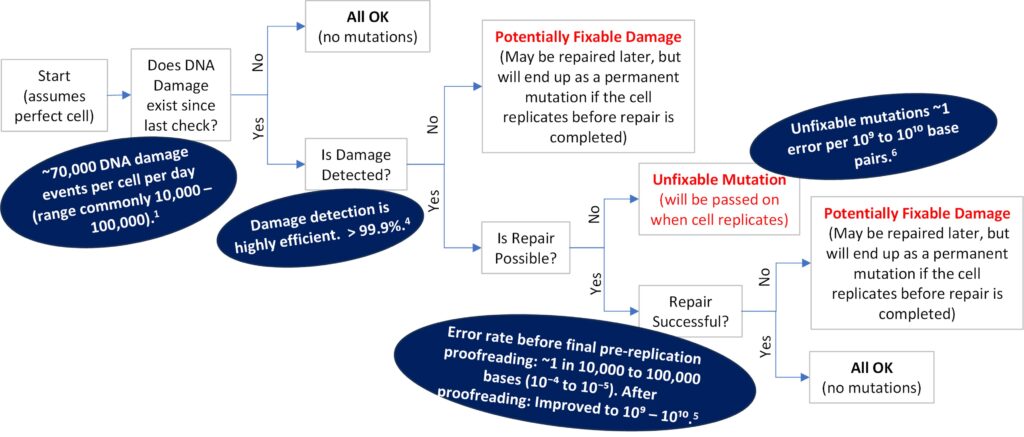
Figure 1. Flowchart of cell proofreading, repair efforts, and mutation possibilities.
 The accuracy of this system is almost beyond comprehension. It is comparable to copying the entire Bible — all 66 books — 300 times and making only a single typo.
Yet despite this incredible precision, mutations still slip through. The reason is the sheer volume of information being copied. Every time a human cell divides, it must accurately replicate over 3 billion base pairs of DNA.7 Even with near-perfect fidelity, the enormous amount of information being processed makes occasional permanent errors statistically inevitable.
And this creates a major problem for evolution: most of those permanent errors are harmful.
- Beneficial mutations: extremely rare — typically less than 1% (often estimated near 0.1% or lower)
- Neutral or nearly neutral mutations: roughly 10–30%
- Deleterious mutations: commonly 70–90% or more8
In other words, mainstream estimates suggest the odds are roughly 1000-to-1 against a mutation being beneficial rather than harmful.
Adjustable Mutation Rates
But there is another fascinating aspect to this story. Mutation rates are not always fixed. Cells can actually adjust them depending on environmental conditions. Scientists refer to this phenomenon as mutation-rate plasticity.
A recent review article examined this very topic:
 DNA mutation rates in evolution, longevity, and disease: An evolutionary and biological trade-off. (Cao, D., Zeng, C., & Ren, R., Cell Investigation, March, 2026).9 In this paper, the authors show that mutation rates are managed by cells as part of finely tuned trade-offs that protect organism health and longevity.
Viewed through evolutionary glasses, this appears to support evolution. But does it?
The authors describe mutation rates as part of a balancing act between preserving genetic stability and supposedly allowing enough variation for evolution to occur.
In their words:
“Mutation rates … represent a fundamental trade-off between the need for genetic stability to ensure longevity and minimize disease, and the requirement for genetic variation to drive evolution and adaptation.”
Let’s examine that trade-off more closely.
Optimizing Energy vs Accuracy
There is a well-known energy-versus-accuracy trade-off in biology. Extremely low mutation rates are theoretically possible, but achieving them requires large amounts of energy and additional repair machinery. The closer a system gets to perfection, the more costly it becomes.
A heavy investment makes excellent sense because most mutations are harmful. Spending significant energy on DNA repair helps protect the organism by reducing cancer, aging, cellular dysfunction, and loss of longevity.
But evolutionary scientists see another side to this equation. In their view, mutation rates cannot become too low because evolution depends on a steady supply of beneficial mutations. Without enough mutations, organisms would supposedly lack the “adaptability” needed to evolve over deep time.
So how do they believe evolution overcomes such terrible odds?
One proposed evolutionary solution to this problem is something called Density-Associated Mutation-rate Plasticity (DAMP). The Cao et al. (2026) review highlights a key 2017 paper that introduced and demonstrated this phenomenon.10
DAMP describes how bacteria adjust their mutation rates based on population density:
- When the population is large and crowded (stable conditions), cells lower their mutation rate and become more genetically “careful.”
- When the population is small or sparse (lonely or stressful conditions), cells raise their mutation rate, allowing more genetic variation.
The Hail Mary Strategy
In effect, stressed cells begin taking more risks. Researchers interpret this as a kind of biological “bet-hedging” strategy — a desperate attempt to generate enough genetic variation that a rare beneficial mutation might appear.
In football terms, it resembles a “Hail Mary” pass.
When conditions are good, cells play it safe. But under stress, they supposedly begin rolling the genetic dice, hoping for a lucky break.
To be fair, the authors do not argue that evolution succeeds primarily through these risky moments. Rather, they see mutation-rate plasticity as one mechanism among many that help populations adapt despite the overwhelming rarity of beneficial mutations.
Nevertheless, many evolutionary explanations ultimately depend on exactly these kinds of extraordinarily fortunate events occurring repeatedly over deep time.
But here’s the real problem: a closer look at mutation-rate plasticity suggests that evolutionary bias may be influencing the interpretation more than the actual evidence. When microbes reduce mutation rates under favorable conditions and increase them during stress, researchers often interpret this as a clever strategy for promoting long-term evolutionary progress.
Energy Conservation
But there is a much simpler explanation. The organism may simply be conserving energy.
Under stressful or resource-poor conditions, cells may reduce investment in expensive high-fidelity repair systems. A higher mutation rate may simply be a side effect of energy conservation rather than a purposeful attempt to evolve.
That interpretation fits far better with what we actually observe:
- mutations are overwhelmingly harmful, so it’s a bad bet,
- genetic systems are designed to minimize errors not increase them,
- and long-term genetic decay appears far more common than upward evolutionary progress.
So, what evolutionists interpret as purposeful, forward-looking strategy for long-term evolutionary progress may simply be an efficient, designed mechanism for short-term survival — prioritizing energy conservation when resources are limited.
So, stepping back, what do all these findings actually reveal?
1. Cells possess astonishingly sophisticated systems capable of handling the roughly 70,000 DNA-damaging events that occur every day. According to secular scientists themselves, without these repair systems, life would rapidly collapse into “error catastrophe” within only a few generations. Such systems would have been absolutely necessary from the very beginning for life to have any chance.
2. DNA replication accuracy is extraordinary from the outset — comparable to copying the entire Bible 300 times with only one typo. This didn’t evolve.
3. This high fidelity requires multiple coordinated systems functioning together with remarkable precision — including polymerase proofreading (the immediate error-checking done while DNA is being copied), mismatch repair (a second system that scans for and fixes copying mistakes that were missed), base excision repair (which detects and repairs damaged DNA bases), and several others.11 Such integrated complexity presents a major challenge for unguided evolutionary explanations, especially since these systems would have been required from the very beginning.
4. These repair systems treat the cell’s current DNA sequence as the correct and best version. Any deviation from the existing sequence is evaluated against the current DNA and often treated as damage to be corrected. This strongly suggests that the original created genome was presumed optimal, with built-in mechanisms engineered to resist deviation from that high standard. This screams design.
5. Not to mention, most mutations are harmful, with truly beneficial ones being exceedingly rare. By mainstream estimates, organisms face roughly 1000 deleterious mutations for every beneficial one.8 Left unchecked, mutational load accumulates rapidly, leading toward genetic deterioration rather than continual improvement —exactly what we observe today.
6. Given these odds, how then does evolution supposedly succeed over deep time? Any beneficial DNA change must survive the cell’s sophisticated repair systems — systems that cannot distinguish between beneficial and deleterious changes. This means some beneficial changes will inevitably be “fixed” (reverted), while those clean enough to be retained will still be accompanied — and often overwhelmed — by roughly 1,000 equally clean deleterious changes.
7. The idea that countless evolutionary “Hail Mary” passes somehow produced all the staggering biological complexity we see today requires an almost miraculous string of lucky accidents, repeatedly succeeding over hundreds of millions of years — despite overwhelmingly unfavorable odds.
In the end, the Cao et al. (2026) review unwittingly exposes a profound contradiction at the heart of evolutionary thinking. Blinded by their commitment to naturalism, researchers take a system clearly engineered to minimize mutations and twist it into a convoluted mechanism supposedly designed to generate them for long-term progress.
 While they celebrate mutation-rate plasticity as a clever evolutionary strategy, the evidence points in the opposite direction: living cells are equipped with extraordinarily sophisticated, energy-intensive systems designed primarily to suppress mutations — because mutations are overwhelmingly harmful.
The heavy bias toward deleterious mutations, the razor-thin margin for error, and the need for multiple coordinated repair systems from the very beginning present a formidable challenge to unguided evolution.
Rather than supporting a long chain of successful evolutionary “Hail Mary” passes over hundreds of millions of years, the evidence fits far better with an originally perfect genome — designed with high stability and fidelity at creation — followed by gradual genetic decay after the Fall. This is fully consistent with a relatively recent creation.
The more scientists uncover about the cell’s astonishing error-management systems, the harder it becomes to believe those systems arose through the very mutations they exist to suppress — especially since they are wired to defend the genome’s current state as the standard.
References
1. Spencer Chapman, M., et al. (2025). Prolonged persistence of mutagenic DNA lesions in somatic cells. Nature. https://doi.org/10.1038/s41586-024-08423-8
2. Eigen, M. (1971). Self organization of matter and the evolution of biological macromolecules. Naturwissenschaften, 58(10), 465–523.
3. Bull, J. J., Sanjuán, R., & Wilke, C. O. (2007). Theory of lethal mutagenesis for viruses. Journal of Virology, 81(6), 2930–2939.
4. Sender, R., Fuchs, S., & Milo, R. (2016). Revised estimates for the number of human and bacteria cells in the body. PLOS Biology, 14(8), e1002533.
5. Alberts, B., Johnson, A., Lewis, J., Morgan, D., Raff, M., Roberts, K., & Walter, P. (2015). Molecular Biology of the Cell (6th ed.). Garland Science. (Chapter on DNA Repair)
6. Kunkel, T. A. (2009). Evolving views of DNA replication (in)fidelity. Cold Spring Harbor Symposia on Quantitative Biology, 74, 91–101. https://doi.org/10.1101/sqb.2009.74.02
7. International Human Genome Sequencing Consortium. (2004). Finishing the euchromatic sequence of the human genome. Nature, 431(7011), 931–945. https://doi.org/10.1038/nature03001
8. Eyre-Walker, A., & Keightley, P. D. (2007). The distribution of fitness effects of new mutations. Nature Reviews Genetics, 8(8), 610–618. https://doi.org/10.1038/nrg2146
9. Cao, D., Zeng, C., & Ren, R. (2026). DNA mutation rates in evolution, longevity, and disease: An evolutionary and biological trade-off. Cell Investigation, 2(1), Article 100061. https://doi.org/10.1016/j.clnves.2026.100061
10. Krašovec, R., Belavkin, R. V., Aston, J. A. D., Channon, A., Aston, E., Rash, B. M., Kadirvel, M., Forbes, S., & Knight, C. G. (2017). Spontaneous mutation rate is a plastic trait associated with population density across domains of life. PLOS Biology, 15(8), Article e2002731. https://doi.org/10.1371/journal.pbio.2002731
11. Kunkel, T. A. (2009). Evolving views of DNA replication (in)fidelity. Cold Spring Harbtradeor Symposia on Quantitative Biology, 74, 91–101.

Ronald D. Fritz, PhD, is a retired research statistician whose career spanned 27 years. Before entering the field of statistics, he worked as an engineer and engineering manager in the defense industry. He earned his doctorate in Industrial Engineering, with a minor in Mathematical Statistics, from Clemson University, where he was honored as a Dean’s Scholar. Dr. Fritz served as a consulting statistician across a broad range of industries, culminating in a 12-year role as a global statistical resource at PepsiCo. During his time at PepsiCo, he led significant research on gluten contamination in oats and its relationship to celiac disease, publishing several articles on the subject.
In retirement, Dr. Fritz developed a deep interest in creation science, sparked by a visit to the Creation Museum in Petersburg, Kentucky. As he delved into the topic, he shared his findings with his pastor, which led to an invitation to speak at their church. This initial presentation opened the door to further speaking engagements at churches throughout the region. Dr. Fritz has been married for 35 years to his wife, Mitzie. They live in the mountain community of Bee Log, North Carolina, within sight of the church where they were married and now worship. In his free time, Dr. Fritz tends a small chestnut orchard on their property, working to revive what was once a cherished local delicacy. The couple has two adult children.
Comments
Great catch of a paper to expose. Good analysis and exposure of the typical evolution blinding dedication.
Evolution = Imaginary Science