


Witness the Power of God in Lightning
For Lightning Safety Awareness Week,
we reflect on how lightning reveals
the power and wisdom of our Creator
Awe in the Flash
How Lightning Reflects the Power of God
by Dr. Sarah Buckland-Reynolds
As a child, I remember watching the sky during the rainy season in fascination at the patterns and differential lighting before rainstorms. My father often recounts how the mild flashes reminded him of light flashes in projected ‘old time movies’ in his day. Many of us have paused at some point in our lives in awe at either the vastness of lightning, or with an alarm at the sharp clap of thunder from time to time. However, to what extent do we really appreciate the vast power and significance of the phenomenon of lightning?
Today, we take the opportunity to reflect on lightning, coinciding with the commemoration of Lightning Safety Awareness week, that occurs during the third week of June (June 21-27, 2026). While mention of ‘safety’ may highlight the potentially destructive power of lightning storms, this article will highlight that even within the warnings of the power of lightning there is a testimony to the wisdom and strength of the Creator, as lightning is not merely a hazard; but bridges science, ecology, and inspires human ingenuity.

Credit: Illustra Media, “In the Image of God”
The Power and Extent of Lightning
Each year, the National Oceanic and Atmospheric Administration (NOAA) estimates that lightning strikes the planet about 1.4 billion times, averaging 40–50 flashes per second worldwide, with up to 100 flashes per second, depending on the season. This immense frequency means that lightning is not a rare accident but a constant, global process woven into the fabric of ecological balance.
 When examining the statistics on energy release, lightning has ranked as among the most powerful natural events on earth. It is estimated that a single bolt can carry up to one billion volts and heat the air to 30,000 Kelvin: five times hotter than the surface of the sun. Lightning comes in a variety of forms, as well as being concentrated in specific hotspots globally. While many of us may be familiar with cloud‑to‑ground bolts, there are other varieties between and within clouds (intra‑cloud flashes), as well as “sprites” above thunderstorms, and rare “blue jets” shooting toward the stratosphere.
Statistics show that both South America and areas in Africa form among the most lightning‑prone locations on earth. Lake Maracaibo in Venezuela ranks as among the most prevalent hotspots, where storms can produce thousands of strikes nightly. Africa’s Congo Basin also records some of the highest strike densities.
The Marvel of Lightning Before the Fall
In light of the vast power of lightning, with an energy release potential beyond that of earth’s sun, one must consider that lightning has immense destructive potential. From a Biblical creationist perspective, one may ask: what was lightning’s role before human sin introduced death and destruction?
Taking the text as is, Genesis describes a “very good” creation. Lightning, in that pristine world, may have functioned as a non-harmful atmospheric regulator, balancing electrical charges between earth and sky, maintaining soil fertility, and energizing ecosystems without destructive consequence. Even today, lightning fixes nitrogen into the soil, enriching fertility and sustaining plant life. This hints at its original purpose: a life‑supporting mechanism rather than a deadly force. In the following section, we elaborate more on some of these constructive functions of lightning.
Lightning’s Role in Ecosystem Maintenance
Lightning plays a powerful function in ecosystems, engineering various environments.
1. One of lightning’s most vital contributions is nitrogen fixation in soils: a vital process to maintain soil fertility.
Even though earth’s atmosphere is nearly 78% nitrogen in its gaseous form, nitrogen is inaccessible to plants. Lightning’s intense heat, (reaching up to 30,000 Kelvin) breaks apart nitrogen molecules, allowing them to combine with oxygen to form nitrates. These nitrates dissolve in rain and enter the soil, becoming a natural fertilizer.
To what extent is lightning involved in this process? Scientists estimate that lightning contributes between 5–10 million metric tonnes of nitrogen globally (up to 10% of the nitrogen compounds) added to soils annually. This underscores how dependent ecosystems are on this process. Without lightning, vast regions would struggle to maintain soil fertility, and plant productivity would decline, destabilizing food chains.
2. Another function of lightning is forest renewal.
Even in wildfires, they may function as ecological reset buttons. In many ecosystems, particularly savannas and pine forests, fire clears out old growth, recycles nutrients locked in dead biomass, and opens space for new species to thrive.
For example, in North American forests, lightning‑induced fires help maintain biodiversity by preventing any single species from dominating.
Studies show that in fire‑dependent ecosystems, up to 70% of natural fires are sparked by lightning, making it a primary agent of ecological balance. What appears destructive may actually function as a mechanism of renewal.
3. A third ecological function of lightning is its contribution to atmospheric balance.
As thunderstorms build up massive electrical charges as ice particles collide within clouds., without discharge, these imbalances could destabilize weather systems. Lightning acts as a release valve, equalizing charges between clouds and the ground. This stabilizing function helps regulate storm dynamics and prevents unchecked buildup of electrical energy. In this sense, lightning contributes to balance that keeps Earth’s atmosphere functioning smoothly.
A Spark of Chance? Cosmological Evolutionary Explanations of Lightning’s Functions

Stanley Miller at spark-discharge apparatus, 1953
Amidst these functions of lightning, evolutionary cosmologists often claim lightning as a phenomenon played among its most significant role in the origin of life. The famous Miller‑Urey experiment (1953) simulated what evolutionists believe to be early earth conditions, sparking gases with electrical discharges to produce amino acids. This is cited as evidence that lightning could have jump‑started life.
However, when examining various aspects of this hypothesis, several inconsistencies abound. Among the most profound inconsistencies is the fact that lightning more often destroys organic molecules than assembles them. This has been explained in a recently published paper:
Isotopic constraints on lightning as a source of fixed nitrogen in Earth’s early biosphere’ (Barth et al. Nature Geoscience, 21 April 2023). The authors performed their research in an evolutionary context:
“It has long been postulated that lightning may have driven the origin and early evolution of life on Earth, on the basis of estimates of fluxes and biological demands.”
Yet they admit to the destructive reality observed:
“In a natural lightning channel, gas is heated within a few microseconds to a peak temperature of 30,000 K… While the gas is cooling, NO [nitric oxide] forms. However, the timescales for thermochemical equilibrium… cause the NO concentration to be fixed once the cooling timescale drops below the equilibrium timescale.”
This passage implies that lightning’s extreme heat rapidly destroys or alters molecules, limiting the persistence of any complex organics.
 The authors themselves note that while lightning can produce nitrogen oxides, it also destabilizes compounds as quickly as they form.
From a Biblical creationist standpoint, this tension is telling: evolutionary scientists invoke lightning as a possible spark for life, yet their own data show lightning’s destructive power overwhelms its constructive potential.
Life requires stable, integrated molecules (DNA, proteins, membranes), which lightning’s chaotic discharges cannot sustain. Instead of being a blind origin mechanism, lightning’s finely tuned role in nitrogen fixation and atmospheric balance points to design and providence.
In addition to its destructive nature to organic compounds, cosmological evolutionists assume that early earth had a reducing atmosphere (methane, ammonia), contradicting geological evidence that suggests the earth’s early atmosphere was not so, with at least two papers published within the last twelve months (2025-2026) questioning the reducing atmosphere hypothesis:
- Redox chemistry of early Earth and the origin of life (Nurbubu T. Moldogazieva et al), Nature Communications Chemistry (02 April 2026), and
- An Archean atmosphere rich in sulfur biomolecules (Nathan W. Reed et al). (1 December 2025).
Reed et al found reason to hypothesize earth’s early atmosphere was a mixed atmosphere with significant CO₂ and N₂, challenging the long‑held reducing model, while Moldogazieva et al (2026) found reason to hypothesize that earth’s early atmosphere was moderately oxidizing, with CO₂ and N₂ dominating, and only trace methane/ammonia. This aligns with geological evidence from sedimentary rocks and isotopic signatures, which do not support a strongly reducing sky.
Thus, while evolutionists invoke lightning as a blind spark of chance, the evidence points instead to purposeful design.

Dean Ortner dazzles the audience with his “million volt man” demonstration at the 20th Anniversary celebration of Illustra Media in 2017 (photo by DFC). Note the lightning bolts emerging from his fingertips while the piece of wood he is holding burst into flame from the electrical energy. God asked Job, “Can you send out lightnings, that they may go, and say to you, ‘Here we are!’?” (Job 38:35). This suggests lightning as a carrier of information, a potential realized in today’s wireless electromagnetic communications.
Human Ingenuity: Harnessing Lightning
With its uniquely powerful properties, lightning does not only benefit ecosystems but has also played a role in inspiring various innovations. Among these include the following:
1. Imitation in Energy:
Plasma Channels and Power Systems: Lightning’s plasma channels (ionized paths that conduct electricity through air) have become models for engineers designing advanced energy systems. In nature, these channels form almost instantaneously, creating a low‑resistance path for massive electrical discharge. Researchers studying plasma arcs have applied this principle to high‑voltage transmission lines and fusion energy experiments, where controlled plasma conduits reduce energy loss.
For example, studies in plasma physics show that mimicking lightning’s branching discharge patterns can improve arc stability in fusion reactors, making them more efficient than earlier designs that struggled with turbulence. Lightning’s natural efficiency in directing energy through unstable mediums has become a blueprint for technologies that must move electricity through challenging environments. This design insight has made modern plasma‑based systems more reliable than predecessors that lacked such natural modeling.
2. Medical Innovations: Defibrillators and the Lightning Jolt:
Lightning has also been used in medical applications. In particular, the sudden, overwhelming jolt of lightning inspired the principle behind cardiac defibrillators. Just as lightning resets electrical imbalances in the atmosphere, defibrillators deliver a controlled shock to reset the heart’s rhythm.
Early defibrillators in the 20th century were bulky and inconsistent, but by studying the pulse duration and intensity of natural electrical discharges, engineers refined the waveform to maximize effectiveness while minimizing tissue damage. Modern biphasic defibrillators, which deliver current in two phases, are directly modeled on the efficiency of lightning’s alternating discharge.
Clinical studies show that biphasic shocks achieve successful defibrillation at lower energy levels than older monophasic devices, reducing burns, and improving survival rates. In this way, lightning’s design has made medical technology more efficient and safer than its predecessors.
3. Supercomputing: Fractal Patterns for Network Optimization:
Lightning’s branching, fractal geometry (where each strike divides into smaller channels) has also become a model for network optimization algorithms.
In computing, data must travel across complex networks with minimal delay. Engineers discovered that mimicking lightning’s fractal branching reduces congestion and improves efficiency. For instance, algorithms inspired by lightning patterns have been applied to parallel processing in supercomputers, where tasks are distributed across thousands of nodes.
By following fractal distribution principles, these systems achieve faster load balancing than traditional linear or grid‑based models. Studies in computational geometry confirm that fractal‑based routing can reduce network bottlenecks by up to 30%, a significant improvement over earlier designs. Lightning’s natural efficiency in distributing energy across multiple paths has thus become a literal design template for distributing information across digital networks.

The Earth is the Lord’s
Lightning as Testimony to the Creator
Lightning Safety Awareness Week provides an opportunity to not only caution persons to remain safe in lightning zones and seasons, but also as a testament to the power of God, our Creator.
As we explored in this article, even in its destructive potential, lightning contributes to ecological cycles. This paradox also mirrors Biblical teaching – as creation groans under the curse yet we still see clear declarations of God’s glory.
While Scripture does not shy away from lightning’s destructive capacity, e.g., the destruction that befell Job’s children (Job 1:19), lightning remains as a Biblical symbol of God’s immense power. As Psalm 97:4 states “His lightning lights up the world; the earth sees and trembles.”
Science continues to show that lightning is both destructive and majestic. The harnessing of its properties in engineering and medicine further provide testimony of how God has endowed humanity with wisdom for responsible stewardship. In every flash across the sky, we glimpse the marvels around us that show the power of God. Next time that there is a rainstorm, may we thank God for the many glimpses of His power in the universe.
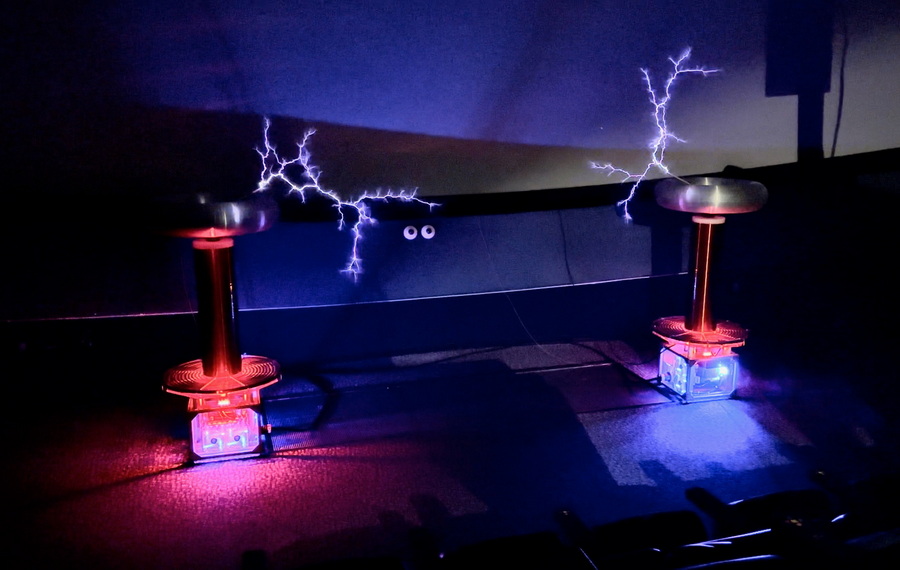
Twin Tesla Coils perform music in a daily demonstration at the Wonders Center and Science Museum in Dickson, Tennessee (credit: David Rives Ministries). God asked Job, “Can you send out lightnings, that they may go, And say to you, ‘Here we are!’? (Job 38:35), suggesting that lightning could be a carrier of information, as it is in today’s wireless electromagnetic communications.
 Dr. Sarah Buckland-Reynolds is a Christian, Jamaican, Environmental Science researcher, and journal associate editor. She holds the degree of Doctor of Philosophy in Geography from the University of the West Indies (UWI), Mona with high commendation, and a postgraduate specialization in Geomatics at the Universidad del Valle, Cali, Colombia. The quality of her research activity in Environmental Science has been recognized by various awards including the 2024 Editor’s Award from the American Meteorological Society for her reviewing service in the Weather, Climate and Society Journal, the 2023 L’Oreal/UNESCO Women in Science Caribbean Award, the 2023 ICETEX International Experts Exchange Award for study in Colombia. and with her PhD research in drought management also being shortlisted in the top 10 globally for the 2023 Allianz Climate Risk Award by Munich Re Insurance, Germany. Motivated by her faith in God and zeal to positively influence society, Dr. Buckland-Reynolds is also the founder and Principal Director of Chosen to G.L.O.W. Ministries, a Jamaican charitable organization which seeks to amplify the Christian voice in the public sphere and equip more youths to know how to defend their faith.
Comments
One of your fellow creationists sites (www.icr.org) says lightning strikes are evidence of earth’s youth.
One little know lightning fact is that neutrons are created as lightning shoves mater together so hard with the electrical z-pinch effect that the massive atoms split by fission and give off neutrons and create all new atoms of all kinds of elements inside some lightning bolts.
Did you ever wonder why the lightning bolts stay together in a kind of column and don’t just fan out and disappear?