



Evolutionist Explains Away Spectacular Dinosaur Graveyard
The problem is not the data.
It’s the evolutionary mindset that
imposes a narrative on the evidence.
Fossils in northeastern Italy tell a story of catastrophe, but no human was watching to see what happened. From remains of bone and sediment layers, it’s clear it involved a lot of water, with ebb and flow of water-borne sediments. It looks like a flood—but a flood that exceeded the power of those known in that area today. Here are some of the observations:
- Dinosaur death poses (23 Nov 2011), suggesting suffocation by drowning [see photo]
- Extraordinary preservation, suggesting rapid burial
- Dinosaurs, plants, and crocodiles buried together
- Soft-tissue outlines preserved
- Paper-thin laminations in the mud
The site is called Villaggio del Pescatore. For the explanation, your daily evolutionary narrator at The Conversation will tell us what happened there “around 80 million” [unobserved] Darwin Years ago.
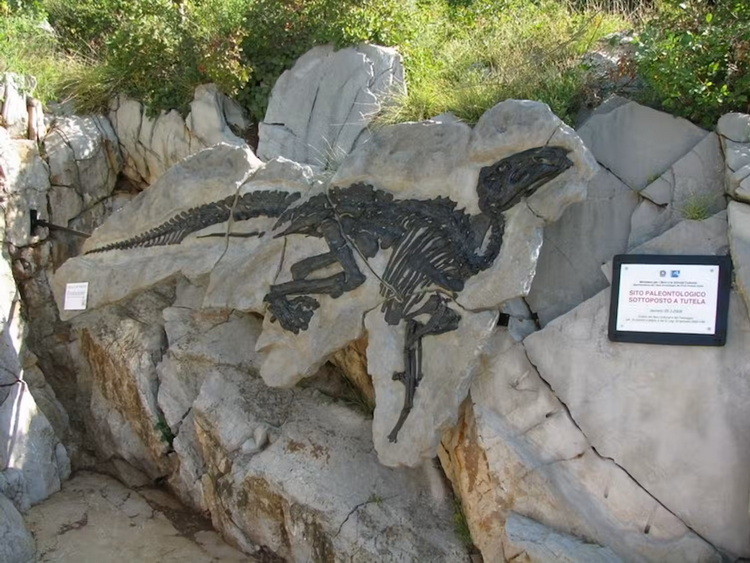
Reconstruction of a Tethyshadros insularis skeleton found at Villaggio del Pescatore, showing typical dinosaur death pose with head arched back. From the article at The Conversation.
 Storms that built a graveyard: ancient monsoons created a spectacular dinosaur fossil site (The Conversation, 22 July 2026). Alfio Alessandro Chiarenza, Royal Society Newton International Fellow in Palaeontology, wants readers to believe that climate change killed these dinosaurs.
After years of research, Professor Federico Fanti of the University of Bologna and I led a multidisciplinary team of palaeontologists, physicists and geologists to determine exactly how this fossil treasure trove formed. Our findings overturn decades of competing interpretations.
I.e., this was “not a quiet, isolated lake or sinkhole, as previously suggested.” How about a new suggestion? Will it deceive today’s readers like the old suggestion deceived the experts for decades?
Villaggio del Pescatore is not simply a place where fossils happen to be beautifully preserved. It is also a record of the weather that shaped the site.
Chiarenza leans on clues from the paper-thin laminae in the surrounding mudstone layers. He has another revision to make: they were not annual layers, but record daily layers. To learn this, he performed divination on X-ray synchrotron radiation of the rock.
The scans revealed that the layers were deposited by ocean tides, two pairs each day. These tides varied according to the familiar fortnightly cycle of stronger and weaker tides that still happen today. We could count these tidal layers, thanks to this unparalleled resolution.
Isn’t it possible that the layers record the ebb and flow of single currents advancing and retreating? After all, he’s talking about monumental storms with exceptional energy, enough to drown heavy dinosaurs. Professor Chiarenza is hip to overthrow previous interpretations, as long as his replacement fits the millions-of-years Darwinian paradigm.
The entire fossil-bearing rock pile, our results calculate, accumulated in only about 40 years, a single human lifetime, frozen in stone. Most fossil deposits containing several individuals average together thousands or millions of years. Here, we’re looking at a few decades.
But does that make sense? Where on earth is climate change causing destructive floods every year for four decades in the same location? Remember: this is not the only fossil dinosaur graveyard. Dr Ron Fritz listed several on 20 May 2026 in different places around the world. If this spot in Italy was so prone to big storms, why didn’t the surviving animals learn their lesson and stay away?
Climate Change: the Catch-All Explanation
Chiarenza shows a graphic to fit his story of an upside-down reptile sinking to the bottom of a flood and settling gently on the bottom, where sediments cover it up without microbes degrading it rapidly. Is that special pleading? One thing it mostly certainly is: an opportunity to preach a sermon about climate change:
This was a tropical regime of intensely wet summers and recurring tropical cyclones, sustained by the greenhouse climate of the age….
We propose that this combination of “ingredients”, monsoon floods, tidal trapping and microbial sealing, represents a recipe for creating exceptionally preserved fossil sites in hot, tropical greenhouse climates – precisely the kind of setting in which rapid decay would normally destroy organic remains….
Understanding how extreme storms transformed this ancient coastline may also help us think about how modern coasts could respond to a warmer and more turbulent climate fuelled by high levels of CO₂.
You may now perform the standard obligatory penance for being complicit in today’s high levels of CO2. Then, ask why climate change 80 million years ago occurred without SUVs or industry, and therefore, wonder why you felt guilty at the end of the sermon.
You might also wonder if the interpretation of layering has ever been challenged. Indeed, creation geologist Steve Austin examined layers that formed in a single day at Mt St Helens, where fine laminations are also found. Those layers, deposited by a single pyroclastic flow, were scoured years later by a single mudflow that carved a canyon 1/40th the size of Grand Canyon. Years after his research was published, I joined Dr Austin with a group to tour the site. We saw the evidence ourselves.

Hikers explore a “mini-Grand Canyon” carved through solid rock within hours by a catastrophic mudflow below Mt St Helens. The strata contain fine laminations deposited by a single pyroclastic flow.
One can imagine Dr Chiarenza examining this same canyon and concluding that the fine layers were not annual layers, but (correcting previous experts), they represent daily layers representing four decades of deposition by storms. It wouldn’t be hard to find pairs of layers his synchrotron radiation tool might lead him to interpret the rate of deposition was much quicker than previously believed—but certainly not as fast as within a few hours. (That, of course, would only be a plausible story if he and other scientists didn’t already know the eyewitness evidence of what actually happened here.)
So what do we make of the evidence at Villaggio del Pescatore? Large animals buried in drowning pose, with impressions of soft details exquisitely preserved, in fine-laminated mudstone deposits, with crocodiles and trees and leaves mixed in – is this a tale of decades of storms caused by climate change? Or is it the silent witness of a catastrophe that left dinosaur graveyards here and around the world?
Notably, the paper by Chiarenza et al in Global and Planetary Change uses the word “rapid” 26 times and “soft tissue” 21 times. The paper mentions the reason for the death pose: “All three specimens display passive postures — arched vertebral columns, asymmetrical limb positions and opisthotonic cervical curvature — consistent with post-mortem relaxation of submerged carcasses rather than peri-mortem convulsions.” This is remarkably common in articulated dinosaur skeletons.
Evolutionists are obligated to maintain the millions-of-years timeline at all times. One might wonder what Dr Chiarenza would say about soft, pliable blood vessels in a T. rex on the other side of the world. (20 March 2025, 19 July 2025).
 David Coppedge, B.S. Education, B.S. Physics, founded Creation-Evolution Headlines in late 2000 as a way to share science news he was encountering at NASA. It has grown into a highly-trusted source of news and commentary critical of the pro-Darwin consensus, providing analysis of breaking news of interest to creationists and evolutionists, without the Darwin spin. He has authored over 7,000 entries at CEH since its inception.
Comments
Villaggio del Pescatore: one of a handful of dinosaur sites around the world that’s troubling to the evolutionist and associates (long ages, deep time, etc.).