


Reality Corrects Evolutionary Tales, Part 2
Scientists within the secular echo
chamber too often mistake their simpli-
fying models for material realities
The Courage to Calibrate: When Reality Corrects the Story, cont.
by John D. Wise, PhD
Read Part 1 about interpreting alligator fossils.
2. The Vertebrate Eye: Reality vs Media Myth
The tendency to value a simplifying narrative over empirical reality is not unique to paleontology. It is a chronic psychological affliction in evolutionary biology, perhaps nowhere more visible than in the long-running ad campaign against the vertebrate eye.
For decades, prominent materialist writers have highlighted the “inverted” layout of the mammalian retina, where the photoreceptors sit at the back, requiring light to pass through layers of neurons and synapses, as a premier example of “poor design.” They confidently assert (not just “asserted”) that a blind, unguided evolutionary tinkering process had accidentally wired the camera backward, leaving vertebrates with an inefficient, clumsy bottleneck that scatters light and degrades visual acuity.
It was a tidy, compelling story. It was also utterly false.
The Fiber-Optic Motherboard
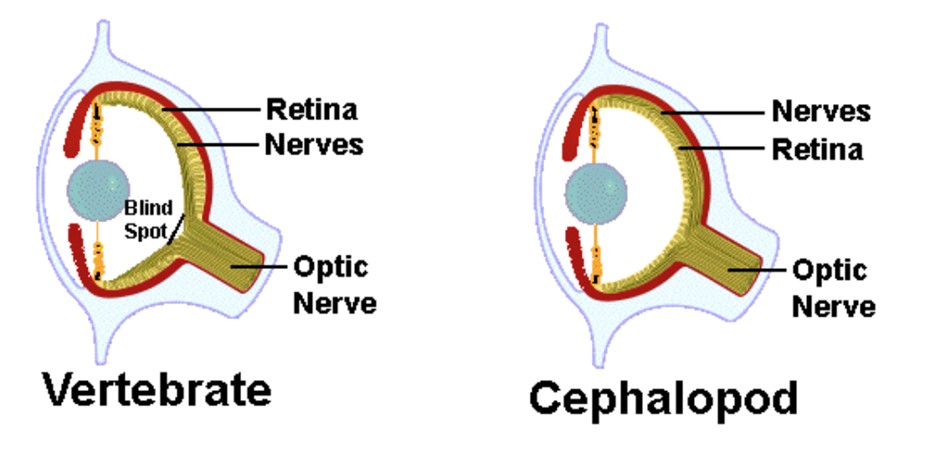
The inverted eye with the retina compared to the cephalopod eye which shows the nerves behind the retina. Illustrations from Wikimedia Commons.
The “wired backward” critique is driven by ideological utility rather than functional evidence. It demands a blindness to the physical constraints of a living, metabolic organ. Photoreceptors have an immense energy demand and must be directly adjacent to the Retinal Pigment Epithelium (RPE) at the back of the eye to shed their spent segments and regenerate visual pigments.
The secular narrative treated the neural layers in front of the sensors as accidental obstructions. Empirical discovery has repeatedly and devastatingly exposed this as hubris.[2]
First came the discovery in the 2010’s of the function of the Müller cells. Far from being structural clutter, these specialized cells act as living fiber-optic cables. They are optimized both physically and optically to funnel photons through the neural layers directly onto the photoreceptors without distortion, while filtering out stray noise. The physical “obstruction” argument was empirically shattered.
Now, a landmark study from the Yale School of Medicine delivers the fatal blow:
 A hierarchical electrical synaptic circuit mechanism for integrative parallel visual processing in the retina (Neuron, 6 May 2026)
Listening to the Intact Circuit
For generations, the “Authority Circle” of ophthalmology operated under a simplifying textbook narrative: the retina sorts visual data into autonomous, isolated parallel pipelines (color, motion, contrast) that run straight to the brain. Researchers historically studied these pathways by slicing retinal tissue into thin sections. Slicing was the available technology of the day, but scientists allowed their preferred narrative to close the story, confidently asserting that these pathways functioned independently.
The Yale team, led by Dr. Yao Xue, refused to let the model speak for the organism. They successfully executed a dual patch-clamp technique on fully intact, whole-mount mouse and human retinas. It was a tour de force of micro-surgical dexterity, lowering glass pipette tips just one micrometer wide deep into an undisturbed, living tissue.
By keeping the tissue whole, they kept the horizontal circuitry alive. And the moment they turned the machine on, the simplifying narrative of isolated pipelines collapsed.
The Reveal of the Commander Cell
Yale scientists found a hidden network inside the eye (ScienceDaily, 13 July 2026)
When the researchers electrically stimulated a single cell, they didn’t see an isolated pathway fire. Instead, they watched a broad, coordinated, cloud-like wave of activity spread instantly across separate channels. The supposedly independent pipelines were plugged into an underlying electrical grid linked by highly conductive gap junctions.
More shocking still to conventional wisdom was the discovery of a top-down control architecture:
The researchers also identified one bipolar cell type, known as BC6, that appeared to play a leading role in coordinating this network. Signals originating from BC6 spread through multiple visual pathways in an organized, hierarchical pattern.
“People had assumed that the different types of bipolar cells were more or less autonomous,” Zhou says. “But we found a driver among all these cell types that creates this network with a hierarchy.”

The vertebrate eye showing some of the main features.
The network is not a decentralized, bottom-up assembly of random survival hacks; it is governed hierarchically by Cone Bipolar Cell 6 (BC6). When light is extremely faint or contrast is low, the signal entering any single channel is too weak to be processed. The BC6 cell acts as a master controller, pooling the weak, distributed inputs across the grid to amplify the signal before it enters the optic nerve for processing. The very layers the critics dismissed as backward-wired evolutionary baggage are an advanced, analog pre-processing motherboard (my words, lol!) designed to rescue low-contrast vision at the threshold of perception.
The Authority Circle vs. Reality
When we place these two scientific triumphs side by side, two common threads are impossible to ignore.
First, we live in an era when phenomenal technological advances are flooding science with astonishing new insights, and we owe immense gratitude to the researchers executing this difficult, high-precision work.
Second, when forced to face these empirical advances, evolutionary biology’s boilerplate arguments suffer devastating setbacks.
The root issue is psychological and epistemological: scientists within the secular echo chamber too often mistake their simplifying models for material realities. A paleontologist calibrates his tools and finds them unreliable in accomplishing the task for which they were designed. Evolutionary apologists fell in love with a flat camera metaphor, looked at broken, sliced retinas, and felt licensed to mock a living supercomputer as an anti-design argument.
In both cases, they searched only for what their narrative dictated they could find. They closed the story to secure validation for their worldview, forgetting Science’s primary allegiance: discovery of the natural world.
Contrast that ideological closure with the posture that enabled the Yale discovery. Reflecting on their breakthrough, author Dr. Seunghoon Lee observed:
“Our experiments didn’t begin with a specific hypothesis but revealed a fundamental processing mechanism in the visual system… It’s an important reminder of how essential curiosity-driven research is to discovery.”
That brief statement is a lesson: real scientific discovery requires that we investigate nature without a predefined agenda. The “wired backward” myth survived for decades precisely because its proponents lacked that curiosity; they approached the eye not to learn how it worked, but to weaponize its layout against teleology.
If science were the purely self-correcting enterprise its defenders claim, the discovery of Müller cell fiber-optics followed by the top-down hierarchical control of the BC6 network would trigger immediate textbook retractions of the “bad design” narrative.
We await Dr. Dawkins’ retraction.
Instead, the political campaign continues, ignoring the living machine to protect the prestige of the failing consensus.
True science is vindicated when we possess the technological sophistication and the intellectual humility to “soften” our assumptions, calibrate our methods, and look once more with childish curiosity, allowing reality to speak for itself.
Science unavoidably tells stories because finite minds must find their way through fragmentary and often confusing evidence. Scientific humility is not found in abandoning stories, but in continually calibrating the tools, methods, assumptions, and interpretations by which those stories are tested against reality.
[2] Dawkins’ The Blind Watchmaker captured the exact moment when the evolutionary establishment took a temporary limitation in laboratory technology, wrapped it in a superficial camera analogy, and declared victory over design. They locked the narrative in 1986 and have spent the next forty years ignoring every empirical discovery proving their camera analogy was a childish oversimplification.

Looks simple till you look into the details.
 John Wise received his PhD in philosophy from the University of CA, Irvine in 2004. His dissertation was titled Sartre’s Phenomenological Ontology and the German Idealist Tradition. His area of specialization is 19th to early 20th century continental philosophy.
He tells the story of his 25-year odyssey from atheism to Christianity in the book, Through the Looking Glass: The Imploding of an Atheist Professor’s Worldview (available on Amazon). Since his return to Christ, his research interests include developing a Christian (YEC) philosophy of science and the integration of all human knowledge with God’s word.
He has taught philosophy for the University of CA, Irvine, East Stroudsburg University of PA, Grand Canyon University, American Intercontinental University, and Ashford University. He currently teaches online for the University of Arizona, Global Campus, and is a member of the Heterodox Academy. He and his wife Jenny are known online as The Christian Atheist with a podcast of that name, in addition to a YouTube channel: John and Jenny Wise.