


News Briefs for a Summer Day
The news this week
is more of the same,
only more so
Here’s an assortment of papers and articles in the news this week that deserve the attention of those interested in origins (i.e., everybody).
Small yet Precise
 Organization of the Stentor body plan by localized mRNAs (PNAS, 10 August 2026). Timothy A. Mitchison comments on a new paper about the complexity in the body plan of a microbe. Even getting the long axis right in the trumpet-shaped ciliated protist Stentor requires multiple coordinated steps (genetic and epigenetic), to say nothing of building the circumferential axis where a ring of cilia sweep nutrients into its cornucopia. “All cells are spatially organized,” Mitchison begins, “but the organizational complexity and precision of most metazoan cells pale in comparison to ciliated protists which display elaborate body plans.” And the little organism can regenerate itself if injured. The author says nothing about evolution.
Cosmic Early Maturity Worsens
 James Webb Space Telescope finds ‘hidden stars’ making the universe’s 1st galaxies much bigger than we knew (Space.com, 20 August 2026). The mass of early galaxies is larger than expected, if small stars are included. Latest images from the James Webb Space Telescope are breaking assumptions. According to Big Bang theory, Population I and II stars and planets needed to form after the first generation of Population III stars—composed of hydrogen and helium—had exploded and sent heavy elements into the gas and dust. “This result shows that much more mass than previously thought is hidden in small stars,” team leader Mariska Kriek of Leiden University said. “That has implications for all kinds of fields within astronomy. Because many planets orbit small stars, it could even mean that more planets formed in the early universe than we previously assumed.”
Secrets in Amber
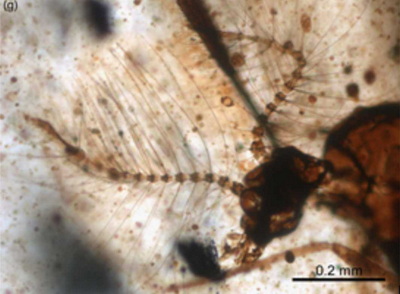
Exquisite detail of a midge’s head and antennae preserved in amber in Spain, from the paper.
The El Soplao Konservat-Lagerstätte: a key Cretaceous amber deposit from Spain (Journal of the Geological Society, 13 Aug 2026). The word “exceptional” appears six times in this Review paper about an amber deposit in Spain with representative species of insects from 11 orders, including termites, cockroaches, lacewings, beetles, gnats, midges and other flies, moths, and more. The four reviewers have almost nothing to say about evolution except its absence: e.g., “direct evidence of a behavioural stasis in debris-carrying for more than 100 million years in the lineage of modern green lacewings,” or when speculating: e.g., “In a broader evolutionary context, the transition towards the Cretaceous Terrestrial Revolution and the shift from gymnosperm- to angiosperm-dominated forests may have modified soil communities.” Also of interest is the possibility of recovering soft tissue and original biological material from specimens said to have died over 100 million years ago:
The exceptional fidelity of some inclusions… raises the possibility that remains of internal soft tissues or biomolecules could be recognizable in this fossiliferous material, particularly as analytical techniques continue to improve.
Oh, No, Not Again


Grok
Rethinking how we name and classify our human ancestors following recent evolutionary discoveries (Monash University, 19 August 2026). The neat “progression” icon is wrong; “the fossil record tells a much more complex story, with new discoveries repeatedly blurring the characteristics once thought to define us and our close relatives.” ScienceDaily‘s title for this press release is: “Scientists say the human family tree may need a major rewrite.” But that’s not news. They’ve been saying that every year for 50 years. The problem is bottom-up thinking (mice to man). THIS ISN’T WORKING, SCIENTISTS! Try the opposite direction: top down (creation to degradation). You can’t rethink forever. It means you were never thinking at all.
Follow the Plume
Odor tracking in flying Drosophila requires visual reafference and compass neurons (Currea et al., PNAS, 10 August 2026). A plume of odor hits you in the face. You need to pursue it or avoid it. What do you do? Get out the odor compass, and track which way it is getting stronger or weaker. This happens in the antennae and brain of an itty-bitty tiny fruit fly that has better aerodynamic equipment than a fighter jet.
A group of cells residing in the navigation center of the fly brain [Ellipsoid body-Protocerebral bridge-Gall (E-PG) neurons] have been shown to function like an internal compass, providing a reference frame for downstream circuits that can encode directional memory of heading changes akin to mammalian head-direction cells. Here, we show that self-generated visual motion signals work with E-PG compass neurons so that the direction of exploratory turns can be stored and recalled to maintain the animal’s heading within an odor plume during flight.
 Data in the Gap?
Lost ‘mega-escarpment’ across ancient USA may explain Grand Canyon’s missing billion years (Univ. of Southampton via Phys.org, 18 August 2026). Science is supposed to be about what you can see, not what you cannot see. A new paper in GeoScienceWorld tries to explain missing data. Operative quote from the press release: “Lead author Thomas Gernon, a professor of Earth science at Southampton, said the Grand Canyon has a geological record spanning 2 billion years, but more than half of its rock record appears to be missing.” A billion years passed (old-earth geologists claim) after the basement granites formed before the first sediments were laid down. Gernon expects readers to believe that his team’s “findings also shed light on the formation of the Great Unconformity, a mysterious gap in the rock record that spans over a billion years.” Don’t forget about all the other mysterious gaps (see figure).

Seeing is believing: Missing “deep time” in Grand Canyon.
Sugar-Coated Life

The basic parts of a cell membrane required to perform the seven basic functions of a membrane. From Wikimedia Commons.
The mammalian glycocalyx (Current Biology, 17 August 2026). Did you know that your body cells are sugar coated? The “glyco-” prefix is Latin for sugar, and “calyx” means a cup-like husk or shell. Layers of complex sugar molecules coat the outside of most of our cells. “The glycocalyx is not simply a decorative sugar coating,” say Ling-Ting Huang and Matthew J. Paszek in this Primer. “It participates in cell signaling, mechanical protection, immune recognition, host–pathogen interactions, and the regulation of vascular function.” It’s another code governing our lives. Sweee-eee-eeet. Some sugars participate with proteins, forming glycoproteins. One example is the antigens on blood cells that determine if you are type A, B, or O. “Blood groups are a reminder that small changes in glycocalyx structure, encoded indirectly through the enzymes that build glycans rather than by a template, can carry profound biological and clinical significance.”
The Center of Vision

The vertebrate eye showing some of the main features.
Readers may wish to pursue details about the eye in the following two papers about the fovea, the center of our vision that contains the most densely-packed photoreceptors.
Approaching a connectome of the human foveal retina (Kim et al., PNAS, 11 August 2026). Within the retina, the center of vision contains an amazing array of photoreceptors. “When we directly view an object, we use the fovea—a tiny region containing over 50 distinct, densely packed neuron types., say these researchers. But “How these diverse cells interconnect through synapses to transmit visual information has been difficult to determine.” They mapped every neuron and its connections to other neurons in a small sample of the fovea.
Rapid fine-scale sensorimotor plasticity in human foveal vision (Moon et al., Current Biology, 17 August 2026). This evolution-free paper describes new findings about how our eyes can rapidly shift to different parts of the center of vision if a disruption occurs, such as in diseases like macular degeneration. This occurs automatically. “Observers, without explicit reports of awareness of the loss, rapidly adopt new preferred retinal loci shifted by ≈5 arcmin to bring stimuli into a visible region.”
A Biased Focus
Americans favor predistributive over redistributive economic policies (Brosca et al., PNAS, 10 Aug 2026). These leftist authors were puzzled that Americans are not as socialist as other countries. They conducted a survey showing that American citizens were more in favor of “predistributive” policies (like minimum wage increases) than “redistributive” policies (i.e., communism). But what about Americans who don’t favor the distribution of wealth at all? The authors simply assume that taking from the haves and giving to the have-nots is morally right. They didn’t even try to see it any other way. The paper ends with a call for activists to shape policy toward communism with propaganda!
Advocates thus likely have more room to shape support through framing where a policy’s type is open to more than one reading than for well-understood policies, whose support is governed by the actual policy features.
In this pseudo-scientific screed you will not find any words about merit, hard work, freedom, liberty, or the Bill of Rights. This is why one must approach academic papers on sociology or economics with their Baloney Detectors on high alert, knowing that the authors are likely leftists if not outright communists. “While Americans generally desire less economic inequality,” they say with some wonderment, “they do not show corresponding support for the policies most commonly proposed for reducing it” (i.e., communism). Why not consider free markets, and individual liberty to pursue the American Dream with sweat, hard work, and merit? Why must government policies rob Peter to pay Paul? The Declaration of Independence stressed God-given rights and government by the consent of the governed.
What is wrong with these eggheads, who ask wrong questions and look the wrong way for understanding? If you ask the wrong questions, you will be almost guaranteed to get wrong answers. Here’s one experiment they should have performed: measure the direction of immigrants who strive to move between America and other countries. Are most people flocking to move into socialist or communist countries where redistribution of wealth is a daily reality? Why were most immigrants in the Biden era risking everything to get out of their hell-holes into America? The heart-breaking stories of migrants dying or being abused on the way are legion. If you think academics are the wisest people to understand the best “scientific” policies for human flourishing, we’ll help you migrate to one of their utopias with a one-way ticket to the beautiful Isle of DeBris.
Comments
Great points in this article. Love the one about evolutionists rethinking and rewriting. They constantly must do that with their theory. The one with the missing millions of years is good as well. Millions of years is missing because they didn’t exist to start with.
Dude, what a hilarious name ID.