


Keeping Titan Old Despite Evidence of Youth
Saturn’s giant moon is having
trouble conforming to consensus
beliefs in billions of years
Saturn and its moons absolutely must be old. Why? Consensus science demands it! The whole superstructure of the evolutionary timeline is threatened if planets and moons are not billions of years old.
Too bad for the scientists that Titan is not listening.
 A Youthful Titan Implied by Improved Impact Simulations (Wakita et al., Geophysical Research Letters, 1 Feb 2026). Titan has a surprising paucity of impact craters. A large gravitational body like it should have collected an abundance of craters over its assumed 4.5 billion year lifetime, even if some of them have been eroded due to its dynamic atmosphere. Where are they? Only about 90 “potential” impact craters have been detected from Cassini data.
Planetary scientists have been guessing, without experiments, that Titan’s surface could be as young as 200 million years old, but could be up to a billion years old using “crater scaling laws” (a statistical model; see problems with crater count dating, 22 May 2012, 29 Jan 2019). That’s a problem already; a billion years represents only about 1/5 of the assumed age. Now, Wakita et al ran actual experiments on crater lifetime under Titan conditions. The new estimate will be bad news for Deep Timers (moyboys):
Titan’s theoretical interior (NASA).
Here, we investigate the formation of impact craters in methane clathrate to revise Titan’s surface age. Our simulations demonstrate that craters formed in a methane-clathrate layer have larger diameters than those formed in a pure water ice crust. We find that Titan’s surface age is 300–340 million years, assuming a surface clathrate, similar to the younger end of the previous estimate.

The high end of that estimate is now less than 8% of the assumed age.
To keep Titan old, Wakita et al. engage in special pleading: “This suggests that Titan’s surface is actively being degraded over time, or a significant event erased Titan’s landscape hundreds of millions of years ago.” Maybe pixie dust buries the craters. Maybe the craters melt away like soft ice cream. Maybe aliens did it. One never knows; stuff happens in evolutionary thought.
More Special Pleading from Big Science Media
Saturn’s rings may have formed after a huge collision with Titan (New Scientist, 24 Feb 2026). Reporter Leah Crane suggests an idea: maybe Titan formed from an impact. Think of the benefits of this notion: you get Saturn’s rings thrown in for free! Let’s give the imaginary impactor a mythical name: Chrysalis! The powers of suggestion go wild. Out of the mythical goddess Chrysalis, the butterfly of imagination springs free to rise into the clouds of speculation.
The Saturn system is awash in mysteries. Its rings seem to be younger than expected, the planet’s wobble isn’t tied to the motion of Neptune as simulations have suggested it ought to be, and its small moon Iapetus has a strangely tilted orbit. Titan itself has strangely few craters and an oval, or eccentric, orbit.
A huge collision that created the Titan we see today could explain all of these elements. “This is sort of a grand unified theory that covers all of the major problems,” says Matija Ćuk at the SETI Institute in California, who led the research team behind this work. “We had some idea about each of them, but this might be how they relate in one story that can be tested.”
The problem is that this is a made-up story without any observational evidence. If it only “might be” the case, planetary scientists should come back after the “story” is tested by the rules of science: observation and replication. But how can one test, replicate, or date a historical model without assuming the very deep time that should be in question?
Did a titanic moon crash create Saturn’s iconic rings? (Space.com, 17 Feb 2026). Reporter Keith Cooper jumped on the impact bandwagon. Think of all the free benefits you can get from one impact! “Debris from the collision could have formed another moon of Saturn called Hyperion, and affected the tilt of Saturn itself.” But there are still nagging questions.
Iapetus from Cassini (JPL PIA06166)
When the Cassini–Huygens mission arrived in the Saturnian system in 2004, it was greeted by a menagerie of mysterious moons with bizarre properties. Titan, the second largest moon in the solar system, is also the only moon in our cosmic neighborhood to sport an atmosphere, one redolent in organic molecules. Then, there’s Hyperion, a battered and bruised body that looks like a giant pumice stone tumbling around Saturn. Meanwhile, the yin-yang world of Iapetus, with its two-toned hemispheres believed to result from passing through Saturn’s E ring — which is formed by material spewed out from Enceladus‘s geysers* — has the most inclined orbit of any of Saturn’s main moons, angled at 15.5 degrees to Saturn’s equatorial plane.
And of course there are Saturn’s rings, unmatched in the solar system; their age is now thought to be a “young” 100 million years, but their origins have remained frustratingly mysterious.
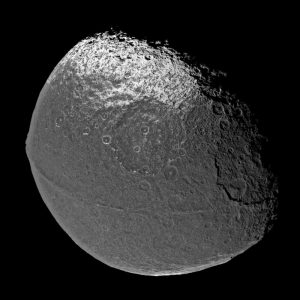
*Fact check: the dust on Iapetus is not from Enceladus, but from far-out retrograde moon Phoebe. Iapetus is too far away from Enceladus to be affected by the E-ring.
Saturn’s largest moon may actually be 2 moons in 1 — and helped birth the planet’s iconic rings (Live Science, 19 Feb 2026). Reporter Harry Baker rides another speculation float in the parade. His entry sports artwork of the massive collision that nobody observed: two big moons colliding, burning up, flinging shrapnel in all directions. Impressive! But the art is pure fiction. How does one come by getting two bodies that big to meet up at just the right time (“hundreds of millions of years ago”) to explain the lack of craters at Titan?
Imagine is such a useful device for storytellers. The impact “may have birthed another Saturnian moon, Hyperion” as a bonus gift. That’s not all. “Additionally, the new hypothesis may explain the unusual orbits of several other Saturnian satellites,” he says. Maybe the imaginary impact event was like when the mythical object Theia crashed into Earth to form our own moon 4.5 billion Darwin Years ago! One can’t rule out such lucky strikes. Stuff happens, you know.
Harry tosses the hot potato to avoid blame for engaging in storytelling. “Researchers” put out this hypothesis, he says. In particular, “lead author and SETI researcher Matija Ćuk” came up with it. So blame him, not Harry or Keith.
Impacts as Magic Wands
It’s plausible, isn’t it? You can imagine this happening, can’t you? Look at all the problems it solves in one fell swoop, not only Saturn’s rings and the erasure of Titan’s presumed old craters, but also the unusual tilts of Rhea and Iapetus, the origin of Hyperion, and even Saturn’s tilt. How can it be wrong if it feels so right?
Well, then, where did that impactor go? Sweeping that question under the rug, the “researchers” suggest that it was destroyed in the impact or “was gravitationally slingshotted away from Saturn.” Ah. So that’s why there is no evidence for this story.
Saturn must be kept old at all costs. “Researchers” (i.e., fallible humans with deep time bias) are willing to add as many speculations as needed to preserve the consensus age. 340 million years sounds like a lot, but it falls far short of what their worldview requires. 100 million years is worse: 1/145th the required age! Aghast and alarmed, the secular scientists charge against the evidence with swords of imagination.

Finding recent youthful phenomena contradicts the assumed lifetime of Saturn.
Without Deep Time (4.5 billion years for the solar system, 13.8 billion years for the universe), evolution is dead. The ramifications of a young solar system or universe are too terrifying for Darwinians to contemplate.
We think “researchers” should follow the evidence where it leads. For those who reject Deep Time, remember that the new age estimates are upper limits. Titan, the other moons, and the rings, could be far younger than that. But making them older decreases the observation-to-assumption ratio, which is undesirable in science (see Extrapolation in the Baloney Detector).
See also our 3 March 2026 article on the unwarranted proliferation of “perhaps” words in science.
Recommended Resource: Spike Psarris’s DVD “Our Created Solar System” makes fun of the many times planetary scientists use impacts to explain everything that doesn’t fit deep time. Watch for the bugle calls “ta-da-ta-da!” as fictional impactors arrive in the nick of time to solve the evolutionists’ puzzles.
Comments
Saturn along with its moons are problematic and troubling to Deep Time.