


Much Ado About New Chinese Ediacaran Fossils
Vague impressions: is that how
we came to be? Or has evolutionary
passion come to a point of desperation?
If you had a theory that tools evolved by blind, unguided processes of nature, you could come up with a convincing presentation showing simple hand axes and clubs evolving into today’s hardware store tool sections over millions of years without any need for human minds. Stuff happens, you could argue. Imagine the story you could tell when finding a new set of axes that looks transitional between simple axes and power tools. “We now know how power tools came to be!” you might shout from the rooftops.
Does this fable come true for scientists who found something they think might solve their biggest headache in the fossil record, the Cambrian Explosion?
 How we came to be: Scientists get first look at the evolution of early complex animals (Phys.org, 4 April 2026). The title of Associated Press reporter Seth Borenstein is audacious. He says a new fossil bed in China shows not “How we might have come to be” or “How materialist Darwinists believe we came to be,” but “How we came to be.” Since (to him) evolution is a fact, he can dispense with any etiquette of discourse and just blurt it out. This is how YOU came to be. You are a product of slime imprinted on Chinese rocks! Be very happy!
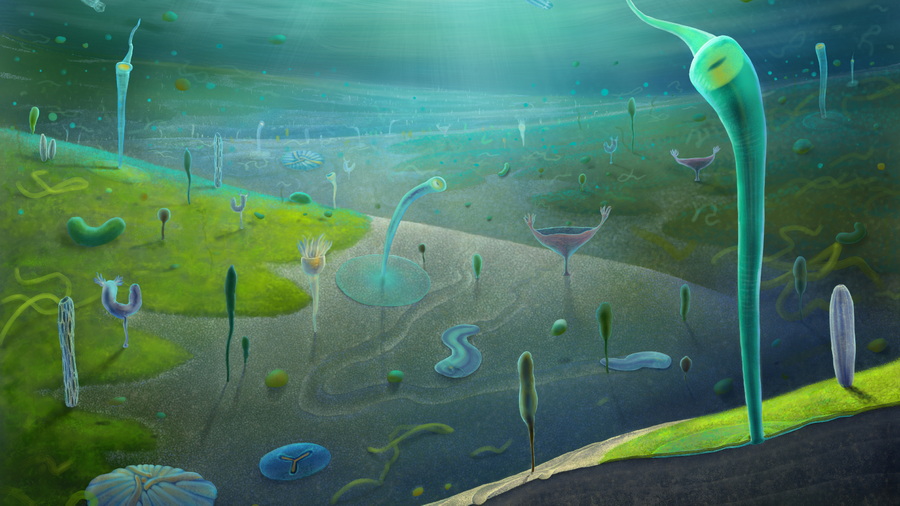
Fossil site in China reveals bevy of complex creatures lived prior to the Cambrian explosion (Live Science, 4 April 2026). Reporter Skyler Ware is only slightly less audacious. His report leads with the standard artwork generated to depict the ecology of the newly-discovered Jiangchuan Biota in China, followed by a photo of one nondescript object alleged to be an early cnidarian (the phylum containing jellyfish and corals).
The diversity and complexity of animal life is thought to have increased rapidly beginning around 539 million years ago, in an evolutionary burst known as the Cambrian explosion. But the new fossil site suggests that some of that complexity was already present several million years before the Cambrian explosion, during the end of the Ediacaran period (roughly 635 million to 539 million years ago).
What do the new fossils look like?
The fossils from this site are mostly flat imprints of the organism on the surrounding rock, known as carbonaceous films. Unlike the three-dimensional imprints left by durable body parts, such as bones and shells, carbonaceous films capture some details of the organism’s soft tissues, such as its gut and mouthparts.
The photo could well leave readers puzzled. How do they know the photo represents an early cnidarian? Where is the gut and mouthparts? It looks like a Rorschach test. You pass the test if you agree with the experts telling you that’s what it is.
Incidentally, the carbonaceous films at Jiangchuan give evolutionists an excuse for why similar fossils have not been found in other Ediacaran strata.
“Our results indicate that the apparent absence of these complex animal groups from other Ediacaran sites may reflect differences in preservation rather than true biological absence,” study co-author Ross Anderson, a researcher who studies the evolution of complex life at the Oxford University Museum of Natural History, said in the statement. “Carbonaceous compressions like those at Jiangchuan are rare in rocks of this age, meaning that similar communities may simply not have been preserved elsewhere.”
After 160 years of intense fossil searches of Precambrian strata, however, it would seem surprising that similar fossils have not been found elsewhere, even in other sites in China where the boundary of the Cambrian is exposed.
Spectacular fossil treasure trove pushes back origins of complex animals (Oxford University, 3 April 2026). Oxford’s press release celebrates its homeboy Dr Gaorong Li, lead author of the paper in Science announcing the Jiangchuan fossil bed. It contains photos of more carbonaceous films alleged to represent complex animals transitioning from the docile Ediacaran organisms, colonial non-motile creatures lacking body systems and internal organization. (See similar write-up at Sci-Tech Daily.) Dr. Li expresses his excitement:
Our discovery closes a major gap in the earliest phases of animal diversification. For the first time, we demonstrate that many complex animals, normally only found in the Cambrian, were present in the Ediacaran period, meaning that they evolved much earlier than previously demonstrated by fossil evidence.
Below, we will ask whether finding complexity “earlier than thought” helps evolutionists (see 26 Jan 2026, 2 Oct 2018, 9 March 2018, 14 April 2011).
The dawn of the Phanerozoic: A transitional fauna from the late Ediacaran of Southwest China (Gaorong Li, Science Magazine, 2 April 2026). This is the scientific paper, where higher standards of evidence and quality of presentation are expected. There is only one mention of evolution:
The presence of a ctenophore fossil with many features of the Cambrian ctenophore body plan suggests that major events in ctenophore evolution had already taken place, including colonization of the water column, by the terminal Ediacaran.
Notice two things in that quote: if the fossil is truly a ctenophore (comb jelly, a jellyfish-like organism not related to cnidarians), it was already fully formed. The other thing to notice is that it was found in the “terminal Ediacaran” near the Cambrian boundary. Evolutionists have been arguing for years whether sponges or ctenophores were the first “animals” to evolve.
Humans’ closest invertebrate ancestors date back much further than thought – how we discovered the fossils that show this (The Conversation, 2 April 2026). In this article, three of the researchers (Gaorong Li, Luke Perry and Frankie Dunn) comment on the significance of the fossils they found. They focus on two themes: (1) these slimy creatures under the sea are our distant ancestors, and (2) they appeared earlier than thought. Like the other articles, it highlights the artwork by Xiaodong Wang, “Artist’s impression of Earth’s earliest complex animals during the late Ediacaran period – before the ‘Cambrian explosion’.
Several of these specimens have a stalk and tentacles, and closely resemble a group of Cambrian fossils called cambroernids. These now-extinct animals are related to living starfish and acorn worms – the closest invertebrate relatives to humans. This shows our own evolutionary story has its roots in the Ediacaran period.
The discovery of diverse, complex animals in the Jingchuan biota suggests several animal groups shared the world with the weird and wonderful Ediacarans for millions of years. Diverse complex animal life has a more ancient heritage than the Cambrian explosion.
Artist interpretation of the Jiangchuan Biota (Xiaodong Wang). Are these animals? Are they ready to explode into the Cambrian?
Now, Take Off the Darwin-Tinted Glasses
OK, we’ve seen the hype from the Darwin Party. The fossils are interesting, and it’s always exciting to find something new. But do these fossils help the evolutionary story? Remember that some 20 phyla appear abruptly in the Cambrian explosion with complex body plans, like trilobites and chordates.
Figure 2 shows a few non-bilaterian fossils found at Jiangchuan. Finding a putative ctenophore “earlier than thought” at the “terminal Ediacaran” is not that surprising, if it is truly a ctenophore. One of the images shows “candidate ctenes” (comb rows) characteristic of comb jellies, but the authors do not express certainty about the identification. (Note: ctenophores have biradial symmetry.)
What would have supported their evolutionary claim better would have been a whole slew of bilaterians— animals with bilateral symmetry (i.e., left and right halves). The majority of complex animals today are bilaterians. What bilaterian animals were found at Jiangchuan? Figure 3 shows candidate bilaterian fossils, but the word “interpreted” appears 9 times in the paper:
- Six specimens resemble Haootia quadriformis, interpreted as a cnidarian, with tetraradial symmetry and fibrous/corrugated features inferred to be muscle fibers…
- It has a circular terminal opening (Fig. 3H) interpreted as a mouth, with a dark, slender band through the interior of the body along its length, most likely representing a gut.
- Finally, we report elongate, tubular fossils with distinctive, regular oval-shaped holes running along their length (Fig. 3, I and J). Similar features are present in the Cambrian Margaretia dorus, most recently interpreted as a dwelling tube for enteropneust hemichordate worms.
- Macroalgae are taphonomically distinct from these specimens interpreted as animals, displaying more extensive carbonaceous preservation….
- Some specimens, which we interpret as cambroernid bilaterians, do show moderately enhanced carbonaceous preservation and cracked carbon films….
- A problematic fossil known from a different Jiangchuan locality has been tentatively compared with vetulicolians, interpreted as chordates, but this comparison is preliminary.
Whole lotta interpretation going on. Who did the interpreting? Who made the inferences? Did the researchers perform a thorough check of contrary interpretations from other paleontologists, like Dr Jerry Bergman said yesterday is required for research integrity? Some of the interpretations are not clearly based on the evidence, but on what evolutionists would hope to see before the Cambrian explosion.
A Few Issues for Inquiring Minds to Consider
One odd thing is that the authors were excited about one fossil they interpreted as a “deuterostome” (two openings, like a mouth and anus). Bad timing. Scientists are questioning the existence of the deuterostome branch that supposedly links chordates, echinoderms, and hemichordates (Current Biology, 4 Aug 2025).
Another problem is that there are no clear representatives of Cambrian animals at Jiangchuan. There are only creatures that “resemble” some of them. Resemblance, however, is in the eye of the beholder. Some animals interpreted as worm-like, for instance, have no clear internal organs, and might be categorized as docile Ediacarans not found elsewhere.
An article by the Geological Society of America in January 2026 hints that the preservation of Ediacaran creatures may be more due to the chemistry, sandstone, and burial conditions than their alleged place on the evolutionary timeline.
The late paleontologist Günter Bechly, an evolutionist turned ID supporter when convinced by the evidence and arguments, said this about the potential for new candidate transitional forms between Ediacarans and Cambrian animals:
Even if some relatives of sponges, cnidarians, stem (eu)metazoans, and maybe even stem bilaterians should be present in the Ediacaran, this would do absolutely nothing to explain the sudden appearance of the many different bilaterian animal body plans in the Cambrian Explosion (Science & Culture today, 2022).
The Cambrian explosion remains Darwin’s Dilemma and Darwin’s Doubt.
Update 20 May 2026: Casey Luskin at the Discovery Institute reports on a secular paleontologist who has even more doubts than he did about the interpretation of these fossils. He doubts that ctenophores or any bilaterians are present in the formation, and even doubts the dates given; they could be closer to the base of the Cambrian than claimed. Read Casey’s report here.
It’s also a crisis for old-earth creationists and theistic evolutionists who, like secular evolutionist moyboys, assume the geologic column with its millions of years. Biblical creationists believe that all marine organisms were created on Day 5 of Creation Week described in Genesis. There were no “transitional forms” since everything was created fully formed and functional from the beginning.
The only variations expected in marine fossils would reflect minor differences that occurred between Creation and the Flood, during which these organisms were buried. Those changes would represent built-in variability by intelligent design, allowing for adaptation to new environments – a far cry from Darwin’s vision of the accumulation of random variations and natural selection.
Since this paper is new, we expect additional analysis by members of the intelligent design community and by other creationists. In the meantime, see our other recent paper about fossils in China (13 Feb 2026).